Chapter 15
Finding Your True Depth
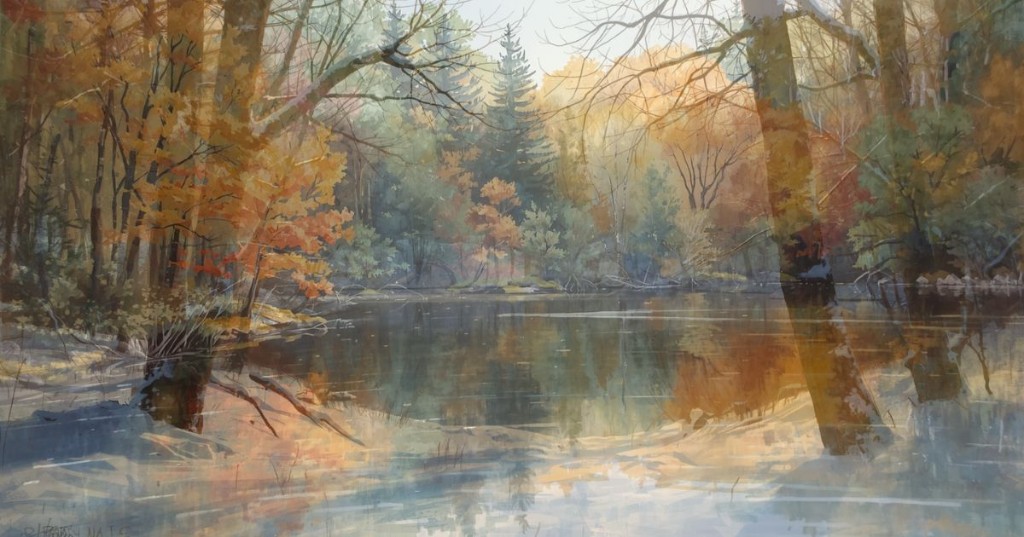
The Pond in Winter After a still winter night I awoke with the impression that some question had been put to me, which I had been endeavoring in vain to answer in my sleep, as what—how—when—where? But there was dawning Nature, in whom all creatures live, looking in at my broad windows with serene and satisfied face, and no question on her lips. I awoke to an answered question, to Nature and daylight. The snow lying deep on the earth dotted with young pines, and the very slope of the hill on which my house is placed, seemed to say,…
Public-domain chapter text, formatted for reading.
Master this chapter. Complete your experience
Purchase the complete book to access all chapters and support classic literature
Available in paperback, hardcover, and e-book formats
Now let's explore the literary elements.
Key Quotes & Analysis
"Such a man has some right to fish, and I love to see Nature carried out in him."
Context: Observing a skilled, intuitive fisherman who knows the pond from long practical experience
The 'right' to fish is earned by genuine knowledge and relationship — not by owning a license but by having made the pond your study. The fisherman who knows the water without books has a kind of standing that the abstract naturalist does not.
In Today's Words:
Expertise that comes from sustained direct contact with the thing itself has a different quality than expertise assembled from theory. Thoreau’s fisherman knows the pond in a way the scientist cannot fully replicate, because his knowledge was built by standing at the water’s edge for years with a line in the water.
"What if all ponds were shallow? Would it not react on the minds of men? I am thankful that this pond was made deep and pure for a symbol."
Context: After measuring the pond to its actual depth of 107 feet, reflecting on why depth matters philosophically
The question is not rhetorical — it is a genuine inquiry into the relationship between physical reality and mental life. Thoreau argues that a measurably deep pond changes what humans can imagine about depth in other domains. The symbol requires the actual fact.
In Today's Words:
The places we grow up around shape what we think is possible. A person who lived near a bottomless-seeming pond might carry a different sense of possibility than one who only ever knew shallow water. Thoreau’s point is that the physical world sets the terms of the imagination, which is why a purely shallow world would impoverish the mind.
"His life itself passes deeper in Nature than the studies of the naturalist penetrate; himself a subject for the naturalist."
Context: Comparing the intuitive expertise of the experienced fisherman with the analytical expertise of the trained naturalist
The fisherman who lives by the water is himself a phenomenon of nature — not studying it from outside but embedded in it as a participant. The naturalist who takes notes on the shore is studying the surface; the man who has been fishing there for decades has gone deeper without knowing it.
In Today's Words:
There is a kind of knowledge that formal study cannot access because it requires years of immersion rather than observation. The person who has lived inside a subject — a craft, a landscape, a relationship — develops an expertise that the person who analyzes it from outside cannot replicate. They are studying each other.
"Heaven is under our feet as well as over our heads."
Measuring the pond's depths, Thoreau finds that the most profound things are found by going down rather than up—that real depth is discovered in the immediate and underfoot rather than the elevated and distant. The profound is hidden in the ordinary, not above it.
In Today's Words:
The deepest and most significant things are not above you, waiting to be elevated toward; they are immediately beneath the surface of the ordinary, available to anyone willing to measure carefully. Most people look up for what is actually down, which is why they keep missing it.
Thematic Threads
Class
In This Chapter
Local fishermen possess deeper knowledge than educated scholars because they combine sustained practice with broad natural observation
Development
Evolved from earlier chapters - Thoreau increasingly values practical wisdom over formal education
In Your Life:
The coworker without a degree who truly understands the job might know more than the supervisor with credentials.
Identity
In This Chapter
Thoreau defines himself as both scientist and poet, refusing to choose between systematic measurement and wonder
Development
Developed from earlier chapters - his identity integration becomes more sophisticated
In Your Life:
You don't have to pick just one role—the nurse who's also an artist brings both skills to patient care.
Social Expectations
In This Chapter
Society expects either scholarly detachment or practical engagement, but Thoreau combines both approaches
Development
Continued from earlier chapters - his rejection of either/or thinking
In Your Life:
People might expect you to be either 'book smart' or 'street smart,' but real wisdom combines both.
Personal Growth
In This Chapter
Growth comes through patient, methodical attention to immediate surroundings rather than seeking exotic experiences
Development
Central theme deepening - local attention yields universal insights
In Your Life:
Understanding your current situation deeply teaches you more than constantly seeking new experiences.
Human Relationships
In This Chapter
The ice harvesters connect his local pond to distant cities, showing how intimate knowledge creates global connections
Development
New development - individual depth creates wider community
In Your Life:
When you truly understand your own community, you better understand how all communities work.
You now have the context. Time to form your own thoughts.
Discussion Questions
This is not a test. Five prompts guide you through the chapter, from how it opens to how it closes, so you notice context and rhythm rather than facts to memorize. Sit with each question in your own words. When you see "One way to read it," treat it as a starting point, not the only answer.
- 1
Thoreau measures the depth of Walden Pond with a plumb line and discovers the deepest point falls precisely at the intersection of its longest and widest dimensions. Why does he find this discovery significant, and what does he do with it?
analysis • surfaceOne way to read it
He finds it significant because the same geometric principle, depth at the intersection of length and breadth, appears to hold in human character and ethics. The person of deepest understanding is likely to be found at the intersection of broadest experience and most concentrated effort.
- 2
Thoreau contrasts the ice-cutters from Cambridge who harvest Walden ice for profit with his own close observation of the pond's winter life. What does this contrast reveal about the difference between using a place and inhabiting it?
analysis • mediumOne way to read it
Using a place extracts its resources; inhabiting it accumulates knowledge of its rhythms, depths, and particularities. The ice-cutters know Walden as a reservoir; Thoreau knows it as a specific body of water with a specific bed, specific temperatures at specific depths, and a specific annual cycle.
- 3
Thoreau says 'heaven is under our feet as well as over our heads.' In the context of a chapter about measuring a pond's depth, what does this mean about where genuine knowledge is found?
application • mediumOne way to read it
He means that depth, in a pond, in a subject, in a person, is found by going down rather than up, by attending to what is underfoot and immediate rather than what is elevated and distant. The most profound things are already present in the ordinary if you are willing to measure them carefully.
- 4
Thoreau describes the winter fishermen who know things about the pond that no naturalist's study has documented, because their knowledge comes from direct engagement rather than observation from a distance. Where in your own field or daily life do practitioners know things that formal experts have not yet recorded?
application • deepOne way to read it
In most skilled trades and practices, experienced practitioners carry embodied knowledge that precedes or exceeds formal documentation, how materials behave under specific conditions, which rules bend in practice, what questions the theory has not yet asked. This knowledge is usually transmitted through apprenticeship rather than text.
- 5
Thoreau's geometric principle suggests that your deepest capacity develops at the intersection of your widest curiosity and your most sustained effort. Looking at your own intellectual and practical life, where is that intersection for you?
reflection • deepOne way to read it
The intersection tends to be in the area where you have been both broadly curious, reading across disciplines, engaging with diverse people, and consistently willing to go deeper than comfort requires. Most people find it is a narrower zone than they expected, which is more useful than a broad shallowness.
Critical Thinking Exercise
Map Your Own Intersection Point
Think about an area where you want to develop real expertise or depth. Draw two lines: one representing your longest sustained effort (what you've consistently worked on over time) and another representing your broadest knowledge (the wide range of things you understand). Where do these lines cross? That's your potential depth point—the place where you could develop genuine mastery.
Consider:
- •Don't confuse busy work with sustained effort—look for what you've consistently returned to over months or years
- •Broad knowledge doesn't mean knowing everything—it means understanding how different pieces connect
- •Your intersection point might be different from what others expect or what looks impressive on paper
Journaling Prompt
Write about a time when you misjudged someone's depth based on surface appearances. What did you miss, and how did you eventually discover their real expertise or character?
Coming Up Next...
Chapter 16: The Art of Paying Attention to Change
As winter gives way to spring, Thoreau witnesses the dramatic awakening of the natural world around his cabin. The changing season brings profound revelations about renewal, growth, and the eternal cycles that govern both nature and human life..