
The Loved Face and the Locked Record
The Picture of Dorian Gray is not a sermon against looking in a mirror. It is the story of a bargain that splits a person into the face other people love and the record those people are not allowed to see. Dorian Gray wants to remain the image Basil Hallward has painted, young and unspoiled, and he wants age, cruelty, and shame to collect somewhere else. Lord Henry Wotton supplies the sentences that make the split feel like taste. The portrait accepts the terms. The book's psychological core is that defence: keep the loved surface intact by storing the lived life in a room that can be locked, then discover that a hidden record still judges, and that destroying the witness is not the same as being forgiven.
The Wish Is to Stay the Object of Love
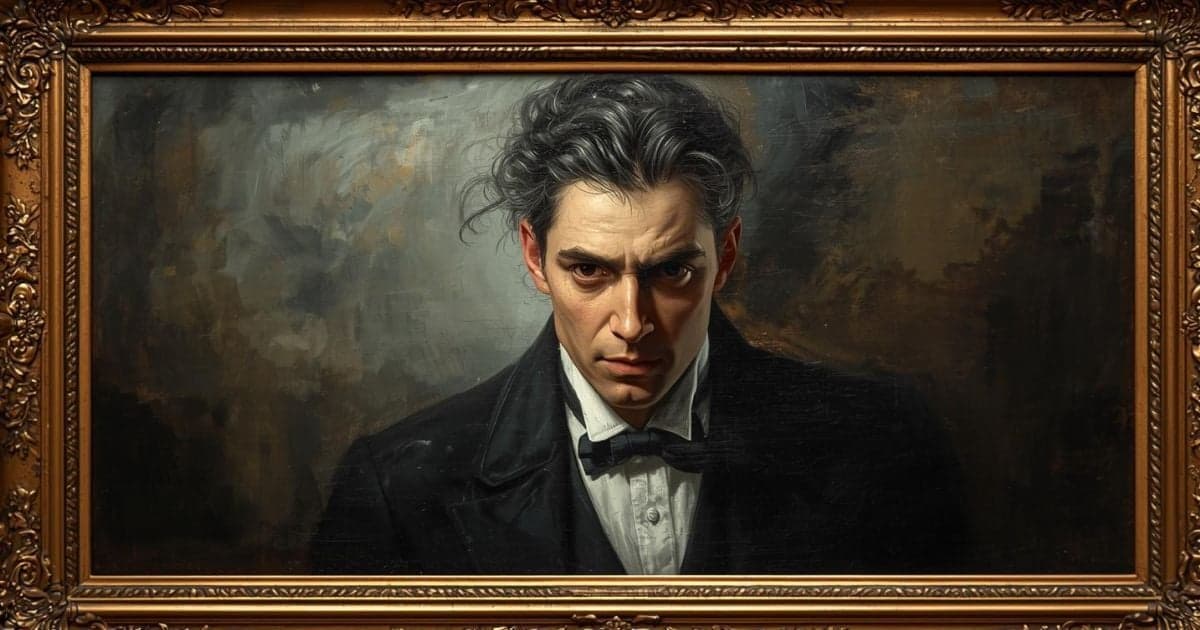
The originating fantasy is spoken while the paint is still wet. Basil has already treated the face as something too intimate to exhibit. Henry has already told the sitter that youth is the only possession worth having. Dorian looks at the finished portrait and asks that the canvas bear the years while he keeps the face. The prayer is not a plan for crime. It is a refusal to become a person who can disappoint the people who are looking at him. He wants to remain the object of that looking.
Basil hears the wish as blasphemy and reaches for a palette knife. Dorian stops him and calls the cut murder, then clings to the canvas as part of himself. The portrait is already a self he will not let anyone destroy, and already a self he does not intend to inhabit. He leaves in Henry's hansom. Basil stays with the painted face. Influence has won the first afternoon, and a soul has been offered in a room where no one is willing to treat the offer as a contract.
What the wish outsources is not only age. It is the right of other people to watch a character change. The canvas is asked to do the answering in private.
Basil Loves a Surface He Has Already Made
Basil Hallward is not a moral chorus waiting in the wings. He is the first person to treat Dorian's face as a soul. In the studio he refuses the Grosvenor because he has poured himself into the picture, and because a portrait painted with real feeling would show London a devotion the town would gossip about. He loves the boy, and he loves the boy as a work. The sitting is how the love gets a body it can bear to show, and then cannot bear to show.
That love teaches Dorian the wrong lesson with perfect kindness. If a face can be too precious to change in public, then any change is a betrayal of the people who painted you. Basil begs Henry not to spoil a nature he calls simple and beautiful. The plea already treats the boy as an object influence can mark. Dorian learns the assumption, and he will punish anyone who asks him to be a person with a history.
When Basil finally sees the hidden canvas, on the eve of Dorian's thirty-eighth birthday, the same devotion has to look at what it worshipped. The paint has not been replaced. The foulness has come from inside the picture Basil signed in vermilion. He begs Dorian to pray. Dorian says it is too late. The man who made the ideal image cannot survive meeting the record of the life that image protected.
Henry Lends a Voice and Never Pays
Lord Henry does not need Dorian to be happy. He needs him to be interesting. The studio epigrams, the garden speech on youth and temptation, the luncheon where reform is mocked for the amusement of the table: none of these sentences have to be lived by the man who says them. Henry collects Dorian's parentage from Lord Fermor the way he collects a scent. Margaret Devereux ran away with a penniless soldier, watched him die in a duel, and left a boy to a cruel grandfather. Henry hears tragedy as atmosphere.
The influence works by flattery that isolates. Ordinary rules are for people less special. The friends who warn you are possessive. Guilt is provincial. Dorian does not merely admire the performance. He installs it. After Sibyl Vane is dead, Henry arrives with a finished explanation: the girl never really lived, so the death can be filed as theatre. Dorian sighs that Harry has explained him to himself. A voice from outside has become the way he accounts for his own cruelty, and the accounting sounds like relief.
Henry's later refusal to believe in the murder is the same method. Crime, he says, belongs to the lower orders, not to Dorian's type. A man who can still be called Prince Paradox at tea cannot, in that system, have stabbed a friend in a schoolroom. The installed voice does not only permit the act. It keeps a category in which the act is vulgar and therefore someone else's. Henry never signs the life he scores.
Sibyl Becomes a Person, and the Mouth Changes
Sibyl Vane is loved as a succession of parts. Juliet is how Dorian can feel destiny without meeting a girl on the Euston Road, with a mother in debt and a brother about to sail. She calls him Prince Charming. When love makes the stage feel false, she acts badly on purpose. She has chosen the man over the pageant. He hears only humiliation.
He tells her she has killed his love, that without the acting she is nothing, and he leaves her on the floor. At home he sees cruelty in the painted mouth, thinks of repair, then tells himself she deserved it. By the next day she is dead by her own hand, and he has been to the opera. The portrait received the news before he did.
Before Sibyl, the wish is a vanity beside wet paint. After her, the canvas has a fact, and the defence acquires a method. Refuse the talk, and the evening can still be company. The mouth on the canvas keeps the sentence he will not say at breakfast.
The Schoolroom Holds What the Drawing Room Withholds
The novel's form is part of its psychology. London is allowed the face, the clubs, the rumours that fall silent when he enters. The reader is allowed the room. Dorian takes the key of the old schoolroom, unopened since his grandfather died, and has the canvas carried there under a purple coverlet that once served as a pall. The hiding place is not a neutral attic. It is the childhood the cruel grandfather left behind, asked now to store the adult record. A life that will not be exhibited is returned to the one chamber that already knew secrecy.
The yellow book does the next piece of work. Henry sends it. Dorian buys nine copies, bound in different colours, so each mood has its own volume. The hero becomes a type of himself, and the story feels like a life written in advance. He would rather live inside a text that has already excused him than remain a man whose next act is still his to own. Collecting fills the years the same way. The face stays innocent at the clubs because the alteration has been given somewhere to go: paint, and a plot he can reread.
Lady Narborough's drawing room, on the evening after the murder, is the defence as a social form: violets and perfect manners. The schoolroom is the other half of that life, with the curtain pulled back. Charm is not the opposite of the hidden ledger. Charm is the ledger's public face.
The Man Who Sees the Canvas Cannot Leave
Basil does not die because he is dull. He dies because he has looked. On the eve of Dorian's thirty-eighth birthday he has waited since nine, with a train to Paris at midnight, and he will not be put off. Dorian takes him upstairs, tears the curtain away, and lets him see his own picture rotted from within. Basil tries damp and mildew, because a technical fault would let the love survive. Dorian tells him about the wish. The witness now knows the mechanism, not only the result.
The murder is a defence against being known. Dorian tells himself the secret is not to realise the situation. He hides the bag and informs the servant that Hallward left for Paris at eleven, borrowing the journey Basil was already going to take. A man who sees too much can be converted back into a story about a departure. Alan Campbell is then required so the body itself will depart. Dorian has a hold over him that this reading will not pretend to itemise. The corpse is still sitting upstairs in the sunshine, and a secret can be used to hire its removal.
That evening he is at Lady Narborough's, as much at ease as a man who has to play a part. The guests cannot believe those lips have cried out. The witness has been silenced. The performance improves.
A Face of Twenty Undoes the Avenger
James Vane is the past that will not stay in the schoolroom. He swore that the man who wronged his sister would answer for it. In the opium den a woman sneers that Prince Charming is what Dorian likes to be called. James forces him under a lamp and finds a boy of twenty, not the man of nearly forty the vow was built to kill. The unchanged face makes a true accusation look like a mistake. James lets him go. A woman by the river then says what the portrait has been saying for years: this is the same man, and he has not aged since he ruined her, eighteen years ago.
At Selby Royal the face appears at the glass. Then a shooting party restores the old arrangement by accident. Geoffrey Clouston fires at a hare, and a tattooed sailor is dead in the thicket. Dorian orders the cloth lifted and cries out with joy. The corpse is James. He is safe. Relief has replaced remorse. The defence that nearly broke at the window is repaired by someone else's bullet.
Hetty Merton is the next attempt to call the repair goodness. She is a village girl who reminds him of Sibyl, and he breaks their plan to run away at dawn. He tells Henry he is going to be good, and that the sparing must not be called a sin. Henry reads it as a new sensation. The portrait, when Dorian goes up hoping for a cleaner face, looks more hypocritical than before, the blood on the hand brighter. A kindness performed so the canvas will compliment him is still a transaction with the record. The record declines to be paid in that coin.
The Knife Is Aimed at the Witness, Not the Life
The ending does not reconcile the face and the ledger. It tries to murder the ledger. Dorian smashes the mirror Henry gave him. Confession, he decides, is impossible. The picture is the last witness. He takes the knife that killed Basil and drives it into the portrait, meaning to kill the past.
The servants hear the cry and find the arrangement reversed. The canvas is the exquisite young man again. On the floor is a withered body they can name only by the rings. The wish has been granted in the cruellest literal sense. The loved face has returned to the object. The lived life has returned to the body, which the people who served the drawing room barely recognise. The split is not healed. It is finished by giving each half what the bargain always threatened: beauty to the picture, consequence to the man.
The rings are an identification, not a mourning. Henry is not in the room to explain him. The defence that stored shame out of sight ends by making the shame the only body left, while the image that excused him hangs, young again, above the wreck. Wilde does not offer a cure. He shows the cost of protecting a surface from the knowledge that surface was invented to avoid.
Why It Resonates Now
The anxiety is not ageing as such. It is a reputation that stays flattering while the damage is filed where the audience does not dine. Wilde writes that lag as a supernatural convenience and then takes the convenience away. Readers still recognise it without the magic: the public image that does not wrinkle on the night the harm was done, and the relief when a threat to that image is removed.
Henry's voice is current in the same way. It is the performance that turns a death into an aesthetic anecdote, a warning into dullness, and a crime into something too vulgar for a certain kind of person to have committed. The novel's unease is that the voice can be borrowed until the borrower supplies it himself. By the morning after Sibyl's death, Dorian can tell Basil that if one does not talk about a thing it has never happened. The influence no longer needs to be in the chair. The drawing room has learned the lines. The locked room has not.
Limits of This Reading
This is a late-Victorian argument about art, influence, and the soul, written in 1890 and revised for the book of 1891, before Wilde's trials made the double life a public fact about the author. Reading the portrait as a code for those trials reverses the order of events. The novel knows scandal, gossip, and a devotion Basil will not exhibit. It does not know the courtroom that came later. A psychological account that starts from the biography will miss how much of the cruelty is ordinary: a boy praised for his face, a wit who never pays, a girl punished for stepping out of a part.
Narcissism, as used here, is a lens for the wish to remain the loved object. It is not a diagnosis of Dorian or of Wilde. The supernatural change is a moral device, not a symptom. Basil's love, and the hold over Alan Campbell, sit inside a century that punished desire between men and that forced the 1891 text to veil what the magazine version had let readers infer. Keeping the centre on the canvas can understate that desire. The parentage Henry collects from his uncle is atmosphere, not a childhood complete enough to explain the wish.
Across the Shelf
The Strange Case of Dr Jekyll and Mr Hyde splits a man so the appetite can have another name and the grave face can keep the credit. Dorian does not want a second body. He wants one body that never has to sign, and a picture that signs for him. Hyde is smaller because the disowned part was kept smaller. Dorian stays beautiful because the disowned part was stored in paint. Frankenstein belongs beside Basil more than beside Henry. A maker falls in love with a face he has produced, then cannot bear what the making reveals, and reaches for a knife while the work is still new. Frankenstein flees the creature. Dorian locks the history in the schoolroom and, at the end, stabs the record instead of living with it. In both, the image keeps a knowledge the maker tried to put outside himself.