Chapter 16
Father and Son Reunited
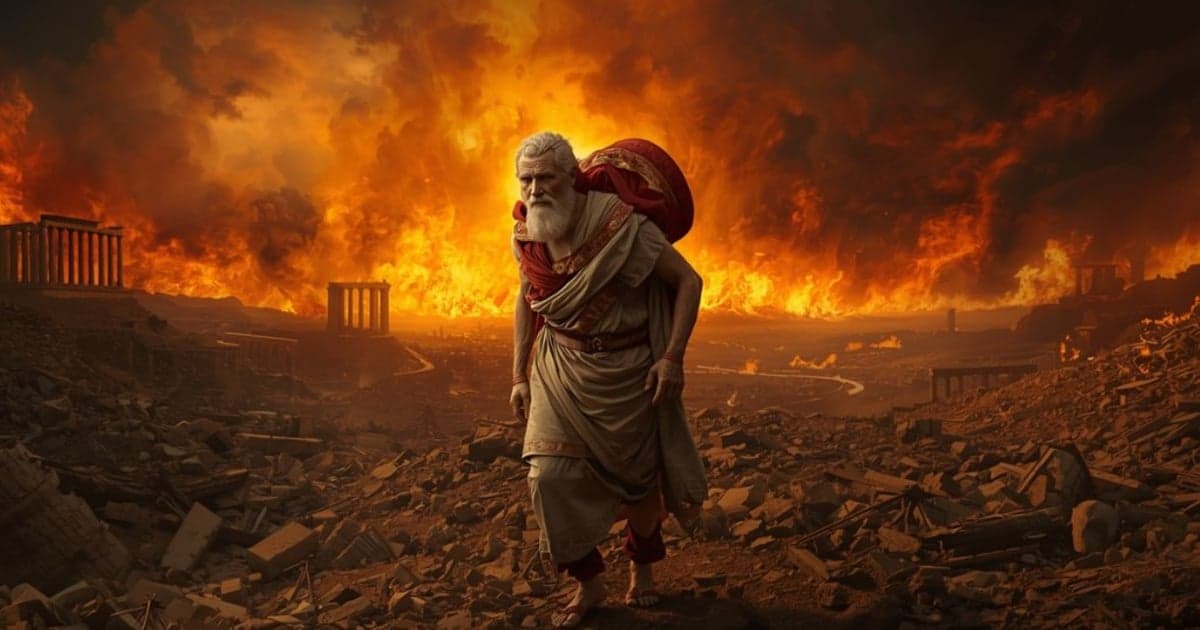
ULYSSES REVEALS HIMSELF TO TELEMACHUS. Meanwhile Ulysses and the swineherd had lit a fire in the hut and were were getting breakfast ready at daybreak, for they had sent the men out with the pigs. When Telemachus came up, the dogs did not bark but fawned upon him, so Ulysses, hearing the sound of feet and noticing that the dogs did not bark, said to Eumaeus: “Eumaeus, I hear footsteps; I suppose one of your men or some one of your acquaintance is coming here, for the dogs are fawning upon him and not barking.” The words were hardly out…
Public-domain chapter text, formatted for reading.
Master this chapter. Complete your experience
Purchase the complete book to access all chapters and support classic literature
Available in paperback, hardcover, and e-book formats
Now let's explore the literary elements.
Key Quotes & Analysis
"So you are come, Telemachus, light of my eyes that you are."
Context: Welcoming Telemachus back to the hut with tears and relief
Eumaeus frames Telemachus as the emotional center of the household, proving that loyalty has survived even when kingship has not.
In Today's Words:
The swineherd greets Telemachus like a father seeing his own child return from war. That line exposes where real loyalty lives, not in titles, but in the people who kept loving your family when power vanished. Omar should notice who stayed steady during long absences.
"I am your father, on whose account you grieve and suffer so much at the hands of lawless men."
Context: Dropping the disguise and naming himself directly to Telemachus
The line combines identity and responsibility: he does not only claim blood, he acknowledges the cost his absence imposed.
In Today's Words:
Ulysses does not just say who he is; he admits Telemachus has carried the pain of his absence under violent men. That makes recognition accountable, not sentimental. Omar can learn that reunion is strongest when you name the damage plainly instead of pretending the lost years never happened.
"There is no other Ulysses who will come hereafter."
Context: Insisting to Telemachus that this return is real and final
He shuts down fantasy and substitutes commitment, forcing the scene from emotional shock into practical alliance.
In Today's Words:
Telemachus wants to believe but fears another cruel illusion. Ulysses answers with finality: no second version is coming, this is the one you get. Omar can use that posture when rebuilding trust, promise less magic, offer one concrete presence, and prove it through repeated action under pressure.
"when Minerva shall put it in my mind, I will nod my head to you, and on seeing me do this you must collect all the armour that is in the house and hide it in the strong store room."
Context: Giving Telemachus the operational signal for disarming the hall
The plan depends on discipline, timing, and shared code, not bravado; this is strategy replacing reactive anger.
In Today's Words:
This is not a speech about courage, it is a protocol. Ulysses gives one signal, one task, and one objective under chaos. Omar, as a truck driver managing risk, can respect this: complex danger gets handled by clear cues, rehearsed roles, and no freelancing when the stakes turn lethal.
Thematic Threads
Identity
In This Chapter
Ulysses strategically reveals his true self only when the moment serves his larger purpose
Development
Evolved from earlier disguises - now identity becomes a tactical weapon rather than just protection
In Your Life:
You might recognize this when you're deciding whether to reveal your true feelings, qualifications, or intentions at work or in relationships
Class
In This Chapter
The suitors' political calculations about killing Telemachus show how class position affects what violence is 'acceptable'
Development
Builds on earlier themes - now showing how class determines which actions carry consequences
In Your Life:
You see this when certain people can get away with behavior that would destroy others in your workplace or community
Personal Growth
In This Chapter
Telemachus instantly shifts from passive recipient to active strategist once he knows the truth
Development
Culmination of his journey - the knowledge transforms him from boy to war partner
In Your Life:
You might experience this when finally getting crucial information that allows you to stop reacting and start planning
Human Relationships
In This Chapter
The father-son bond instantly becomes a strategic alliance built on shared purpose
Development
Transforms from absence and searching into active partnership
In Your Life:
You see this when relationships deepen through shared challenges rather than just shared comfort
Social Expectations
In This Chapter
Everyone expects Ulysses to remain 'dead' and the suitors to face no real consequences
Development
Builds toward the complete overturning of established social order
In Your Life:
You encounter this when people underestimate your capabilities or assume you'll accept unfair treatment indefinitely
You now have the context. Time to form your own thoughts.
Discussion Questions
This is not a test. Five prompts guide you through the chapter, from how it opens to how it closes, so you notice context and rhythm rather than facts to memorize. Sit with each question in your own words. When you see "One way to read it," treat it as a starting point, not the only answer.
- 1
Why does Homer place the father-son recognition in Eumaeus' hut rather than in the palace?
analysis • surfaceOne way to read it
The hut is a loyal space outside suitor control, so the reunion can happen safely and become strategy before public exposure.
- 2
How does Telemachus' response to the stranger show growth before he knows the stranger is Ulysses?
analysis • mediumOne way to read it
He shows political realism, concern for security, and careful resource thinking, which proves he is already moving from boyhood to leadership.
- 3
What leadership principle is embedded in Ulysses' instruction about the nod and the hidden armor?
application • mediumOne way to read it
Crisis leadership works through pre-briefed signals and clear roles, not improvised heroics once conflict begins.
- 4
Where in modern family or business life do people fail to convert emotional reconciliation into operational alignment?
application • deepOne way to read it
Teams often celebrate reconciliation but avoid concrete commitments, leaving old conflict patterns to reappear under the next stress spike.
- 5
When have you needed both vulnerability and tactical clarity in the same conversation?
reflection • deepOne way to read it
Strong answers connect honest emotion with specific next-step coordination, showing that trust and planning are not opposites.
Critical Thinking Exercise
Map Your Strategic Disclosure
Think of a situation where you have important information that others need to know, but revealing it could have major consequences. Map out your strategic disclosure plan using Ulysses' pattern: timing, method, environment, and follow-up plan. Consider both the immediate reaction and the long-term outcome you want.
Consider:
- •What groundwork needs to be laid before the revelation?
- •Who needs to be your allies versus who might resist?
- •What evidence or support do you need ready for the aftermath?
Journaling Prompt
Write about a time when someone revealed important information to you. How did their timing and method affect your response? What would have made you more or less receptive to hearing difficult truths?
Coming Up Next...
Chapter 17: The Beggar at the Door
At dawn Ulysses enters his own city as a beggar while Telemachus must play host to the men plotting his death. A faithful dog will recognize what nobles cannot, and every insult in the hall will become evidence for the reckoning to come..