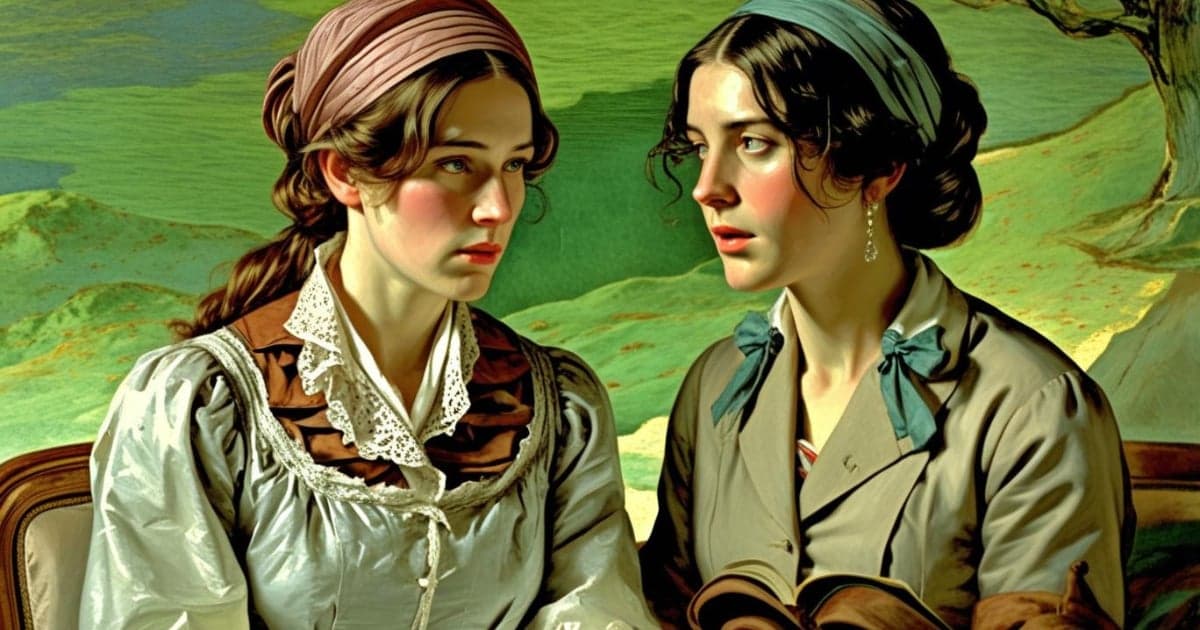
Maggie enters St. Ogg's high society through Lucy's connections, becoming an object of fascination and mild envy among the social elite. For the first time in her life, she experiences leisure, admiration, and the intoxicating freedom from constant responsibility. She rediscovers her love of music and finds herself enjoying the attention of young men who previously would never have noticed her. Meanwhile, a dangerous undercurrent develops between Maggie and Stephen Guest, Lucy's unofficial fiancé.
Though both try to maintain proper distance when alone together, their mutual attraction grows stronger through suppression. When Lucy goes out for the evening, Stephen impulsively visits Maggie alone, creating an charged encounter that neither can fully control. They share a brief walk in the garden, with Stephen offering his arm in a gesture that feels both innocent and loaded with meaning.
The chapter ends with Maggie fleeing inside in tears, longing for the simple days with Philip, while Stephen spends the evening trying to convince himself he's not falling in love with the wrong woman. Eliot masterfully shows how social mobility can create new forms of emotional danger, and how the heart often wants what it cannot have precisely because it cannot have it.
Eliot understood something psychologists now confirm: forbidden attraction intensifies precisely because it's forbidden.
Maggie doesn't fall for Stephen despite the obstacles, she falls for him because of them.
The secrecy, the stolen moments, the sense that 'no one understands us', these aren't unfortunate complications of their connection.
We tell ourselves we're fighting against circumstances, but we're actually addicted to the fight itself.
The drama, the obstacles, the sense of being special enough to overcome them, this feeds something deep in us that stable, available love simply cannot.
Understanding this doesn't make you immune, but it does help you recognize when you're chasing the barrier rather than what's behind it.
The next time you find yourself drawn to someone or something that requires breaking rules or betraying commitments, ask yourself: would this still feel so compelling if it were freely available?
Sometimes the answer reveals that what you really want isn't the person or opportunity, it's the feeling of being someone who could have them.