Master this chapter. Complete your experience
Purchase the complete book to access all chapters and support classic literature
As an Amazon Associate, we earn a small commission from qualifying purchases at no additional cost to you.
Available in paperback, hardcover, and e-book formats
Why This Matters
Connect literature to life
This chapter teaches how to recognize when institutions fear truth more than they value solutions.
Practice This Today
This week, notice when presenting facts creates defensiveness rather than discussion - that's a power dynamic, not a communication problem.
Now let's explore the literary elements.
Key Quotes & Analysis
"Not only is it inevitable that you small capitalists shall pass away, but it is inevitable that the large capitalists, and the trusts also, shall pass away."
Context: Ernest begins his mathematical demonstration of capitalism's inevitable collapse
This quote reveals Ernest's systematic approach to revolution - he's not just angry, he's logical. He shows that even the powerful trusts are temporary, caught in the same contradictions that will destroy smaller capitalists.
In Today's Words:
Your small business is doomed, but so are the big corporations - the whole system is breaking down.
"I'll give you the mathematics of my dream; and here, in advance, I challenge you to show that my mathematics are wrong."
Context: Ernest prepares to prove his argument with economic facts rather than ideology
Ernest weaponizes logic against people who benefit from keeping economics mysterious. By demanding they disprove his math, he shifts the burden of proof and exposes their ignorance of their own system.
In Today's Words:
I'm going to show you the numbers, and I dare you to prove me wrong with facts instead of feelings.
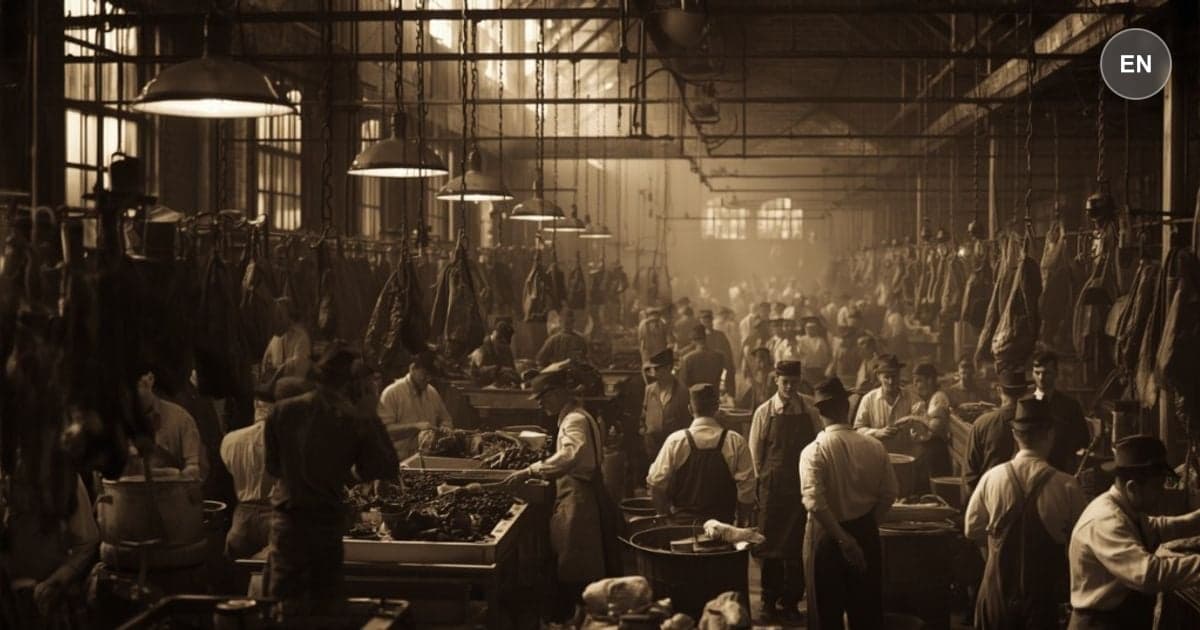
"What has happened? One hundred dollars has been added to the value of the leather."
Context: Ernest begins his shoe factory example to demonstrate surplus value
This simple example cuts through economic jargon to show how wealth is actually created - through labor. Ernest makes complex economic theory accessible while building toward his devastating conclusion about overproduction.
In Today's Words:
The workers created that extra hundred dollars of value - so where does it go?
Thematic Threads
Class
In This Chapter
Ernest mathematically proves the middle class has no real power, trapped between giant trusts and organized labor
Development
Evolved from earlier social observations to concrete economic proof of powerlessness
In Your Life:
You might recognize this when you realize your job title sounds important but you have zero influence over actual decisions.
Truth
In This Chapter
Mathematical facts become weapons that terrify rather than enlighten the dinner party guests
Development
Introduced here as Ernest shifts from philosophical arguments to undeniable numerical proof
In Your Life:
You've experienced this when presenting clear evidence of a problem only to be treated as the problem yourself.
Power
In This Chapter
Seven groups secretly control everything while the middle class owns nothing but illusions of influence
Development
Builds on earlier themes by revealing the specific oligarchy structure behind social inequality
In Your Life:
You see this when you realize the 'decision makers' you deal with are just following orders from people you'll never meet.
Fear
In This Chapter
Calvin admits their plan to 'break the machines' is absurd but necessary for survival
Development
Introduced here as desperate fear driving irrational but understandable responses to powerlessness
In Your Life:
You might recognize this in your own impulse to retreat to 'simpler times' when modern complexity feels overwhelming.
Economics
In This Chapter
Workers can only buy back half of what they produce, creating inevitable system collapse
Development
Introduced here as the mathematical foundation underlying all previous social observations
In Your Life:
You experience this every time your paycheck can't buy what your labor helped produce.
You now have the context. Time to form your own thoughts.
Discussion Questions
- 1
What specific evidence does Ernest use to prove capitalism must collapse, and why can't the businessmen argue against it?
analysis • surface - 2
Why do the dinner guests react with fear rather than gratitude when Ernest shows them the mathematical truth about their economic system?
analysis • medium - 3
Think about a time when someone presented you with uncomfortable facts backed by solid evidence. How did you react, and why?
reflection • medium - 4
If you were in Ernest's position, knowing your truth-telling would create fear and hostility, how would you approach sharing this information differently?
application • deep - 5
What does this chapter reveal about why people often 'shoot the messenger' instead of dealing with uncomfortable truths?
analysis • deep
Critical Thinking Exercise
Map Your Own Truth-Telling Moment
Think of a situation where you have uncomfortable facts that others need to hear - maybe about workplace safety, family finances, or a friend's relationship. Write down the evidence you have, predict how people will react, and design a strategy for sharing this information that protects you while still getting the message across.
Consider:
- •People's identity and comfort zone are often more important to them than facts
- •The messenger usually pays a price, so calculate if you can afford the backlash
- •Timing and framing can make the difference between being heard and being dismissed
Journaling Prompt
Write about a time when someone told you a hard truth with evidence you couldn't deny. How did you react initially, and how do you feel about their honesty now? What does this teach you about being both a truth-teller and a truth-receiver?
Coming Up Next...
Chapter 10: When Power Shows Its True Face
The dinner party's aftermath reveals the true scope of the oligarchy's power as Ernest and Avis witness the machinery of oppression in action. The theoretical becomes terrifyingly real.