Wide Reads
Literature MattersLife IndexEducators
Sign in
Where to Begin
The Day's Work - The Bridge-Builders

Rudyard Kipling

The Day's Work

The Bridge-Builders

Home›Books›The Day's Work›Chapter 1
1 of 12
Next

Summary

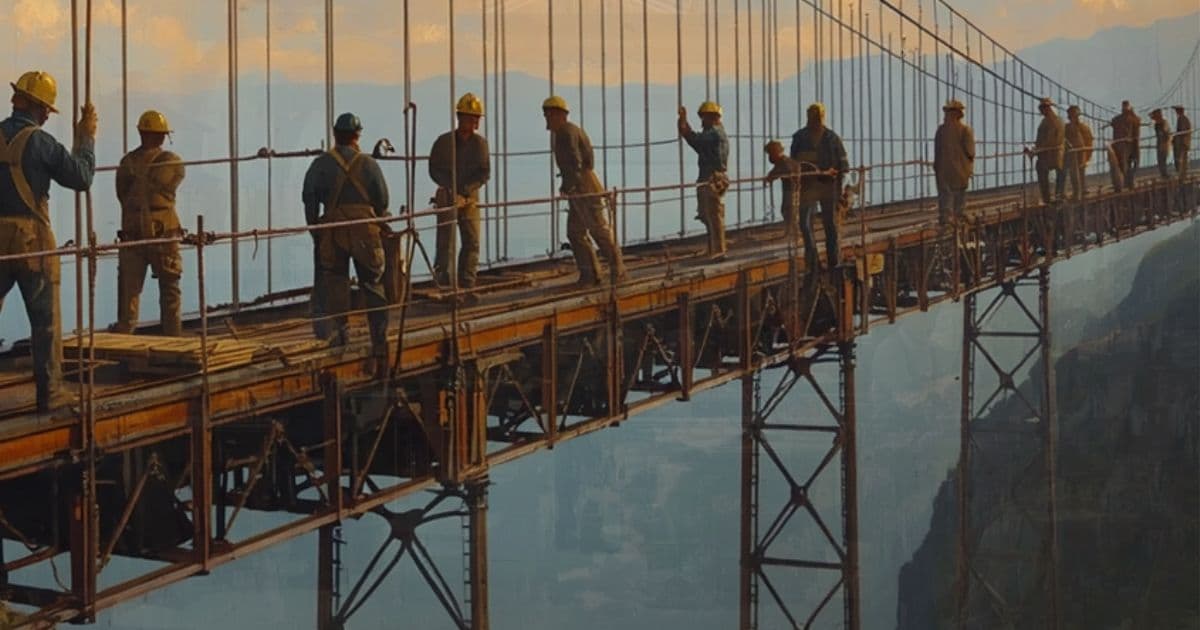
Chief Engineer Findlayson and his assistant Hitchcock have spent three grueling years building a massive bridge across the Ganges River in India. Just as their monumental project nears completion, an unexpected flood threatens to destroy everything they've worked for. The story follows their desperate night trying to save the bridge as the river rises dangerously high. Findlayson, exhausted and overwhelmed, takes opium offered by Peroo, a skilled Lascar seaman who has become invaluable to the project. Under the drug's influence, Findlayson experiences vivid hallucinations where he encounters the Hindu gods debating whether to destroy the bridge. The gods - including Ganesh, Shiva, Kali, and others - argue about whether this symbol of British engineering represents progress or sacrilege. Krishna, speaking for the common people, warns that the old gods will eventually fade as people embrace new ways of thinking brought by railways and bridges. When morning comes, both men survive their ordeal on a small island, and the bridge stands intact. The story explores the collision between traditional beliefs and modern progress, the weight of responsibility that comes with great undertakings, and how individuals cope when everything they've built hangs in the balance. Through Findlayson's crisis, Kipling examines what it means to create something permanent in an impermanent world.

Coming Up in Chapter 2

From the engineering marvels of India, we shift to the rolling pastures of Vermont, where a very different kind of work crisis unfolds among the farm animals. A smooth-talking outsider arrives with promises of revolution, but the established order has its own wisdom.

Share it with friends

Next Chapter
GO ADS FREE — JOIN US
Original text
complete·13,240 words
T

[3]

HE BRIDGE-BUILDERS

1 / 78

Master this chapter. Complete your experience

Purchase the complete book to access all chapters and support classic literature

Read Free on GutenbergBuy at Powell'sBuy on Amazon

As an Amazon Associate, we earn a small commission from qualifying purchases at no additional cost to you.

Available in paperback, hardcover, and e-book formats

GO ADS FREE — JOIN US

Why This Matters

Connect literature to life

Skill: Recognizing the Limits of Control

This chapter teaches how to distinguish between what you can influence and what you must accept, preventing burnout and enabling effective action.

Practice This Today

This week, notice when you're fighting forces beyond your control—traffic, other people's decisions, company policies—and practice redirecting that energy toward what you can actually influence.

GO ADS FREE — JOIN US

Now let's explore the literary elements.

Key Quotes & Analysis

"The river was very low, and on the dazzling white sand between the three centre piers stood squat cribs of railway-sleepers, filled within and daubed without with mud"

— Narrator

Context: Describing the bridge construction site during the dry season

This shows the precarious nature of the entire project - built on shifting sand and dependent on water levels. The detailed technical description emphasizes how much human effort has gone into fighting against natural forces.

In Today's Words:

Everything they'd built was sitting on sand, waiting for the river to decide their fate.

"It is not good to think of all one's work sinking in one night"

— Findlayson

Context: When he realizes the flood might destroy the bridge

This captures the existential dread of seeing years of work potentially destroyed in hours. It's the nightmare of anyone who has invested everything in a single project or goal.

In Today's Words:

Watching everything you've worked for disappear overnight is soul-crushing.

"When the gods change, the people change also, but very slowly"

— Krishna

Context: During Findlayson's opium-induced vision of the gods debating

This suggests that technological and social progress happens gradually, and that new ways of thinking eventually replace old beliefs. It's both a justification for colonial projects and an observation about how societies evolve.

In Today's Words:

People adapt to new ways of doing things, but it takes time for everyone to get on board.

Thematic Threads

Class

In This Chapter

British engineer Findlayson depends on Indian worker Peroo for survival, reversing colonial power dynamics

Development

Introduced here

In Your Life:

You might discover that the people you overlook at work have the skills you need most in a crisis.

Identity

In This Chapter

Findlayson's identity as master engineer crumbles under forces beyond his control

Development

Introduced here

In Your Life:

You might find your professional identity challenged when circumstances demand skills you don't have.

Responsibility

In This Chapter

The weight of three years' work and countless lives depending on the bridge's success

Development

Introduced here

In Your Life:

You might feel overwhelmed when others depend on projects or decisions that feel too big for you to handle.

Progress

In This Chapter

The bridge represents modern advancement clashing with traditional beliefs and natural forces

Development

Introduced here

In Your Life:

You might struggle when your efforts to improve things meet resistance from established systems or unexpected obstacles.

Human Relationships

In This Chapter

Findlayson's survival depends entirely on his relationship with Peroo, built through years of working together

Development

Introduced here

In Your Life:

You might find that the relationships you build during ordinary times become your lifeline during extraordinary challenges.

GO ADS FREE — JOIN US

You now have the context. Time to form your own thoughts.

Discussion Questions

  1. 1

    What specific challenges does Findlayson face when the flood threatens his bridge, and how does he initially try to handle the crisis?

    analysis • surface
  2. 2

    Why does Findlayson turn to opium during this crisis, and what does his hallucination about the gods reveal about his mental state?

    analysis • medium
  3. 3

    Where do you see this pattern of 'losing control when everything you've built is threatened' in modern workplaces or family situations?

    application • medium
  4. 4

    When facing a situation where years of your work might be destroyed overnight, what would be your strategy for maintaining focus on what you can actually control?

    application • deep
  5. 5

    What does Findlayson's relationship with Peroo teach us about the importance of building trust with people who have different backgrounds and skills than our own?

    reflection • deep

Critical Thinking Exercise

10 minutes

Crisis Decision Tree

Think of a current situation in your life where you're heavily invested in an outcome but facing forces beyond your control. Create a simple decision tree: What can you control vs. what you cannot? For each 'can control' item, write one specific action you could take this week. For each 'cannot control' item, write how you might accept or adapt to that reality.

Consider:

  • •Focus on actions, not just worries or hopes
  • •Consider who in your life might be like Peroo - someone with different skills who could help
  • •Ask yourself what 'core responsibility' you need to maintain even if other things fall apart

Journaling Prompt

Write about a time when you had to accept help from someone unexpected during a crisis. What did that experience teach you about your own limitations and strengths?

GO ADS FREE — JOIN US

Coming Up Next...

Chapter 2: The Walking Delegate

From the engineering marvels of India, we shift to the rolling pastures of Vermont, where a very different kind of work crisis unfolds among the farm animals. A smooth-talking outsider arrives with promises of revolution, but the established order has its own wisdom.

Continue to Chapter 2
Contents
Next
The Walking Delegate

Continue Exploring

The Day's Work Study GuideTeaching ResourcesEssential Life IndexBrowse by ThemeAll Books

You Might Also Like

Jane Eyre cover

Jane Eyre

Charlotte Brontë

Explores personal growth

Great Expectations cover

Great Expectations

Charles Dickens

Explores personal growth

The Strange Case of Dr Jekyll and Mr Hyde cover

The Strange Case of Dr Jekyll and Mr Hyde

Robert Louis Stevenson

Explores personal growth

Don Quixote cover

Don Quixote

Miguel de Cervantes Saavedra

Explores personal growth

Browse all 47+ books
GO ADS FREE — JOIN US

Share This Chapter

Know someone who'd enjoy this? Spread the wisdom!

TwitterFacebookLinkedInEmail

Read ad-free with Prestige

Get rid of ads, unlock study guides and downloads, and support free access for everyone.

Subscribe to PrestigeCreate free account
Intelligence Amplifier
Intelligence Amplifier™Powering Wide Reads

Exploring human-AI collaboration through books, essays, and philosophical dialogues. Classic literature transformed into navigational maps for modern life.

2025 Books

→ The Amplified Human Spirit→ The Alarming Rise of Stupidity Amplified→ San Francisco: The AI Capital of the World
Visit intelligenceamplifier.org
hello@widereads.com

WideReads Originals

→ You Are Not Lost→ The Last Chapter First→ The Lit of Love→ Wealth and Poverty→ 10 Paradoxes in the Classics · coming soon
Arvintech
arvintechAmplify your Mind
Visit at arvintech.com

Navigate

  • Home
  • Library
  • Essential Life Index
  • How It Works
  • Subscribe
  • Account
  • About
  • Contact
  • Authors
  • Suggest a Book
  • Landings

Made For You

  • Students
  • Educators
  • Families
  • Readers
  • Literary Analysis
  • Finding Purpose
  • Letting Go
  • Recovering from a Breakup
  • Corruption
  • Gaslighting in the Classics

Newsletter

Weekly insights from the classics. Amplify Your Mind.

Legal

  • Privacy Policy
  • Terms of Service
  • Cookie Policy
  • Accessibility

Why Public Domain?

We focus on public domain classics because these timeless works belong to everyone. No paywalls, no restrictions—just wisdom that has stood the test of centuries, freely accessible to all readers.

Public domain books have shaped humanity's understanding of love, justice, ambition, and the human condition. By amplifying these works, we help preserve and share literature that truly belongs to the world.

A Pilgrimage

Powell's City of Books

Portland, Oregon

If you ever find yourself in Portland, walk to the corner of Burnside and 10th. The building takes up an entire city block. Inside is over a million books, new and used on the same shelf, organized by color-coded rooms with names like the Rose Room and the Pearl Room. You can lose an afternoon. You can lose a weekend. You will find a book you have been looking for your whole life, and three you did not know existed.

It is a pilgrimage. We cannot find a bookstore like it anywhere on earth. If you read the classics, and you ever get the chance, go. It belongs on every reader's bucket list.

Visit powells.com

We are not in any way affiliated with Powell's. We are just a very big fan.

© 2026 Wide Reads™. All Rights Reserved.

Intelligence Amplifier™ and Wide Reads™ are proprietary trademarks of Arvin Lioanag.

Copyright Protection: All original content, analyses, discussion questions, pedagogical frameworks, and methodology are protected by U.S. and international copyright law. Unauthorized reproduction, distribution, web scraping, or use for AI training is strictly prohibited. See our Copyright Notice for details.

Disclaimer: The information provided on this website is for general informational and educational purposes only and does not constitute professional, legal, financial, or technical advice. While we strive to ensure accuracy and relevance, we make no warranties regarding completeness, reliability, or suitability. Any reliance on such information is at your own risk. We are not liable for any losses or damages arising from use of this site. By using this site, you agree to these terms.