Wide Reads
Literature MattersLife IndexEducators
Sign in
Where to Begin

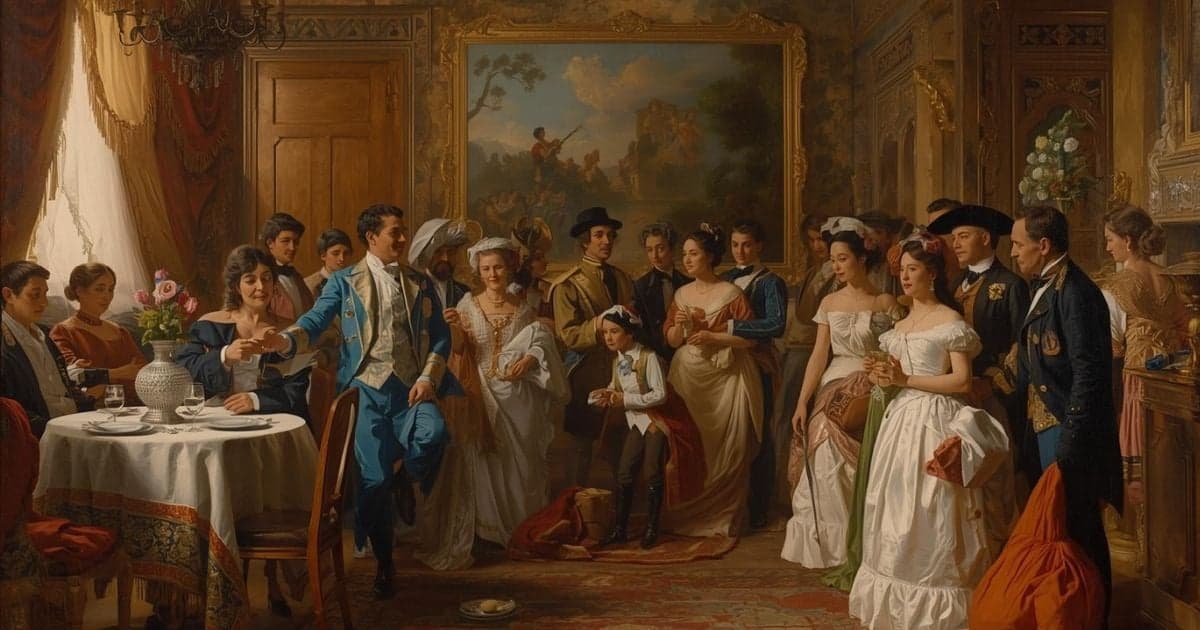
The Evening of the Betrothal — The Count of Monte Cristo

The Count of Monte Cristo - The Evening of the Betrothal

Alexandre Dumas

The Count of Monte Cristo

The Evening of the Betrothal

Home›Books›The Count of Monte Cristo›Chapter 9: The Evening of the Betrothal
Previous
9 of 117
Next

Analysis by the Wide Reads editorial team·Reviewed against the source text·Updated November 29, 2025

Summary

The Evening of the Betrothal

The Count of Monte Cristo by Alexandre Dumas

0:000:00
Listen to Next Chapter

Villefort returns to the Saint-Méran betrothal salon on the evening he imprisoned Edmond, and the guests immediately joke about a fresh Reign of Terror or the Corsican ogre breaking loose. He pulls the marquis aside, orders him to sell out of the funds at once, and demands letters to his broker and to the king so he can reach the Tuileries before anyone else and claim the glory.

Mercédès has come to his door in the shadow. When she asks after Edmond, Villefort tells her flatly that the young man is a great criminal and he can do nothing. He pushes past her, but remorse follows him into the salon. Renée, far from pleading for Dantès, hates the man whose arrest has separated her from her fiancé on the eve of their wedding.

The chapter closes on five reactions to Edmond's fate: Mercédès in grief with Fernand, Morrel fighting refusals because Dantès is already labeled a Bonapartist, Caderousse drinking himself into visions, Danglars sleeping in peace after securing the Pharaon, and Villefort racing to Paris. The hapless Dantès is doomed while his destroyer still feels the wound he inflicted.

In this chapter: Terms Characters Key Quotes Themes Modern Story

Why This Matters

Connect literature to life

Skill: Separating Guilt from Repair

Private remorse does not undo public harm if the harmful action still completes on schedule. Villefort feels the weight of sacrificing an innocent man on his betrothal evening, yet he still tells Mercédès that Edmond is a great criminal, shuts the door on her tears, and springs into the carriage for Paris. When someone hurts you and then looks miserable about it, watch whether they stop the process or only want relief from their own discomfort.

Coming Up in Chapter 10

Villefort reaches Paris with trebled post fees and is ushered into the king's closet at the Tuileries, where Louis XVIII. is annotating Horace while his ministers insist Napoleon is harmless on Elba.

Share it with friends

PreviousPrevious ChapterNextNext Chapter
Original text
1,815 wordscomplete

Chapter 09

The Evening of the Betrothal

Villefort had, as we have said, hastened back to Madame de Saint-Méran’s in the Place du Grand Cours, and on entering the house found that the guests whom he had left at table were taking coffee in the salon. Renée was, with all the rest of the company, anxiously awaiting him, and his entrance was followed by a general exclamation. “Well, Decapitator, Guardian of the State, Royalist, Brutus, what is the matter?” said one. “Speak out.” “Are we threatened with a fresh Reign of Terror?” asked another. “Has the Corsican ogre broken loose?” cried a third. “Marquise,” said Villefort, approaching…

Public-domain chapter text, formatted for reading.

Master this chapter. Complete your experience

Purchase the complete book to access all chapters and support classic literature

Buy at Powell'sBuy on Amazon

Available in paperback, hardcover, and e-book formats

Now let's explore the literary elements.

Key Quotes & Analysis

"“Then sell out—sell out, marquis, or you will lose it all.”"

— Villefort

Context: Private library talk with the marquis before racing to Paris

Villefort speaks with insider certainty, not speculation. He converts political panic into immediate financial action and positions himself as the man who sees the crisis first.

In Today's Words:

When someone with access to early information tells a wealthy ally to liquidate everything immediately, they are not sharing gossip. They are converting a private advantage into proof that they read the crisis before the market does. In any workplace or family network, that kind of urgent instruction is a signal that the speaker already knows which way the ground is shifting.

"“The young man you speak of,” said Villefort abruptly, “is a great criminal, and I can do nothing for him, mademoiselle.”"

— Villefort

Context: Mercédès intercepts him at his door after she has heard no news of Edmond

Villefort uses legal language to end a human plea. He does not argue, explain, or soften. The abruptness is the point: mercy would require admitting what he has done.

In Today's Words:

Mercédès asks for the truth about Edmond, and Villefort answers with a label instead of a location. That move is familiar anywhere power wants to close a conversation: declare the victim guilty, declare yourself powerless, and walk away before sympathy can take hold. The cruelty is not only what he says, but how quickly he refuses to be moved.

"“I do not know; he is no longer in my hands,” replied Villefort."

— Villefort

Context: Mercédès asks whether Edmond is alive or dead

He tells a half-truth that sounds like bureaucratic distance. Edmond is gone from his custody, but Villefort chose the path that made that disappearance possible.

In Today's Words:

When Mercédès asks whether Edmond is alive, Villefort hides behind process. He is no longer in my hands sounds like neutrality, but it is evasion. People in institutions use that phrase when they want credit for having acted and none of the shame for what happens next. The answer comforts no one because it was never meant to.

"Danglars alone was content and joyous—he had got rid of an enemy and made his own situation on the _Pharaon_ secure."

— Narrator

Context: Closing montage of Marseilles after Edmond's arrest

While others grieve, drink, or fight, Danglars sleeps. His satisfaction is arithmetic: one rival removed, one position secured. The narrator marks this as the coldest response in the chapter.

In Today's Words:

While Mercédès grieves and Morrel petitions in vain, Danglars sleeps well because the math finally worked. Remove the rival, take the ship, move on. That cold satisfaction appears whenever someone treats another person's ruin as a career calculation. The chapter ends by showing that not everyone experiences injustice as tragedy. For some, it is simply a problem solved.

Thematic Threads

Ambition

In This Chapter

Villefort orders the marquis to sell funds and secure letters to the king because reaching the Tuileries first will make his fortune.

Development

His arrest of Edmond was a gamble; this chapter shows him converting that gamble into royal service and social ascent.

In Your Life:

You might see this when someone treats another person's ruin as the opening move in their own promotion.

Betrayal

In This Chapter

Mercédès comes to Villefort's door for mercy and receives a legal label instead of a location; he pushes past her into the carriage.

Development

The prosecutor who examined Edmond now refuses even the appearance of justice to the woman who loves him.

In Your Life:

You might feel this when the official who smiled during the process becomes unreachable once the damage is done.

Class

In This Chapter

Morrel petitions influential men and meets refusal because Edmond is already publicly branded a Bonapartist agent.

Development

Without connections, even a respected shipowner cannot reverse a prosecutor's hidden order.

In Your Life:

You might see this when reputation and rumor close doors before evidence gets a hearing.

Human Relationships

In This Chapter

Renée hates Edmond for delaying her marriage rather than pleading for him; Fernand kneels by Mercédès while she feels nothing.

Development

Personal bonds fracture under competing griefs, and not everyone mourns the same victim.

In Your Life:

You might notice how a crisis reveals who is grieving, who is calculating, and who is simply waiting for an opening.

You now have the context. Time to form your own thoughts.

Discussion Questions

This is not a test. Five prompts guide you through the chapter, from how it opens to how it closes, so you notice context and rhythm rather than facts to memorize. Sit with each question in your own words. When you see "One way to read it," treat it as a starting point, not the only answer.

  1. 1

    Why does Villefort urge the Marquis de Saint-Méran to sell out of the funds immediately before racing to Paris?

    ▶One way to read it

    Villefort claims inside knowledge of coming political danger. He wants letters to the king and the broker so he can arrive first in Paris with news and profit from the crisis he is helping create.

    analysis • surface
  2. 2

    Mercédès waits at Villefort's door, and he tells her Edmond is a great criminal and he can do nothing. How does his public manner differ from his private remorse?

    ▶One way to read it

    To Mercédès he is abrupt and final. Alone he feels the weight of sacrificing an innocent man on his betrothal day. He pushes past her because sentiment cannot be allowed to undo ambition.

    analysis • medium
  3. 3

    Morrel fights for Edmond while Danglars quietly becomes temporary commander of the Pharaon. Where have you seen an accuser inherit the victim's position?

    ▶One way to read it

    Think of the coworker who undermines you then takes your project, or the rival who benefits the moment you are sidelined. Danglars planned removal and immediate replacement in one motion.

    application • medium
  4. 4

    Villefort feels remorse for destroying an innocent man yet still leaves for Paris to claim credit. How can guilt and career calculation coexist?

    ▶One way to read it

    He labels the feeling private and the opportunity official. Remorse does not reverse the act; it only shadows it. He converts guilt into urgency to reach the king before others do.

    application • deep
  5. 5

    The chapter closes with five responses to Edmond's fate: Mercédès' grief, Morrel's fight, Caderousse's drunken dread, Danglars' contentment, and Fernand at Mercédès' side. Which response does Dumas treat as most corrosive long-term?

    ▶One way to read it

    Danglars sleeps in peace because he reduced a life to arithmetic. Predatory calm after harm, not hot jealousy or late remorse, shows how thoroughly profit can replace conscience.

    reflection • deep

Critical Thinking Exercise

10 minutes

Map Your Paper Trail Defense System

Think of an important situation in your life where you depend on an institution - your job, healthcare, housing, or legal matters. Create a simple map showing what records you control versus what records they control. Then identify three specific ways you could create backup documentation that exists outside their system, just like Dantès wishes he had done before his arrest.

Consider:

  • •What evidence of your interactions exists only in their files?
  • •Who outside the institution could serve as witnesses to important conversations or agreements?
  • •What personal records could you keep that would be harder for them to dispute or erase?

Journaling Prompt

Write about a time when you felt powerless against a bureaucratic system. What would you do differently now, knowing how institutions can make people disappear through paperwork and procedure?

Coming Up Next...

Chapter 10: The King's Closet at the Tuileries

Villefort reaches Paris with trebled post fees and is ushered into the king's closet at the Tuileries, where Louis XVIII. is annotating Horace while his ministers insist Napoleon is harmless on Elba.

Continue to Chapter 10
Previous
The Château d'If
Contents
Next
The King's Closet at the Tuileries
Keep exploring

Continue Exploring

Study guides, teaching tools, themes, and the full library.More ways to read The Count of Monte Cristo: study guides, teaching tools, and the wider library.

  • The Count of Monte Cristo Study Guide
  • Teaching Resources
  • Essential Life Index
  • Browse by Theme
  • All Books

Life-skill deep dives in The Count of Monte Cristo

  • Distinguishing Justice from RevengeExplore distinguishing justice from revenge through The Count of Monte Cristo by Alexandre Dumas. Timeless wisdom for modern life.
  • How Trauma Transforms IdentitySee how suffering creates new selves—Edmond Dantès dies in the Château d
  • Surviving Catastrophic BetrayalUnderstand how to endure when people you trusted destroy you—Dantès loses everything yet survives through will and learning, showing growth is...
  • Understanding Collateral DamageRecognize how revenge never limits itself to the guilty—watch how the Count
Moral Dilemmas & EthicsPower & CorruptionIdentity & Self-Discovery

You Might Also Like

Les Misérables: Essential Edition cover

Les Misérables: Essential Edition

Victor Hugo

Explores justice & fairness

Noli Me Tángere cover

Noli Me Tángere

José Rizal

Explores justice & fairness

A Tale of Two Cities cover

A Tale of Two Cities

Charles Dickens

Explores justice & fairness

Crime and Punishment cover

Crime and Punishment

Fyodor Dostoevsky

Explores suffering & resilience

Browse all 106+ books

Share This Chapter

Know someone who'd enjoy this? Spread the wisdom!

TwitterFacebookLinkedInEmail

Go further with Prestige

Unlock study guides and downloads, early access, and exclusive content — and support free access for everyone.

Subscribe to PrestigeCreate free account
Intelligence Amplifier
Intelligence Amplifier™Powering Wide Reads

Exploring human-AI collaboration through books, essays, and philosophical dialogues. Classic literature transformed into navigational maps for modern life.

2025 Books

→ The Amplified Human Spirit→ The Alarming Rise of Stupidity Amplified→ San Francisco: The AI Capital of the World
Visit intelligenceamplifier.org
hello@widereads.com

WideReads Originals

→ You Are Not Lost→ The Last Chapter First→ The Lit of Love→ Wealth and Poverty→ Wisdom for the Wounded
Arvintech
arvintechAmplify your Mind
Visit at arvintech.com

Navigate

  • Home
  • Library
  • Essential Life Index
  • How It Works
  • Subscribe
  • Account
  • About
  • Contact
  • Authors
  • Suggest a Book
  • Landings

Made For You

  • Trending
  • Students
  • Educators
  • Families
  • Readers
  • Literary Analysis
  • Finding Purpose
  • Letting Go
  • Recovering from a Breakup
  • Corruption
  • Gaslighting in the Classics

Newsletter

Weekly insights from the classics. Amplify Your Mind.

Legal

  • Privacy Policy
  • Terms of Service
  • Editorial Standards
  • Cookie Policy
  • Accessibility

Why Public Domain?

We focus on public domain classics because these timeless works belong to everyone. No paywalls, no restrictions—just wisdom that has stood the test of centuries, freely accessible to all readers.

Public domain books have shaped humanity's understanding of love, justice, ambition, and the human condition. By amplifying these works, we help preserve and share literature that truly belongs to the world.

A Pilgrimage

Powell's City of Books

Portland, Oregon

If you ever find yourself in Portland, walk to the corner of Burnside and 10th. The building takes up an entire city block. Inside is over a million books, new and used on the same shelf, organized by color-coded rooms with names like the Rose Room and the Pearl Room. You can lose an afternoon. You can lose a weekend. You will find a book you have been looking for your whole life, and three you did not know existed.

It is a pilgrimage. We cannot find a bookstore like it anywhere on earth. If you read the classics, and you ever get the chance, go. It belongs on every reader's bucket list.

Visit powells.com

We are not in any way affiliated with Powell's. We are just a very big fan.

© 2026 Wide Reads™. All Rights Reserved.

Intelligence Amplifier™ and Wide Reads™ are proprietary trademarks of Arvin Lioanag.

Copyright Protection: All original content, analyses, discussion questions, pedagogical frameworks, and methodology are protected by U.S. and international copyright law. Unauthorized reproduction, distribution, web scraping, or use for AI training is strictly prohibited. See our Copyright Notice for details.

Disclaimer: The information provided on this website is for general informational and educational purposes only and does not constitute professional, legal, financial, or technical advice. While we strive to ensure accuracy and relevance, we make no warranties regarding completeness, reliability, or suitability. Any reliance on such information is at your own risk. We are not liable for any losses or damages arising from use of this site. By using this site, you agree to these terms.