Wide Reads
Literature MattersLife IndexEducators
Sign in
Where to Begin

Bread and Salt — The Count of Monte Cristo

The Count of Monte Cristo - Bread and Salt

Alexandre Dumas

The Count of Monte Cristo

Bread and Salt

Home›Books›The Count of Monte Cristo›Chapter 71: Bread and Salt
Previous
71 of 117
Next

Analysis by the Wide Reads editorial team·Reviewed against the source text·Updated November 29, 2025

Summary

Bread and Salt

The Count of Monte Cristo by Alexandre Dumas

0:000:00
Listen to Next Chapter

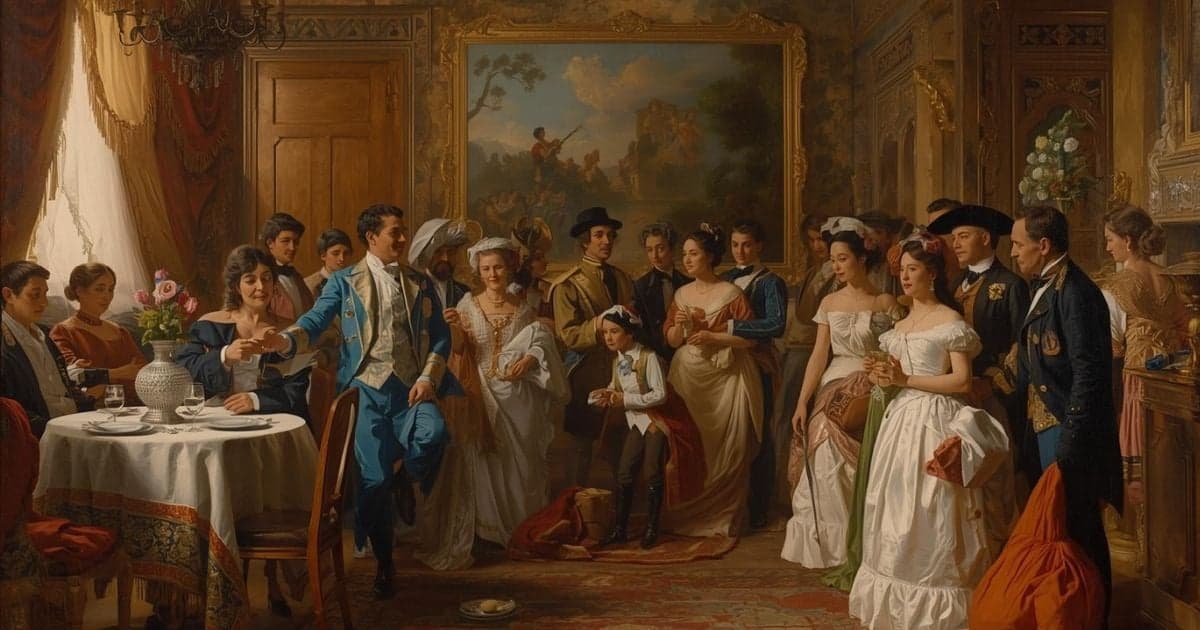
Mercédès leads Monte Cristo from the Morcerf ball into the linden grove and the greenhouse, where she tries to speak across twenty years without naming Edmond. She offers Muscatel grapes and a peach; he refuses both, and each refusal lands harder than the last.

She invokes the Arabian custom of eating bread and salt under one roof to make eternal friends. Monte Cristo answers that in France such friendships are rare, yet when she asks if they are friends, he says yes while his body turns pale and crimson by turns.

Their walk becomes a masked confession. He tells a story of a girl loved at Malta who married another while he was at war. Mercédès presses whether he still hates those who separated them; he says he hates no one, then refuses the grapes again as Inflexible man.

Albert interrupts with news that M. de Saint-Méran is dead and Villefort has come for his wife and daughter. Valentine faints at the name; the ball ends in grief. Mercédès joins Albert's hand with the Count's and asks again if they are friends; Monte Cristo answers with respectful distance, and she leaves wiping her eyes while Albert thinks all is well.

In this chapter: Terms Characters Key Quotes Themes Modern Story

Why This Matters

Connect literature to life

Skill: Hearing Refusal Beneath Yes

Agreement can be verbal while the body still refuses. Mercédès asks Monte Cristo to share bread and salt; he says they are friends yet will not eat her grapes. When someone accepts the label but rejects the ritual, treat the refusal as the truer message.

Coming Up in Chapter 72

At the Villefort house the marquis will arrive in his coffin from Marseilles while Madame de Saint-Méran brings word that will turn mourning into suspicion.

Share it with friends

PreviousPrevious ChapterNextNext Chapter
Original text
1,319 wordscomplete

Chapter 71

Bread and Salt

Madame de Morcerf entered an archway of trees with her companion. It led through a grove of lindens to a conservatory. “It was too warm in the room, was it not, count?” she asked. “Yes, madame; and it was an excellent idea of yours to open the doors and the blinds.” As he ceased speaking, the count felt the hand of Mercédès tremble. “But you,” he said, “with that light dress, and without anything to cover you but that gauze scarf, perhaps you feel cold?” “Do you know where I am leading you?” said the countess, without replying to the…

Public-domain chapter text, formatted for reading.

Master this chapter. Complete your experience

Purchase the complete book to access all chapters and support classic literature

Buy at Powell'sBuy on Amazon

Available in paperback, hardcover, and e-book formats

Now let's explore the literary elements.

Key Quotes & Analysis

"Arabian custom"

— Mercédès de Morcerf

Context: Mercédès speaks of bread and salt making eternal friends

She asks for reconciliation in ritual because she cannot say the name.

In Today's Words:

Mercédès cites the Arabian custom that eating bread and salt under one roof makes eternal friends. She wants a bond without saying why. When someone reaches for old ritual, listen for the apology or plea underneath. The pattern is not abstract. It appears whenever power, timing, and social ritual quietly decide what people treat as real.

"never eat"

— The Count of Monte Cristo

Context: Monte Cristo refuses Mercédès's Muscatel grapes

Small refusals carry the whole history of the house.

In Today's Words:

Monte Cristo tells Mercédès he never eats Muscatel grapes when she offers them in the greenhouse. Refusing food can be a boundary. When someone will not take what you offer, ask what memory the plate holds. The pattern is not abstract. It appears whenever power, timing, and social ritual quietly decide what people treat as real.

"Malta"

— The Count of Monte Cristo

Context: The Count tells Mercédès he loved a girl at Malta who married another

He speaks in third person while she hears Edmond.

In Today's Words:

Monte Cristo says he loved a young girl at Malta and returned to find her married. He tells the truth in disguise. When someone narrates your shared past as a stranger's story, decide whether to call the name aloud. The pattern is not abstract. It appears whenever power, timing, and social ritual quietly decide what people treat as real.

"Inflexible man"

— Mercédès de Morcerf

Context: Mercédès murmurs after the Count refuses her grapes again

She names the wall he will not lower with food or friendship.

In Today's Words:

Mercédès murmurs inflexible man when Monte Cristo refuses her grapes a second time. Labels can end a conversation. When someone calls you rigid, ask whether mercy would cost more than pride. The pattern is not abstract. It appears whenever power, timing, and social ritual quietly decide what people treat as real.

Thematic Threads

Food as boundary

In This Chapter

Monte Cristo refuses grapes and peach in the greenhouse.

Development

Abstinence continues the ball's table refusal.

In Your Life:

Declined meals can say what politeness forbids.

Masked confession

In This Chapter

The Count tells a Malta love story in third person.

Development

Mercédès hears Edmond without the name spoken.

In Your Life:

People often test whether you recognize them in a parable.

Interrupted plea

In This Chapter

Saint-Méran's death ends the garden walk.

Development

Public tragedy breaks private recognition.

In Your Life:

Urgent news often arrives when hard conversations finally start.

You now have the context. Time to form your own thoughts.

Discussion Questions

This is not a test. Five prompts guide you through the chapter, from how it opens to how it closes, so you notice context and rhythm rather than facts to memorize. Sit with each question in your own words. When you see "One way to read it," treat it as a starting point, not the only answer.

  1. 1

    Mercédès leads Monte Cristo to the greenhouse and speaks of the Arabian custom of eating bread and salt together. What is she asking for without saying it?

    ▶One way to read it

    One way to read it: not romance but safety. She wants a bond strong enough to protect Albert from whatever the count truly is.

    analysis • surface
  2. 2

    Monte Cristo refuses the Muscatel grapes Mercédès offers him. Why does such a small refusal carry so much weight?

    ▶One way to read it

    One way to read it: he will not share food under her roof as a friend might. She hears rejection in a gesture that looks polite to anyone watching.

    analysis • medium
  3. 3

    News arrives that M. de Saint-Méran is dead and the Villefort women leave the ball in grief. How does tragedy interrupt Mercédès' private plea?

    ▶One way to read it

    One way to read it: fate answers her fear before the count can. Misfortune proves her right that happiness and danger walk together in Paris.

    application • medium
  4. 4

    Mercédès joins Albert's hand with the count's and asks if they are friends. Why does he answer with respectful distance?

    ▶One way to read it

    One way to read it: friendship would bind his revenge. He gives her the word she needs publicly while keeping Edmond locked away inside.

    application • deep
  5. 5

    Mercédès raises her handkerchief to her eyes as she leaves while Albert thinks all is well. When does a mother's silence protect a son from truth he cannot bear?

    ▶One way to read it

    One way to read it: she buys peace with tears he will not understand until later. The count sees the cost; Albert sees only courtesy.

    reflection • deep

Critical Thinking Exercise

10 minutes

Map Your Recognition Triggers

Think of someone from your past who would recognize the 'real you' despite any changes you've made. Write down three specific things they would notice - not physical appearance, but deeper patterns like how you laugh, what makes you angry, or how you show care. Then consider: what does this reveal about your core self that never really changes?

Consider:

  • •Focus on emotional or behavioral patterns, not physical traits
  • •Consider both positive and challenging aspects of your authentic self
  • •Think about whether you're comfortable with this level of being 'seen'

Journaling Prompt

Write about a time when someone from your past saw through a change you'd made and recognized who you really were. How did that make you feel, and what did you learn about yourself?

Coming Up Next...

Chapter 72: Madame de Saint-Méran

At the Villefort house the marquis will arrive in his coffin from Marseilles while Madame de Saint-Méran brings word that will turn mourning into suspicion.

Continue to Chapter 72
Previous
The Ball
Contents
Next
Madame de Saint-Méran
Keep exploring

Continue Exploring

Study guides, teaching tools, themes, and the full library.More ways to read The Count of Monte Cristo: study guides, teaching tools, and the wider library.

  • The Count of Monte Cristo Study Guide
  • Teaching Resources
  • Essential Life Index
  • Browse by Theme
  • All Books

Life-skill deep dives in The Count of Monte Cristo

  • Distinguishing Justice from RevengeExplore distinguishing justice from revenge through The Count of Monte Cristo by Alexandre Dumas. Timeless wisdom for modern life.
  • How Trauma Transforms IdentitySee how suffering creates new selves—Edmond Dantès dies in the Château d
  • Surviving Catastrophic BetrayalUnderstand how to endure when people you trusted destroy you—Dantès loses everything yet survives through will and learning, showing growth is...
  • Understanding Collateral DamageRecognize how revenge never limits itself to the guilty—watch how the Count
Moral Dilemmas & EthicsPower & CorruptionIdentity & Self-Discovery

You Might Also Like

Les Misérables: Essential Edition cover

Les Misérables: Essential Edition

Victor Hugo

Explores justice & fairness

Noli Me Tángere cover

Noli Me Tángere

José Rizal

Explores justice & fairness

A Tale of Two Cities cover

A Tale of Two Cities

Charles Dickens

Explores justice & fairness

Crime and Punishment cover

Crime and Punishment

Fyodor Dostoevsky

Explores suffering & resilience

Browse all 106+ books

Share This Chapter

Know someone who'd enjoy this? Spread the wisdom!

TwitterFacebookLinkedInEmail

Go further with Prestige

Unlock study guides and downloads, early access, and exclusive content — and support free access for everyone.

Subscribe to PrestigeCreate free account
Intelligence Amplifier
Intelligence Amplifier™Powering Wide Reads

Exploring human-AI collaboration through books, essays, and philosophical dialogues. Classic literature transformed into navigational maps for modern life.

2025 Books

→ The Amplified Human Spirit→ The Alarming Rise of Stupidity Amplified→ San Francisco: The AI Capital of the World
Visit intelligenceamplifier.org
hello@widereads.com

WideReads Originals

→ You Are Not Lost→ The Last Chapter First→ The Lit of Love→ Wealth and Poverty→ Wisdom for the Wounded
Arvintech
arvintechAmplify your Mind
Visit at arvintech.com

Navigate

  • Home
  • Library
  • Essential Life Index
  • How It Works
  • Subscribe
  • Account
  • About
  • Contact
  • Authors
  • Suggest a Book
  • Landings

Made For You

  • Trending
  • Students
  • Educators
  • Families
  • Readers
  • Literary Analysis
  • Finding Purpose
  • Letting Go
  • Recovering from a Breakup
  • Corruption
  • Gaslighting in the Classics

Newsletter

Weekly insights from the classics. Amplify Your Mind.

Legal

  • Privacy Policy
  • Terms of Service
  • Editorial Standards
  • Cookie Policy
  • Accessibility

Why Public Domain?

We focus on public domain classics because these timeless works belong to everyone. No paywalls, no restrictions—just wisdom that has stood the test of centuries, freely accessible to all readers.

Public domain books have shaped humanity's understanding of love, justice, ambition, and the human condition. By amplifying these works, we help preserve and share literature that truly belongs to the world.

A Pilgrimage

Powell's City of Books

Portland, Oregon

If you ever find yourself in Portland, walk to the corner of Burnside and 10th. The building takes up an entire city block. Inside is over a million books, new and used on the same shelf, organized by color-coded rooms with names like the Rose Room and the Pearl Room. You can lose an afternoon. You can lose a weekend. You will find a book you have been looking for your whole life, and three you did not know existed.

It is a pilgrimage. We cannot find a bookstore like it anywhere on earth. If you read the classics, and you ever get the chance, go. It belongs on every reader's bucket list.

Visit powells.com

We are not in any way affiliated with Powell's. We are just a very big fan.

© 2026 Wide Reads™. All Rights Reserved.

Intelligence Amplifier™ and Wide Reads™ are proprietary trademarks of Arvin Lioanag.

Copyright Protection: All original content, analyses, discussion questions, pedagogical frameworks, and methodology are protected by U.S. and international copyright law. Unauthorized reproduction, distribution, web scraping, or use for AI training is strictly prohibited. See our Copyright Notice for details.

Disclaimer: The information provided on this website is for general informational and educational purposes only and does not constitute professional, legal, financial, or technical advice. While we strive to ensure accuracy and relevance, we make no warranties regarding completeness, reliability, or suitability. Any reliance on such information is at your own risk. We are not liable for any losses or damages arising from use of this site. By using this site, you agree to these terms.