Chapter 64
The Beggar
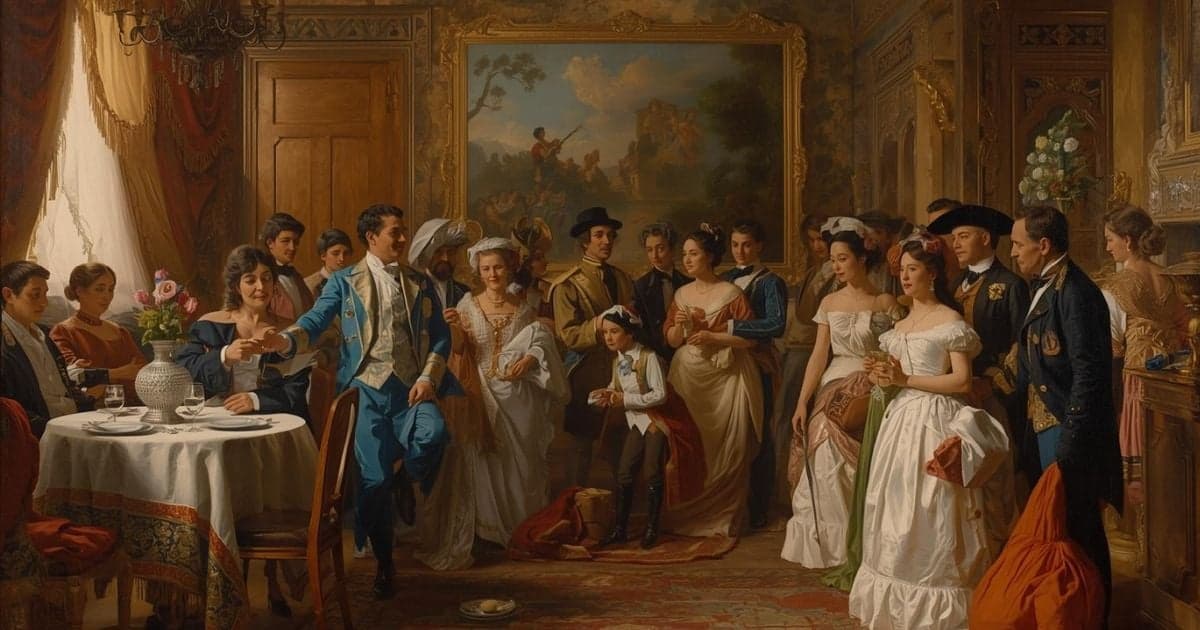
The evening passed on; Madame de Villefort expressed a desire to return to Paris, which Madame Danglars had not dared to do, notwithstanding the uneasiness she experienced. On his wife’s request, M. de Villefort was the first to give the signal of departure. He offered a seat in his landau to Madame Danglars, that she might be under the care of his wife. As for M. Danglars, absorbed in an interesting conversation with M. Cavalcanti, he paid no attention to anything that was passing. While Monte Cristo had begged the smelling-bottle of Madame de Villefort, he had noticed the approach…
Public-domain chapter text, formatted for reading.
Master this chapter. Complete your experience
Purchase the complete book to access all chapters and support classic literature
Available in paperback, hardcover, and e-book formats
Now let's explore the literary elements.
Key Quotes & Analysis
"Benedetto"
Context: The beggar stops Andrea and uses his real name
The false heir's past arrives without invitation in the road.
In Today's Words:
Caderousse calls Andrea Benedetto when he stops the tilbury after Auteuil. Old names pursue new fortunes. When someone from your past knows your real name, assume they also know your price. The pattern is not abstract. It appears whenever power, timing, and social ritual quietly decide what people treat as real.
"Here are two hundred"
Context: Andrea pays Caderousse to buy silence
Cash is cheaper than a pistol shot in the street.
In Today's Words:
Andrea says here are two hundred and hands Caderousse ten gold louis. Quick payment can be panic management. Ask whether you are settling a debt or renting silence for one month. The pattern is not abstract. It appears whenever power, timing, and social ritual quietly decide what people treat as real.
"pistol"
Context: Andrea and Caderousse nearly fight over the payoff
Blackmail and pride share the same carriage seat.
In Today's Words:
The narrator says Andrea reached for a pistol while Caderousse opened his knife. Threats escalate fast when both sides feel cornered. Keep distance when money and memory meet at night. The pattern is not abstract. It appears whenever power, timing, and social ritual quietly decide what people treat as real.
"completely happy"
Context: Andrea sighs after Caderousse keeps the greatcoat and escapes
Success still feels like ransom when the past lives.
In Today's Words:
Andrea sighs that one cannot be completely happy in this world after Caderousse leaves with his coat. Victory can feel unfinished when someone knows your name. Budget for the past when you buy a new life. The pattern is not abstract. It appears whenever power, timing, and social ritual quietly decide what people treat as real.
Thematic Threads
Departures unequal
In This Chapter
Ladies leave with Villefort while Danglars chats with Cavalcanti.
Development
Some guests miss the fear others carry home.
In Your Life:
After tense events, not everyone leaves with the same information.
Roadside blackmail
In This Chapter
Caderousse demands money using the name Benedetto.
Development
The heir's costume meets its maker.
In Your Life:
Past identities often collect payment at inconvenient stops.
Coat as truce
In This Chapter
Andrea and Caderousse compromise over the groom's greatcoat.
Development
Neither wants a corpse on the road tonight.
In Your Life:
Small stolen comforts sometimes end standoffs that could turn fatal.
You now have the context. Time to form your own thoughts.
Discussion Questions
This is not a test. Five prompts guide you through the chapter, from how it opens to how it closes, so you notice context and rhythm rather than facts to memorize. Sit with each question in your own words. When you see "One way to read it," treat it as a starting point, not the only answer.
- 1
Caderousse stops Andrea's carriage after the Auteuil dinner and calls him Benedetto. How does the past arrive without an invitation?
analysis • surfaceOne way to read it
One way to read it: the count's world is full of people who knew other names. A beggar in a red handkerchief can undo a count's evening with one word.
- 2
Andrea pays Caderousse two hundred louis and arranges monthly money through the steward. Is that charity or blackmail?
analysis • mediumOne way to read it
One way to read it: both at once. Andrea buys silence he cannot afford to test; Caderousse sells discretion he will not keep forever.
- 3
They discuss the Count of Monte Cristo as the man who invented father and son Cavalcanti. What does Andrea admit he does not understand?
application • mediumOne way to read it
One way to read it: the purpose of the masquerade. He and the major play their parts and split the fees, knowing someone else holds the script.
- 4
Andrea reaches for a pistol while Caderousse opens a knife, then they compromise on a coat and a hat. What kind of peace is that?
application • deepOne way to read it
One way to read it: a truce between predators who need each other alive today. Both know violence would end the income, not the threat.
- 5
Andrea sighs that one cannot be completely happy in this world after Caderousse keeps his greatcoat. When does success feel like ransom?
reflection • deepOne way to read it
One way to read it: the title, horse, and dinner mean nothing if Marseilles can ride beside you. Every step upward revives who you were.
Critical Thinking Exercise
Map Your Identity Layers
Draw three circles representing different versions of yourself: who you were 5 years ago, who you are now, and who you're becoming. Write 3-4 words in each circle describing that version. Then identify which people in your life can still see each version of you, and consider what they might be recognizing that you've forgotten or tried to leave behind.
Consider:
- •Some changes represent growth worth celebrating, while others might be masks we wear
- •People who knew us 'before' aren't necessarily trying to hold us back - they might see valuable qualities we've abandoned
- •Recognition from our past can be either a gift or a challenge, depending on how we respond to it
Journaling Prompt
Write about a time when someone from your past made you realize you'd changed in ways you hadn't fully acknowledged. What did their recognition help you understand about yourself?
Coming Up Next...
Chapter 65: A Conjugal Scene
At the Place Louis XV, Morrel, Château-Renaud, and Debray will ride their separate ways while Danglars waits at home to confront his wife about seven hundred thousand francs lost on a telegraph lie At the Place Louis XV, Morrel, Château-Renaud, and Debray separate toward their own evenings while Danglars returns home to settle accounts of a different kind. He tells Hermine he lost seven.