Wide Reads
Literature MattersLife IndexEducators
Sign in
Where to Begin

The Dinner — The Count of Monte Cristo

The Count of Monte Cristo - The Dinner

Alexandre Dumas

The Count of Monte Cristo

The Dinner

Home›Books›The Count of Monte Cristo›Chapter 63: The Dinner
Previous
63 of 117
Next

Analysis by the Wide Reads editorial team·Reviewed against the source text·Updated November 29, 2025

Summary

The Dinner

The Count of Monte Cristo by Alexandre Dumas

0:000:00
Listen to Next Chapter

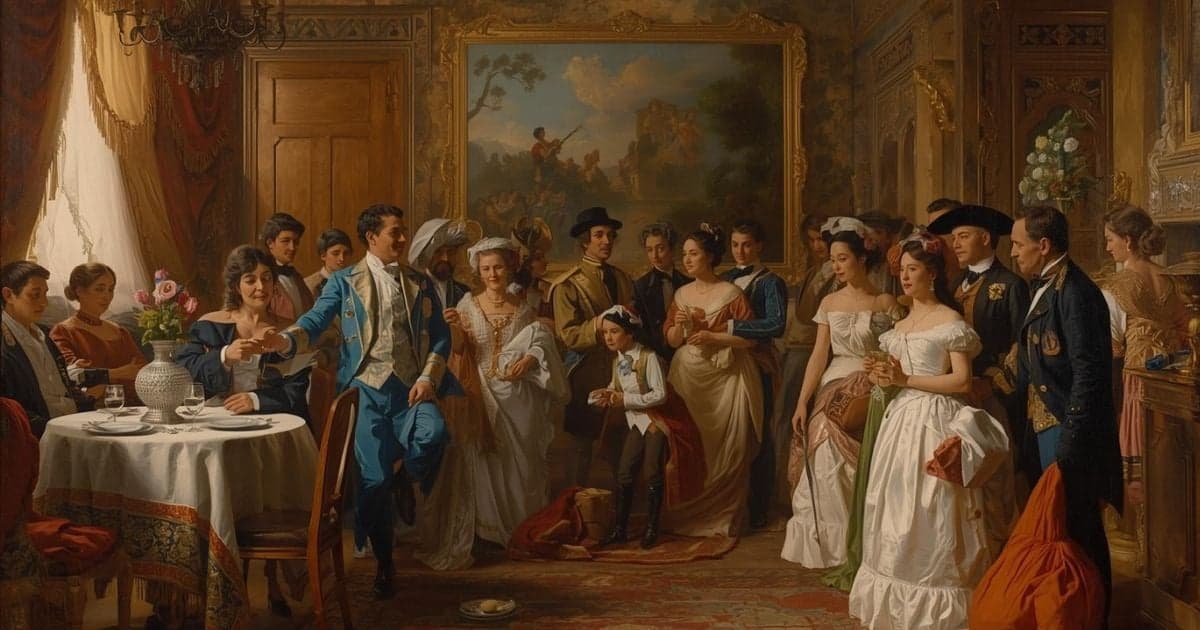
Every guest enters the Auteuil dining-room moved by the same uneasy curiosity. Villefort flinches when asked to escort Madame Danglars; the Cavalcantis perform nobility; even caution cannot compete with the Count's reputation and wealth.

The meal is impossible theatre: sterlet from the Volga, lamprey from Lake Fusaro, fish still alive in casks, porcelain jars large enough for chestnut trees. Monte Cristo feeds Paris spectacle while watching who sweats first.

After dessert he offers a tour of the red damask room, comparing it to the Marquise de Ganges and Desdemona. He describes a crime among the hangings, a buried newborn's skeleton under the plantain tree, and a staircase that once carried murder.

Madame Danglars faints; Héloïse's smelling-bottle revives her while Villefort whispers to the baroness to meet tomorrow in his office. Horror and appointment leave the table together.

In this chapter: Terms Characters Key Quotes Themes Modern Story

Why This Matters

Connect literature to life

Skill: Watching Who Faints

A story aimed at guilt does not need proof to work. Monte Cristo describes a newborn's skeleton under the plantain tree, and Madame Danglars collapses while Villefort arranges a private meeting. When someone tells a crime aloud in company, study the bodies before you study the evidence.

Coming Up in Chapter 64

After the ladies depart in Villefort's carriage, Andrea's tilbury will stop on the road for a beggar who calls him Benedetto, demands gold, and nearly turns the night into pistol steel.

Share it with friends

PreviousPrevious ChapterNextNext Chapter
Original text
3,366 wordscomplete

Chapter 63

The Dinner

It was evident that one sentiment affected all the guests on entering the dining-room. Each one asked what strange influence had brought them to this house, and yet astonished, even uneasy though they were, they still felt that they would not like to be absent. The recent events, the solitary and eccentric position of the count, his enormous, nay, almost incredible fortune, should have made men cautious, and have altogether prevented ladies visiting a house where there was no one of their own sex to receive them; and yet curiosity had been enough to lead them to overleap the bounds…

Public-domain chapter text, formatted for reading.

Master this chapter. Complete your experience

Purchase the complete book to access all chapters and support classic literature

Buy at Powell'sBuy on Amazon

Available in paperback, hardcover, and e-book formats

Now let's explore the literary elements.

Key Quotes & Analysis

"sterlet"

— Château-Renaud

Context: Guests identify impossible fish at the Auteuil dinner

Luxury here is live, traveling, and deliberately excessive.

In Today's Words:

Château-Renaud names sterlet among the fish served at Monte Cristo's table. Extravagance can be a threat dressed as hospitality. When a host feeds you the impossible, ask what obedience he is buying. The pattern is not abstract. It appears whenever power, timing, and social ritual quietly decide what people treat as real.

"lamprey"

— The Count of Monte Cristo

Context: The Count identifies another rare fish for Danglars

He teaches bankers to marvel while he prepares darker instruction.

In Today's Words:

Monte Cristo points out lamprey from Lake Fusaro at the dinner. He mixes wonder with control. If a meal feels like a test, listen for the lesson after the plates are cleared. The pattern is not abstract. It appears whenever power, timing, and social ritual quietly decide what people treat as real.

"damask"

— Madame Danglars

Context: Madame Danglars reacts to the room the Count will show

She senses drama before the crime story is spoken aloud.

In Today's Words:

Madame Danglars says the red damask room appears quite dramatic to her. People often feel danger in décor before facts arrive. Trust the guest who flinches at a room before the story starts. The pattern is not abstract. It appears whenever power, timing, and social ritual quietly decide what people treat as real.

"skeleton of a"

— The Count of Monte Cristo

Context: Monte Cristo describes what was found under the plantain tree

He turns dinner into confession aimed at the guilty.

In Today's Words:

Monte Cristo tells his guests a skeleton of a newly born infant was found under the plantain tree. He uses fiction or memory as a weapon. When a host narrates a burial, watch who cannot breathe. The pattern is not abstract. It appears whenever power, timing, and social ritual quietly decide what people treat as real.

Thematic Threads

Feast as dominance

In This Chapter

Sterlet and lamprey arrive from living casks at Auteuil.

Development

Wealth forces guests to stay despite fear.

In Your Life:

Extravagant hospitality can pin people to their chairs.

Room with memory

In This Chapter

The Count tours the red damask bedroom after dinner.

Development

Decoration becomes accusation.

In Your Life:

A house tour can be cross-examination in slow motion.

Whispered appointment

In This Chapter

Villefort tells Madame Danglars to meet in his office tomorrow.

Development

Public horror shifts to private alliance.

In Your Life:

After a scandalous story, side deals often begin in low voices.

You now have the context. Time to form your own thoughts.

Discussion Questions

This is not a test. Five prompts guide you through the chapter, from how it opens to how it closes, so you notice context and rhythm rather than facts to memorize. Sit with each question in your own words. When you see "One way to read it," treat it as a starting point, not the only answer.

  1. 1

    Monte Cristo serves sterlet from the Volga and lamprey from Lake Fusaro, then reveals spare fish still alive in casks. What is he proving to Paris?

    ▶One way to read it

    One way to read it: that money can make the impossible routine. Guests doubt; he opens the proof and turns doubt into applause.

    analysis • surface
  2. 2

    He leads the company to the red damask room and describes a crime among the hangings. Why stage horror during dessert?

    ▶One way to read it

    One way to read it: he watches who flinches. Villefort and Madame Danglars know that room; their faces tell him more than any confession.

    analysis • medium
  3. 3

    Monte Cristo claims a newborn's skeleton was found under the plantain tree, then offers Héloïse's red elixir when Madame Danglars faints. How do fiction and chemistry work together here?

    ▶One way to read it

    One way to read it: the story cracks them open; the vial shows he holds their remedies and their secrets. Terror and relief come from the same hand.

    application • medium
  4. 4

    Villefort whispers to Madame Danglars to meet tomorrow in his office while Danglars talks railways with the major. What separate plots leave the same house?

    ▶One way to read it

    One way to read it: the banker hunts fortune, the procureur hunts cover, the count hunts reaction. One dinner feeds three different fears.

    application • deep
  5. 5

    Château-Renaud says the house looked guilty before Monte Cristo transformed it. Can decoration ever erase what a place remembers?

    ▶One way to read it

    One way to read it: trees and lawns change in days; guilt moves slower. The count knows the soil still holds what the guests only imagine.

    reflection • deep

Critical Thinking Exercise

10 minutes

Map Your Identity Layers

Think of a situation where someone from your past encountered your present self and it created tension or discomfort. Draw or list three layers: who you were then, who you are now, and what authentic core connects both versions. Identify which parts of your evolution you want to defend and which parts of your past self you want to honor.

Consider:

  • •Consider whether the tension came from genuine growth or from hiding parts of yourself you're ashamed of
  • •Notice if you felt defensive about your past self or your present self during the encounter
  • •Think about whether this person's recognition threatened your progress or actually helped you stay grounded

Journaling Prompt

Write about a time when someone's recognition of your past self either helped you stay authentic or made you question who you'd become. What did you learn about the difference between healthy growth and identity abandonment?

Coming Up Next...

Chapter 64: The Beggar

After the ladies depart in Villefort's carriage, Andrea's tilbury will stop on the road for a beggar who calls him Benedetto, demands gold, and nearly turns the night into pistol steel.

Continue to Chapter 64
Previous
Ghosts
Contents
Next
The Beggar
Keep exploring

Continue Exploring

Study guides, teaching tools, themes, and the full library.More ways to read The Count of Monte Cristo: study guides, teaching tools, and the wider library.

  • The Count of Monte Cristo Study Guide
  • Teaching Resources
  • Essential Life Index
  • Browse by Theme
  • All Books

Life-skill deep dives in The Count of Monte Cristo

  • Distinguishing Justice from RevengeExplore distinguishing justice from revenge through The Count of Monte Cristo by Alexandre Dumas. Timeless wisdom for modern life.
  • How Trauma Transforms IdentitySee how suffering creates new selves—Edmond Dantès dies in the Château d
  • Surviving Catastrophic BetrayalUnderstand how to endure when people you trusted destroy you—Dantès loses everything yet survives through will and learning, showing growth is...
  • Understanding Collateral DamageRecognize how revenge never limits itself to the guilty—watch how the Count
Moral Dilemmas & EthicsPower & CorruptionIdentity & Self-Discovery

You Might Also Like

Les Misérables: Essential Edition cover

Les Misérables: Essential Edition

Victor Hugo

Explores justice & fairness

Noli Me Tángere cover

Noli Me Tángere

José Rizal

Explores justice & fairness

A Tale of Two Cities cover

A Tale of Two Cities

Charles Dickens

Explores justice & fairness

Crime and Punishment cover

Crime and Punishment

Fyodor Dostoevsky

Explores suffering & resilience

Browse all 106+ books

Share This Chapter

Know someone who'd enjoy this? Spread the wisdom!

TwitterFacebookLinkedInEmail

Go further with Prestige

Unlock study guides and downloads, early access, and exclusive content — and support free access for everyone.

Subscribe to PrestigeCreate free account
Intelligence Amplifier
Intelligence Amplifier™Powering Wide Reads

Exploring human-AI collaboration through books, essays, and philosophical dialogues. Classic literature transformed into navigational maps for modern life.

2025 Books

→ The Amplified Human Spirit→ The Alarming Rise of Stupidity Amplified→ San Francisco: The AI Capital of the World
Visit intelligenceamplifier.org
hello@widereads.com

WideReads Originals

→ You Are Not Lost→ The Last Chapter First→ The Lit of Love→ Wealth and Poverty→ Wisdom for the Wounded
Arvintech
arvintechAmplify your Mind
Visit at arvintech.com

Navigate

  • Home
  • Library
  • Essential Life Index
  • How It Works
  • Subscribe
  • Account
  • About
  • Contact
  • Authors
  • Suggest a Book
  • Landings

Made For You

  • Trending
  • Students
  • Educators
  • Families
  • Readers
  • Literary Analysis
  • Finding Purpose
  • Letting Go
  • Recovering from a Breakup
  • Corruption
  • Gaslighting in the Classics

Newsletter

Weekly insights from the classics. Amplify Your Mind.

Legal

  • Privacy Policy
  • Terms of Service
  • Editorial Standards
  • Cookie Policy
  • Accessibility

Why Public Domain?

We focus on public domain classics because these timeless works belong to everyone. No paywalls, no restrictions—just wisdom that has stood the test of centuries, freely accessible to all readers.

Public domain books have shaped humanity's understanding of love, justice, ambition, and the human condition. By amplifying these works, we help preserve and share literature that truly belongs to the world.

A Pilgrimage

Powell's City of Books

Portland, Oregon

If you ever find yourself in Portland, walk to the corner of Burnside and 10th. The building takes up an entire city block. Inside is over a million books, new and used on the same shelf, organized by color-coded rooms with names like the Rose Room and the Pearl Room. You can lose an afternoon. You can lose a weekend. You will find a book you have been looking for your whole life, and three you did not know existed.

It is a pilgrimage. We cannot find a bookstore like it anywhere on earth. If you read the classics, and you ever get the chance, go. It belongs on every reader's bucket list.

Visit powells.com

We are not in any way affiliated with Powell's. We are just a very big fan.

© 2026 Wide Reads™. All Rights Reserved.

Intelligence Amplifier™ and Wide Reads™ are proprietary trademarks of Arvin Lioanag.

Copyright Protection: All original content, analyses, discussion questions, pedagogical frameworks, and methodology are protected by U.S. and international copyright law. Unauthorized reproduction, distribution, web scraping, or use for AI training is strictly prohibited. See our Copyright Notice for details.

Disclaimer: The information provided on this website is for general informational and educational purposes only and does not constitute professional, legal, financial, or technical advice. While we strive to ensure accuracy and relevance, we make no warranties regarding completeness, reliability, or suitability. Any reliance on such information is at your own risk. We are not liable for any losses or damages arising from use of this site. By using this site, you agree to these terms.