Chapter 46
Unlimited Credit
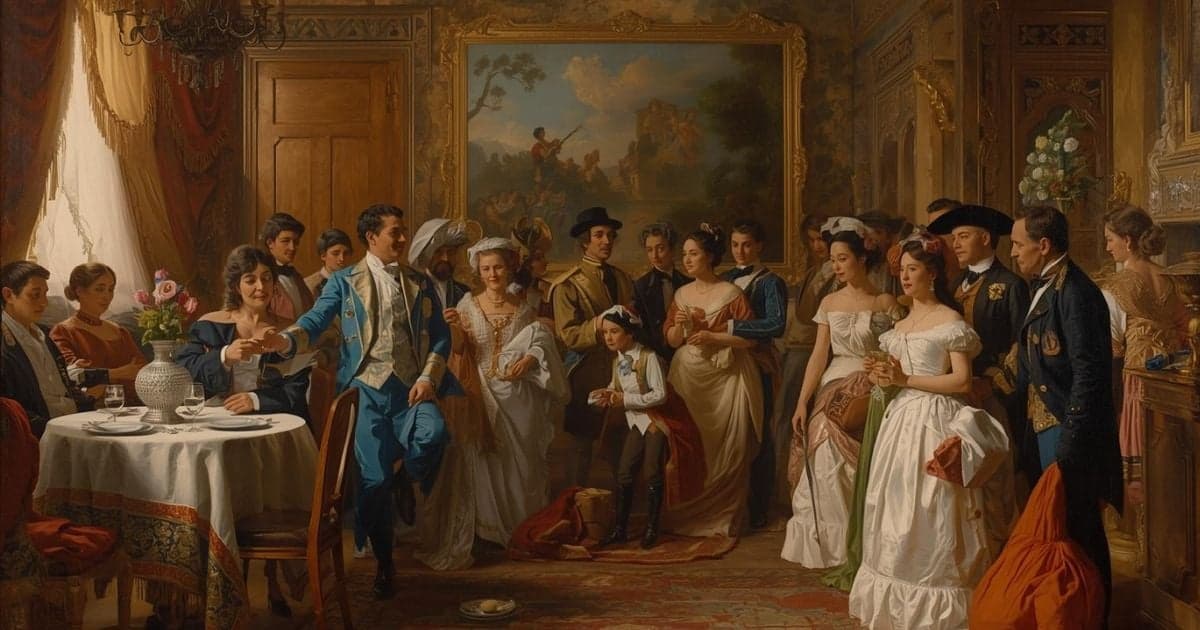
About two o’clock the following day a calash, drawn by a pair of magnificent English horses, stopped at the door of Monte Cristo and a person, dressed in a blue coat, with buttons of a similar color, a white waistcoat, over which was displayed a massive gold chain, brown trousers, and a quantity of black hair descending so low over his eyebrows as to leave it doubtful whether it were not artificial so little did its jetty glossiness assimilate with the deep wrinkles stamped on his features—a person, in a word, who, although evidently past fifty, desired to be taken…
Public-domain chapter text, formatted for reading.
Master this chapter. Complete your experience
Purchase the complete book to access all chapters and support classic literature
Available in paperback, hardcover, and e-book formats
Now let's explore the literary elements.
Key Quotes & Analysis
"unlimited credit"
Context: Danglars cites his account at Thomson and French to calm himself at the door
He treats banking language as armor before he knows whether the Count will receive him.
In Today's Words:
Danglars mutters about unlimited credit while waiting to be admitted. Financial status is his ID card. When someone leads with their bank balance before saying hello, they may be more nervous than powerful. The pattern is not abstract. It appears whenever power, timing, and social ritual quietly decide what people treat as real.
"Thomson & French"
Context: The banker names the firm backing the Count's Paris funds
A shared banker links Marseilles debt to Paris leverage.
In Today's Words:
Danglars invokes Thomson and French as proof the Count is real money, not theater. Shared financial rails connect strangers faster than introductions. Ask who already shares your bank when a new player arrives. The pattern is not abstract. It appears whenever power, timing, and social ritual quietly decide what people treat as real.
"you had taken upon yourself to speak of me to any"
Context: The Count warns Baptistin against gossiping about his affairs
Secrecy is enforced with money removed, not mere scolding.
In Today's Words:
The Count tells Baptistin that speaking of him to outsiders costs a bonus fund servants depend on. Silence is purchased, not requested. When a boss ties speech to pay, assume information itself is part of the job. The pattern is not abstract. It appears whenever power, timing, and social ritual quietly decide what people treat as real.
"500,000 francs each"
Context: The Count produces treasury orders when Danglars doubts unlimited credit
Paper at sight ends the banker's skepticism without argument.
In Today's Words:
The narrator describes treasury orders for five hundred thousand francs each, payable at sight. Liquidity ends debate. In negotiations, the side that can prove cash now often controls the room without raising their voice. The pattern is not abstract. It appears whenever power, timing, and social ritual quietly decide what people treat as real.
Thematic Threads
Credit as chain
In This Chapter
Danglars clings to unlimited credit at the door, then watches the Count prove it.
Development
The banker who once moved Marseilles money now needs Paris approval.
In Your Life:
Debt and banking ties can make former predators into dependents.
Display vs paper
In This Chapter
Horses, diamonds, and mansions give way to treasury orders.
Development
Wealth here wins by documents, not ornament.
In Your Life:
In business, the quiet proof often beats the loud office tour.
Purchased silence
In This Chapter
Baptistin loses his bonus if he gossips about the Count.
Development
Servants are bound by money as much as loyalty.
In Your Life:
Teams that punish curiosity are protecting a strategy, not privacy.
You now have the context. Time to form your own thoughts.
Discussion Questions
This is not a test. Five prompts guide you through the chapter, from how it opens to how it closes, so you notice context and rhythm rather than facts to memorize. Sit with each question in your own words. When you see "One way to read it," treat it as a starting point, not the only answer.
- 1
Danglars is refused at the door yet reassures himself with Thomson and French unlimited credit. Why does the banker need the count more than the count needs him?
analysis • surfaceOne way to read it
One way to read it: Danglars wants to test a fortune that could embarrass him. The count already knows Danglars' face, house, and vanity from behind a blind.
- 2
Monte Cristo opens two treasury orders for five hundred thousand francs when Danglars doubts "unlimited." How does he turn a banking interview into a duel?
analysis • mediumOne way to read it
One way to read it: he answers pride with proof. Danglars wanted a limit; the count shows backup banks and names six million for his first year.
- 3
The count buys Danglars' horses for double the price and sends Bertuccio to find a Norman harbor for his corvette. What does that mixture of luxury and logistics reveal?
application • mediumOne way to read it
One way to read it: Paris society is theater, but escape routes are real. He spends lavishly in public while placing ships, relays, and coastlines in private.
- 4
Danglars mentions Albert's bandit story and Eugénie Danglars almost in one breath. How does the count enter Paris already tied to two enemy houses?
application • deepOne way to read it
One way to read it: Morcerf brought him to Albert's home; Morrel named Thomson and French; Danglars holds the fortune. Every introduction is a line in the net.
- 5
Monte Cristo tells Baptistin that curiosity about his affairs costs a servant his bonus. When is secrecy a tool of power rather than privacy?
reflection • deepOne way to read it
One way to read it: he buys silence before anyone knows enough to talk. In his house, information flows one way only.
Critical Thinking Exercise
Document Your Evidence Strategy
Think of a situation where you've felt powerless against someone with more authority—a boss, family member, or institution. Map out how you would apply the Count's three-stage approach: What evidence would you document? Who could serve as credible witnesses? What would be the ideal timing for revelation? Create a strategic plan rather than an emotional reaction.
Consider:
- •Focus on facts and patterns, not feelings or opinions
- •Identify who else has been affected and might support your case
- •Consider when the powerful person would be most vulnerable or when you'd have maximum support
- •Think about what outcome you actually want—justice, change, or protection
Journaling Prompt
Write about a time when you reacted emotionally to unfair treatment instead of responding strategically. How might systematic documentation and patient timing have changed the outcome? What would you do differently now?
Coming Up Next...
Chapter 47: The Dappled Grays
Danglars will lead the Count into Madame Danglars's pink boudoir, where a pair of famous dappled grays will expose how profit and marriage already quarrel in that house Danglars leads the Count through apartments heavy with ostentation until they reach Madame Danglars's pink boudoir, the one room in the mansion where taste survived the baron's architect. Debray's influence shows in Boucher shepherds and muslin.