Wide Reads
Literature MattersLife IndexEducators
Sign in
Where to Begin

The Presentation — The Count of Monte Cristo

The Count of Monte Cristo - The Presentation

Alexandre Dumas

The Count of Monte Cristo

The Presentation

Home›Books›The Count of Monte Cristo›Chapter 41: The Presentation
Previous
41 of 117
Next

Analysis by the Wide Reads editorial team·Reviewed against the source text·Updated November 29, 2025

Summary

The Presentation

The Count of Monte Cristo by Alexandre Dumas

0:000:00
Listen to Next Chapter

Albert leads the Count through his bachelor pavilion after breakfast, joking that a man who sleeps in a grotto needs no luxury while showing off a life built for display. The rooms are a catalogue of taste and expense: Sevres vases, Boulle cabinets, Japanese screens, weapons, and a portrait of a Catalan fisher-girl that stops the Count cold.

Albert explains the painting as a mistress in local dress; the Count recognizes Mercédès and must perform indifference while Albert praises the eyes and the costume. The tour becomes a duel of composure: Albert chatters about comfort and conquests while the man beside him measures a face he last saw in Marseilles. Every object Albert displays is a boast; every pause the Count takes is reconnaissance.

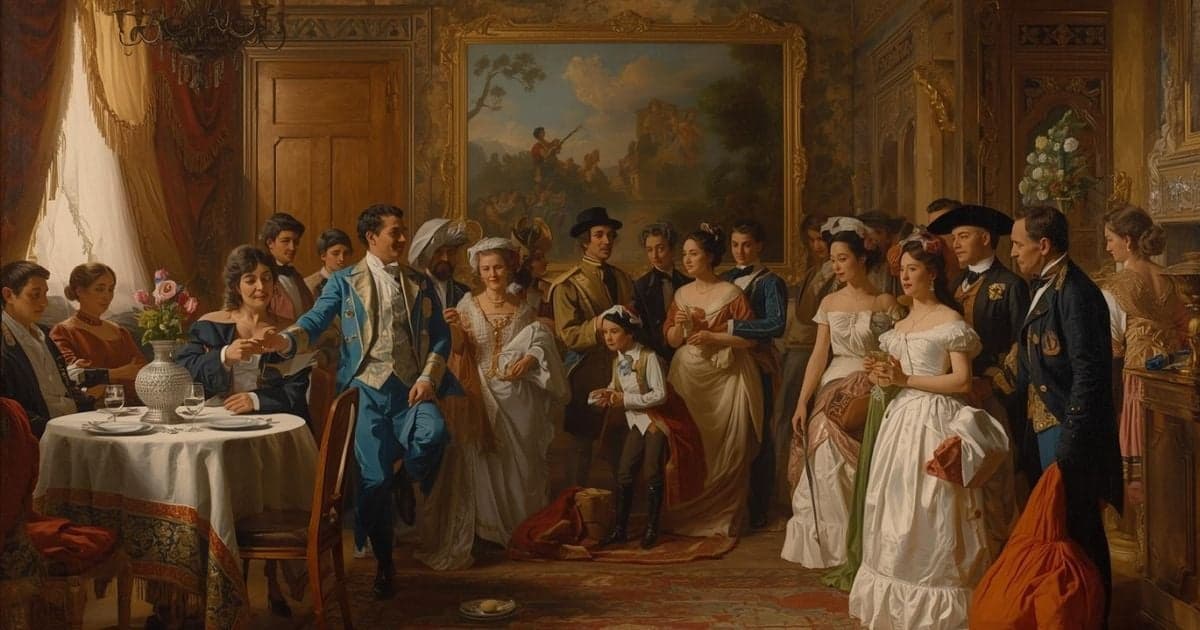
The Count and Countess de Morcerf arrive for the promised introduction. Fernand enters with military polish and patriotic anecdotes; Mercédès follows, still beautiful, still watchful. She thanks the Count for saving Albert in Rome, grows pale at his voice, and searches his face for the youth she buried under titles and years. Albert is proud to unite his friend with his parents; he cannot see the room as a reunion disguised as etiquette.

Conversation turns on Spain, Provence, and Fernand's rise from fisherman to general. The Count answers with polished irony that flatters without surrendering ground. He speaks of travel, of despising honors, of passports as sufficient titles. Fernand hears respect; Mercédès hears cadence. Albert beams at the harmony; the table treats the visit as social success while two people inventory a shared past they are forbidden to name.

When the parents leave, Albert offers his carriage; the Count refuses with a joke about honors on passports and calls for his own equipage. Koller brings the perfect team while Albert's borrowed horses look common by comparison. The departure is another performance of superiority without insult: the foreign count leaves on his own terms in plain sight of the house he intends to ruin.

Mercédès retreats among tuberoses and smelling salts, veiling herself against a recognition she cannot yet speak. She asks whether Monte Cristo is really what he seems, a question Albert cannot hear as danger. Albert escorts the Count out, proud of the visit; the Count carries a portrait's confirmation that his enemy's house still holds the woman who once pledged herself to Edmond Dantès.

The presentation is complete, and every courtesy has tightened the knot he came to Paris to loosen. Fernand has shown his medals; Mercédès has shown her fear; Albert has shown the Count where love and vanity hang on the wall. No one has said Edmond, yet the chapter ends with all three truths in the same room.

In this chapter: Terms Characters Key Quotes Themes Modern Story

Why This Matters

Connect literature to life

Skill: Reading Courtesy as Cover

A room can stay polite while a private past walks through the door. Albert shows a portrait of a Catalan girl and calls her a mistress; the Count knows it is Mercédès and still completes the Morcerf introduction without breaking character. Watch what people do after the handshake, not only what they say during it.

Coming Up in Chapter 42

The Count will settle into the Champs-Élysées house Bertuccio bought and then sign for a country estate at Auteuil, a name that turns his steward's face to ash before anyone explains why.


Share it with friends

PreviousPrevious ChapterNextNext Chapter
Original text
5,049 wordscomplete

Chapter 41

The Presentation

When Albert found himself alone with Monte Cristo, “My dear count,” said he, “allow me to commence my services as cicerone by showing you a specimen of a bachelor’s apartment. You, who are accustomed to the palaces of Italy, can amuse yourself by calculating in how many square feet a young man who is not the worst lodged in Paris can live. As we pass from one room to another, I will open the windows to let you breathe.” Monte Cristo had already seen the breakfast-room and the salon on the ground floor. Albert led him first to his atelier,…

Public-domain chapter text, formatted for reading.

Master this chapter. Complete your experience

Purchase the complete book to access all chapters and support classic literature

Buy at Powell'sBuy on Amazon

Available in paperback, hardcover, and e-book formats

Now let's explore the literary elements.

Key Quotes & Analysis

"she it is whom you see here"

— Albert de Morcerf

Context: Albert shows the Count a portrait he calls his Catalan mistress

Albert unknowingly introduces Mercédès as decoration while the Count absorbs proof of who still lives in this house.

In Today's Words:

Albert points at the painting and says she is the woman you see here, meaning a casual romance. He does not know the Count sees his mother as a bride. When someone displays a private story as small talk, listen for what the quiet listener already knows.

"Azure seven merlets, or, placed bender"

— The Count of Monte Cristo

Context: The Count reads the Morcerf coat of arms from the carriage panels

Heraldry turns a social call into a ledger entry: the enemy now has a visible house mark.

In Today's Words:

The Count recites the Morcerf blazon from the carriage door as if it were a riddle he already solved. Symbols make status legible at a glance. Before you enter a powerful home, notice what it prints on its vehicles and letterhead. The pattern is not abstract. It appears whenever power, timing, and social ritual quietly decide what people treat as real.

"I feel some emotion on seeing, for the first time"

— Mercédès de Morcerf

Context: Mercédès meets the Count who saved her son

She names feeling while the room treats the visit as routine gratitude.

In Today's Words:

Mercédès admits she feels emotion meeting the man who saved Albert, though she cannot say why. Public gratitude often masks private alarm. When your body reacts before your story catches up, treat that signal as information. The pattern is not abstract. It appears whenever power, timing, and social ritual quietly decide what people treat as real.

"despises all honors"

— Albert de Morcerf

Context: Albert explains why the Count refused his carriage

Albert mistakes performed modesty for character while the Count stages superiority through refusal.

In Today's Words:

Albert says the Count despises honors and only keeps those on his passport. That makes eccentric charm out of controlled distance. People who reject small status gifts may be training the room to accept larger ones later. The pattern is not abstract. It appears whenever power, timing, and social ritual quietly decide what people treat as real.

Thematic Threads

Portrait as trap

In This Chapter

Albert displays Mercédès in fisher dress as a conquest while the Count absorbs the image in silence.

Development

Art here is not decoration; it is evidence placed inside the enemy's house.

In Your Life:

A photo or gift displayed casually can reopen a history the host does not know you share.

Status performance

In This Chapter

Fernand recounts Spain and medals; the Count answers with irony that keeps control.

Development

Both men perform merit while one already knows the other's origin.

In Your Life:

Résumés and war stories often function as shields when someone fears being seen too clearly.

Mother's intuition

In This Chapter

Mercédès pales, thanks the Count, and later veils herself among flowers.

Development

She senses what Albert's charm prevents him from fearing.

In Your Life:

Parents and close friends sometimes read danger in a guest before anyone can prove it.

You now have the context. Time to form your own thoughts.

Discussion Questions

This is not a test. Five prompts guide you through the chapter, from how it opens to how it closes, so you notice context and rhythm rather than facts to memorize. Sit with each question in your own words. When you see "One way to read it," treat it as a starting point, not the only answer.

  1. 1

    Monte Cristo freezes before Mercédès' portrait in Catalan dress while Albert thinks it is a mistress. What does that moment reveal before father and son enter?

    ▶One way to read it

    One way to read it: the past is still alive in him. Albert sees décor; the count sees the woman he lost and the life that was taken from him.

    analysis • surface
  2. 2

    Fernand praises his own patriotism while Monte Cristo answers with polished irony about Provence and Spain. How does each man perform in this first meeting?

    ▶One way to read it

    One way to read it: Fernand offers the legend he has built since Marseilles. The count speaks as if he already knows every line of that legend and finds it hollow.

    analysis • medium
  3. 3

    Mercédès thanks the count for saving Albert, grows pale, and later asks whether Monte Cristo is really what he seems. What might she sense that Albert misses?

    ▶One way to read it

    One way to read it: she hears the old voice beneath the title. Albert hears charm, horses, and Paris success; his mother hears a man she once loved in mortal danger of being recognized.

    application • medium
  4. 4

    Albert warns his mother against new acquaintances yet cannot name any danger the count poses. When has charm made you doubt a warning you could not prove?

    ▶One way to read it

    One way to read it: Albert lists what the count does not do, not what he might be. Mercédès' fear outruns her evidence because recognition does not need proof to feel true.

    application • deep
  5. 5

    The count leaves with a perfect carriage while Mercédès veils herself among tuberoses and smelling salts. What does their opposite reactions suggest about this reunion?

    ▶One way to read it

    One way to read it: he enters Paris armed and composed; she survives the visit by concealment. The presentation succeeds socially while reopening a wound neither can yet name aloud.

    reflection • deep

Critical Thinking Exercise

10 minutes

Map Your Recognition Moments

Think of three people from different periods of your life who could still 'see through' any changes you've made. For each person, write down what they would recognize about your core self and what they might miss about who you've become. Consider both the helpful and uncomfortable aspects of their perspective.

Consider:

  • •Focus on people who knew you during significant life phases
  • •Consider what they saw in you that you might have forgotten
  • •Think about whether their view of you is limiting or illuminating

Journaling Prompt

Write about a time when someone from your past saw something in you that surprised you - either something you'd lost or something you didn't realize you still carried.

Coming Up Next...

Chapter 42: Monsieur Bertuccio

The Count will settle into the Champs-Élysées house Bertuccio bought and then sign for a country estate at Auteuil, a name that turns his steward's face to ash before anyone explains why.

Continue to Chapter 42
Previous
The Breakfast
Contents
Next
Monsieur Bertuccio
Keep exploring

Continue Exploring

Study guides, teaching tools, themes, and the full library.More ways to read The Count of Monte Cristo: study guides, teaching tools, and the wider library.

  • The Count of Monte Cristo Study Guide
  • Teaching Resources
  • Essential Life Index
  • Browse by Theme
  • All Books

Life-skill deep dives in The Count of Monte Cristo

  • Distinguishing Justice from RevengeExplore distinguishing justice from revenge through The Count of Monte Cristo by Alexandre Dumas. Timeless wisdom for modern life.
  • How Trauma Transforms IdentitySee how suffering creates new selves—Edmond Dantès dies in the Château d
  • Surviving Catastrophic BetrayalUnderstand how to endure when people you trusted destroy you—Dantès loses everything yet survives through will and learning, showing growth is...
  • Understanding Collateral DamageRecognize how revenge never limits itself to the guilty—watch how the Count
Moral Dilemmas & EthicsPower & CorruptionIdentity & Self-Discovery

You Might Also Like

Les Misérables: Essential Edition cover

Les Misérables: Essential Edition

Victor Hugo

Explores justice & fairness

Noli Me Tángere cover

Noli Me Tángere

José Rizal

Explores justice & fairness

A Tale of Two Cities cover

A Tale of Two Cities

Charles Dickens

Explores justice & fairness

Crime and Punishment cover

Crime and Punishment

Fyodor Dostoevsky

Explores suffering & resilience

Browse all 106+ books

Share This Chapter

Know someone who'd enjoy this? Spread the wisdom!

TwitterFacebookLinkedInEmail

Go further with Prestige

Unlock study guides and downloads, early access, and exclusive content — and support free access for everyone.

Subscribe to PrestigeCreate free account
Intelligence Amplifier
Intelligence Amplifier™Powering Wide Reads

Exploring human-AI collaboration through books, essays, and philosophical dialogues. Classic literature transformed into navigational maps for modern life.

2025 Books

→ The Amplified Human Spirit→ The Alarming Rise of Stupidity Amplified→ San Francisco: The AI Capital of the World
Visit intelligenceamplifier.org
hello@widereads.com

WideReads Originals

→ You Are Not Lost→ The Last Chapter First→ The Lit of Love→ Wealth and Poverty→ Wisdom for the Wounded
Arvintech
arvintechAmplify your Mind
Visit at arvintech.com

Navigate

  • Home
  • Library
  • Essential Life Index
  • How It Works
  • Subscribe
  • Account
  • About
  • Contact
  • Authors
  • Suggest a Book
  • Landings

Made For You

  • Trending
  • Students
  • Educators
  • Families
  • Readers
  • Literary Analysis
  • Finding Purpose
  • Letting Go
  • Recovering from a Breakup
  • Corruption
  • Gaslighting in the Classics

Newsletter

Weekly insights from the classics. Amplify Your Mind.

Legal

  • Privacy Policy
  • Terms of Service
  • Editorial Standards
  • Cookie Policy
  • Accessibility

Why Public Domain?

We focus on public domain classics because these timeless works belong to everyone. No paywalls, no restrictions—just wisdom that has stood the test of centuries, freely accessible to all readers.

Public domain books have shaped humanity's understanding of love, justice, ambition, and the human condition. By amplifying these works, we help preserve and share literature that truly belongs to the world.

A Pilgrimage

Powell's City of Books

Portland, Oregon

If you ever find yourself in Portland, walk to the corner of Burnside and 10th. The building takes up an entire city block. Inside is over a million books, new and used on the same shelf, organized by color-coded rooms with names like the Rose Room and the Pearl Room. You can lose an afternoon. You can lose a weekend. You will find a book you have been looking for your whole life, and three you did not know existed.

It is a pilgrimage. We cannot find a bookstore like it anywhere on earth. If you read the classics, and you ever get the chance, go. It belongs on every reader's bucket list.

Visit powells.com

We are not in any way affiliated with Powell's. We are just a very big fan.

© 2026 Wide Reads™. All Rights Reserved.

Intelligence Amplifier™ and Wide Reads™ are proprietary trademarks of Arvin Lioanag.

Copyright Protection: All original content, analyses, discussion questions, pedagogical frameworks, and methodology are protected by U.S. and international copyright law. Unauthorized reproduction, distribution, web scraping, or use for AI training is strictly prohibited. See our Copyright Notice for details.

Disclaimer: The information provided on this website is for general informational and educational purposes only and does not constitute professional, legal, financial, or technical advice. While we strive to ensure accuracy and relevance, we make no warranties regarding completeness, reliability, or suitability. Any reliance on such information is at your own risk. We are not liable for any losses or damages arising from use of this site. By using this site, you agree to these terms.