Chapter 40
The Breakfast
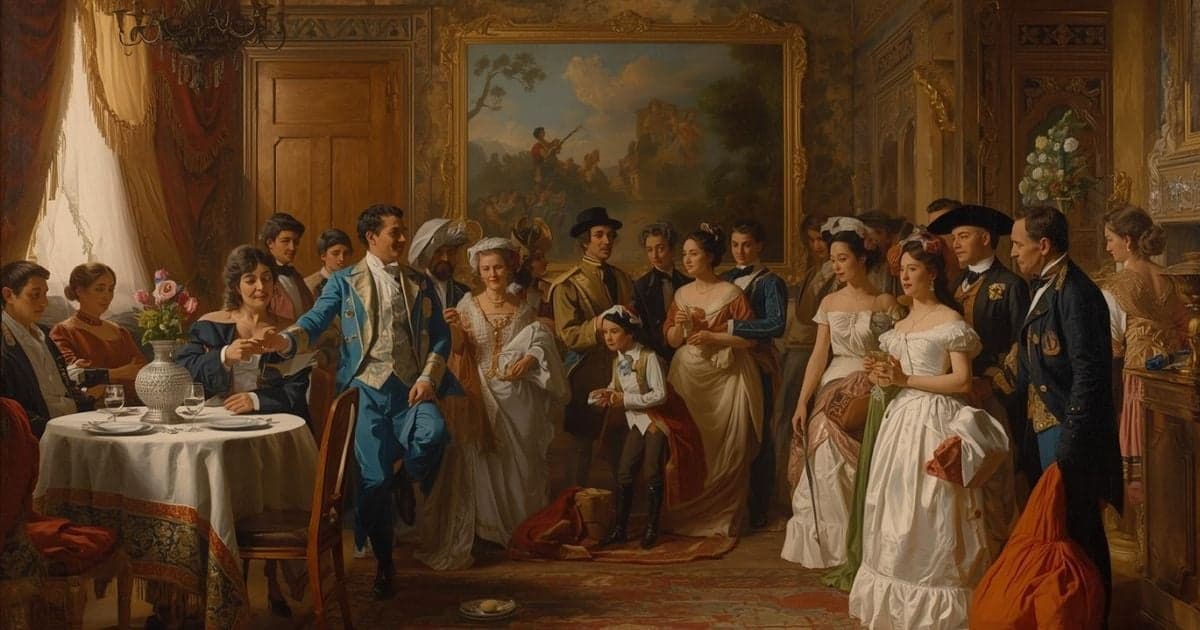
And what sort of persons do you expect to breakfast?” said Beauchamp. “A gentleman, and a diplomatist.” “Then we shall have to wait two hours for the gentleman, and three for the diplomatist. I shall come back to dessert; keep me some strawberries, coffee, and cigars. I shall take a cutlet on my way to the Chamber.” “Do not do anything of the sort; for were the gentleman a Montmorency, and the diplomatist a Metternich, we will breakfast at eleven; in the meantime, follow Debray’s example, and take a glass of sherry and a biscuit.” “Be it so; I will…
Public-domain chapter text, formatted for reading.
Master this chapter. Complete your experience
Purchase the complete book to access all chapters and support classic literature
Available in paperback, hardcover, and e-book formats
Now let's explore the literary elements.
Key Quotes & Analysis
"Punctuality,” said Monte Cristo, “is the politeness of kings"
Context: The Count apologizes for arriving a few seconds after half past ten
He turns lateness into royalty while proving he controls the room's first impression.
In Today's Words:
The Count calls punctuality the politeness of kings while arriving after a journey of five hundred leagues. He frames timing as power, not courtesy. When someone makes precision part of their brand, check whether it builds trust or simply sets the terms. The pattern is not abstract. It appears whenever power, timing, and social ritual quietly decide what people treat as real.
"There is no Count of Monte Cristo"
Context: Paris friends dismiss Albert's story before the Count appears
Social registers deny what experience has already confirmed in Rome.
In Today's Words:
Debray insists there is no Count of Monte Cristo because the title does not appear in Paris registers. Bureaucratic reality often lags behind lived encounters. Do not confuse what society has filed with what has already changed your life. The pattern is not abstract. It appears whenever power, timing, and social ritual quietly decide what people treat as real.
"opium, which I fetched myself from Canton in order to have it pure"
Context: The Count explains his sleeping pills at breakfast
He normalizes chemical control of body and perception as casual table talk.
In Today's Words:
The Count says he fetched opium from Canton himself to keep it pure, then offers the recipe like a party trick. People with resources can medicate perception as casually as they travel. Notice when mastery over the body is presented as charm rather than warning.
"I never seek to protect a society which does not protect me"
Context: The Count explains why he helps bandits but rejects social duty rhetoric
He states the revenge ethic plainly while the table hears philosophy.
In Today's Words:
The Count says he never protects a society that failed to protect him, turning rescue into selective choice. That logic can feel honest after betrayal and dangerous in a group setting. Ask whether someone is explaining boundaries or rehearsing permission to harm. The pattern is not abstract. It appears whenever power, timing, and social ritual quietly decide what people treat as real.
Thematic Threads
Skepticism to silence
In This Chapter
Paris wits deny the Count exists until Germain announces him.
Development
Laughter dies once punctuality and presence match Albert's story.
In Your Life:
Groups often mock a warning until the warned-about person proves it in person.
Old debts resurfacing
In This Chapter
Morrel reacts to Thomson and French and keeps September fifth habits.
Development
Marseilles salvation enters Paris under another name.
In Your Life:
Financial and family histories can arrive in a room before anyone explains them aloud.
Selective morality
In This Chapter
The Count preaches egotism while freeing Albert and Peppino.
Development
He rescues individuals, not systems, and calls that consistency.
In Your Life:
People may justify helping friends while refusing any wider obligation.
You now have the context. Time to form your own thoughts.
Discussion Questions
This is not a test. Five prompts guide you through the chapter, from how it opens to how it closes, so you notice context and rhythm rather than facts to memorize. Sit with each question in your own words. When you see "One way to read it," treat it as a starting point, not the only answer.
- 1
Morrel says he celebrates September 5 because his father was saved that day, then tells how he rescued Château-Renaud in Africa. Why link those two rescues in one breakfast?
analysis • surfaceOne way to read it
One way to read it: Morrel treats deliverance as a family date. He repays fortune by saving others when the calendar turns.
- 2
Albert's friends doubt bandits, vampires, and even the count's title until he arrives on the stroke of half past ten. What shifts when the story becomes a person at the door?
analysis • mediumOne way to read it
One way to read it: mockery stops at manners and punctuality. The narrative was fantasy until Monte Cristo walks in dressed like any first-rate Parisian.
- 3
The count names hashish and opium from an emerald box and says Franz tasted them at Rome. How does revealing a secret to one guest affect the whole table?
application • mediumOne way to read it
One way to read it: he binds Albert's tale to proof only Franz can confirm. Wonder and unease spread together; the count controls what each man knows.
- 4
When Monte Cristo mentions Thomson and French, Morrel starts as if shocked. What might that banking name mean to a Morrel that Paris society does not yet see?
application • deepOne way to read it
One way to read it: the house tied to his father's rescue still lives in his memory. The count touches Marseilles before anyone knows he was Edmond's heir.
- 5
The count says he never protects a society that failed to protect him, yet he freed Peppino and Albert. How do you square his egotism speech with those acts?
reflection • deepOne way to read it
One way to read it: he helps on his terms, for debts and plans, not from civic duty. Morrel catches the gap; Albert hears only charisma.
Critical Thinking Exercise
Map Your Reinvention Risk
Think about a time when you gained new status, knowledge, or influence - a promotion, degree, skill, or social position. Draw two columns: 'What I Gained' and 'What I Risk Losing.' In the first column, list the practical benefits. In the second, identify relationships, values, or parts of yourself that could be compromised. Then circle the items in column two that matter most to you.
Consider:
- •Consider how your communication style changes when you feel powerful versus vulnerable
- •Notice which relationships become more difficult to maintain as you gain status
- •Think about whether you're becoming someone others admire but can't connect with
Journaling Prompt
Write about someone you know who gained power or status and seemed to lose touch with who they used to be. What specific changes did you notice? How did it affect your relationship with them? What would you do differently in their position?
Coming Up Next...
Chapter 41: The Presentation
With the other guests gone, Albert will show the Count his bachelor pavilion room by room, opening windows and collections while the man who just dominated breakfast studies what Morcerf taste looks like up close.