Chapter 07
Standing Your Ground Under Fire
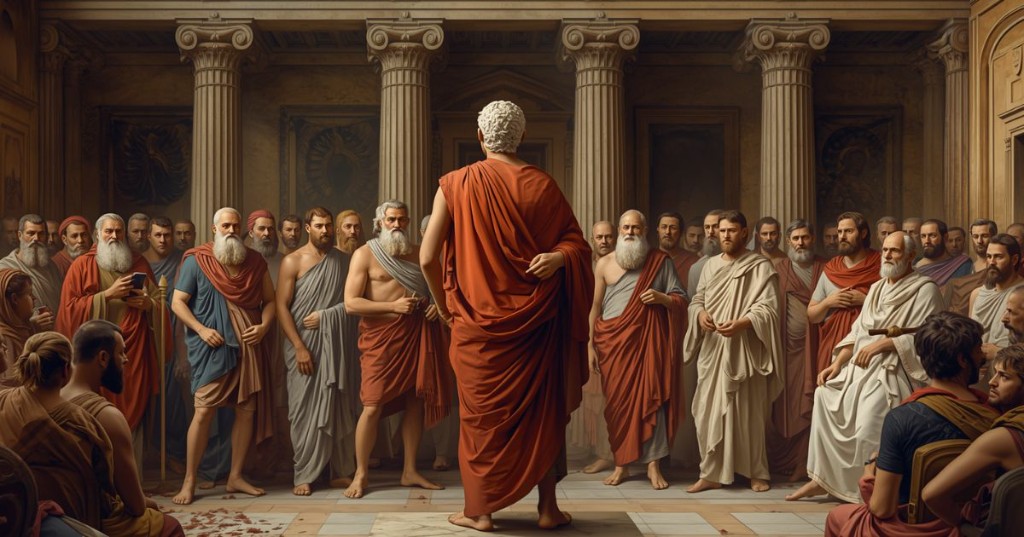
I have said enough in answer to the charge of Meletus: any elaborate defence is unnecessary, but I know only too well how many are the enmities which I have incurred, and this is what will be my destruction if I am destroyed;—not Meletus, nor yet Anytus, but the envy and detraction of the world, which has been the death of many good men, and will probably be the death of many more; there is no danger of my being the last of them. Some one will say: And are you not ashamed, Socrates, of a course of life which…
Public-domain chapter text, formatted for reading.
Master this chapter. Complete your experience
Purchase the complete book to access all chapters and support classic literature
Available in paperback, hardcover, and e-book formats
Now let's explore the literary elements.
Key Quotes & Analysis
"not Meletus, nor yet Anytus, but the envy and detraction of the world, which has been the death of many good men, and will probably be the death of many more; there is no danger of my being the last of them."
Context: Naming the real force behind his trial after answering the formal charges
The prosecution is surface; public hostility toward questioners is the deeper pattern.
In Today's Words:
Socrates says envy and detraction of the world will destroy him if he is destroyed, not Meletus or Anytus alone. Many good men have died that way before and more will follow. When a formal case feels personal, ask what cultural hostility the paperwork is riding on.
"a man who is good for anything ought not to calculate the chance of living or dying; he ought only to consider whether in doing anything he is doing right or wrong—acting the part of a good man or of a bad."
Context: Answering the charge that he should be ashamed of a life leading to death
Moral judgment and survival math are different operations; character asks whether an act is right, not safe.
In Today's Words:
A person worth anything should not calculate living or dying; he should ask only whether he is doing right or wrong. Socrates rejects shame about an early death and points to Achilles choosing honor over safety. Before you choose comfort, ask whether the action fits the person you mean to be.
"I shall obey God rather than you, and while I have life and strength I shall never cease from the practice and teaching of philosophy, exhorting any one whom I meet and saying to him after my manner: You, my friend,—a citizen of the great and mighty and wise city of Athens,—are you not ashamed of heaping up the greatest amount of money and honour and reputation, and caring so little about wisdom and truth and the greatest improvement of the soul, which you never regard or heed at all? And if the person with whom I am arguing, says: Yes, but I do care; then I do not leave him or let him go at once; but I proceed to interrogate and examine and cross-examine him, and if I think that he has no virtue in him, but only says that he has, I reproach him with undervaluing the greater, and overvaluing the less."
Context: Rejecting a hypothetical acquittal if he would stop questioning
Freedom with a gag order is not freedom; he will not trade his mission for survival.
In Today's Words:
Socrates honors Athens but will obey God rather than the court and never cease philosophizing while he has life and strength. He rejects acquittal on condition he stop examining people about virtue and the soul. When relief requires you to stop doing the work that defines you, name that trade before you accept it.
"virtue is not given by money, but that from virtue comes money and every other good of man, public as well as private."
Context: Stating the teaching he is accused of giving the young
If this doctrine corrupts, he owns the charge; his teaching puts soul before wealth.
In Today's Words:
Socrates tells Athenians that virtue is not bought with money; from virtue come money and every other good. He exhorts them to care for wisdom and the soul before persons or properties. If that is the teaching that corrupts youth, he accepts the label rather than reverse the priority.
Thematic Threads
Purpose
In This Chapter
Socrates reveals his divine mission as Athens' philosophical challenger, a calling he refuses to abandon despite death threats
Development
Evolution from earlier defensive arguments to clear declaration of life purpose
In Your Life:
You might recognize this when a job, relationship, or situation demands you compromise something fundamental to who you are
Courage
In This Chapter
Socrates draws parallels between his military service and philosophical mission, showing consistent bravery across contexts
Development
Building on earlier themes of intellectual honesty to reveal moral courage
In Your Life:
You might need this when standing up to authority figures who demand you violate your principles
Social Expectations
In This Chapter
Socrates rejects the expected response of begging for mercy or promising to change his ways
Development
Deepening from earlier challenges to social norms into outright refusal to conform
In Your Life:
You might face this when family or community expects you to stay quiet about problems you feel compelled to address
Wisdom
In This Chapter
Socrates admits ignorance about death while claiming certainty about the evil of injustice and disobedience to higher authority
Development
Continuation of his theme of knowing what he doesn't know, now applied to ultimate questions
In Your Life:
You might apply this by focusing on what you can control and know rather than worrying about unknowable outcomes
Identity
In This Chapter
Socrates defines himself completely through his philosophical mission, making it inseparable from his existence
Development
Culmination of earlier identity themes into complete integration of role and self
In Your Life:
You might experience this when discovering work or activities that feel like calling rather than just jobs
You now have the context. Time to form your own thoughts.
Discussion Questions
This is not a test. Five prompts guide you through the chapter, from how it opens to how it closes, so you notice context and rhythm rather than facts to memorize. Sit with each question in your own words. When you see "One way to read it," treat it as a starting point, not the only answer.
- 1
What does Socrates say is more likely to destroy him than Meletus or Anytus?
analysis • surfaceOne way to read it
The envy and detraction of the world, which has been the death of many good men and will probably be the death of many more.
- 2
How does Socrates use Achilles to answer the charge that he should be ashamed of facing death?
analysis • mediumOne way to read it
Achilles chose to avenge Patroclus knowing he would die, fearing dishonor more than death; a man should remain at his post and think of disgrace, not death.
- 3
What would Socrates do if the jury offered acquittal on condition he stop philosophizing?
application • mediumOne way to read it
He would refuse: he honors Athens but will obey God rather than the court and never cease examining citizens about virtue and the soul.
- 4
Why does Socrates compare his military service at Potidaea and Delium to his philosophical mission?
application • deepOne way to read it
He remained where generals placed him in war; it would be strange to desert the post God assigned him now out of fear of death.
- 5
What non-negotiable would you refuse to trade even for safety?
reflection • deepOne way to read it
Socrates will not stop examining lives even if he must die many times; your answer might name integrity, truth-telling, or care for others over quiet survival.
Critical Thinking Exercise
Map Your Non-Negotiables
List three principles you absolutely will not compromise, even if it costs you something important. For each principle, write down a specific situation where you might be pressured to abandon it. Then describe what 'holding your position' would look like in that scenario, using Socrates' military analogy.
Consider:
- •Think about areas where you've already shown courage in smaller situations
- •Consider what consequences you could actually live with versus what would destroy your self-respect
- •Remember that principled stands often protect or serve others, even when they don't thank you for it
Journaling Prompt
Write about a time when you compromised a principle for safety or convenience. What did that cost you internally? How would you handle the same situation now?
Coming Up Next...
Chapter 8: The Gadfly's Final Stand
Socrates warns the jury that killing him will hurt them more than it hurts him. He's about to explain why removing a gadfly like himself damages the very people who think they're protecting themselves.