Wide Reads
Literature MattersLife IndexEducators
Sign in
Where to Begin

Facing Death with Dignity — The Apology

The Apology - Facing Death with Dignity

Plato

The Apology

Facing Death with Dignity

Home›Books›The Apology›Chapter 10: Facing Death with Dignity
Previous
10 of 10

Summary

Facing Death with Dignity

The Apology by Plato

0:000:00

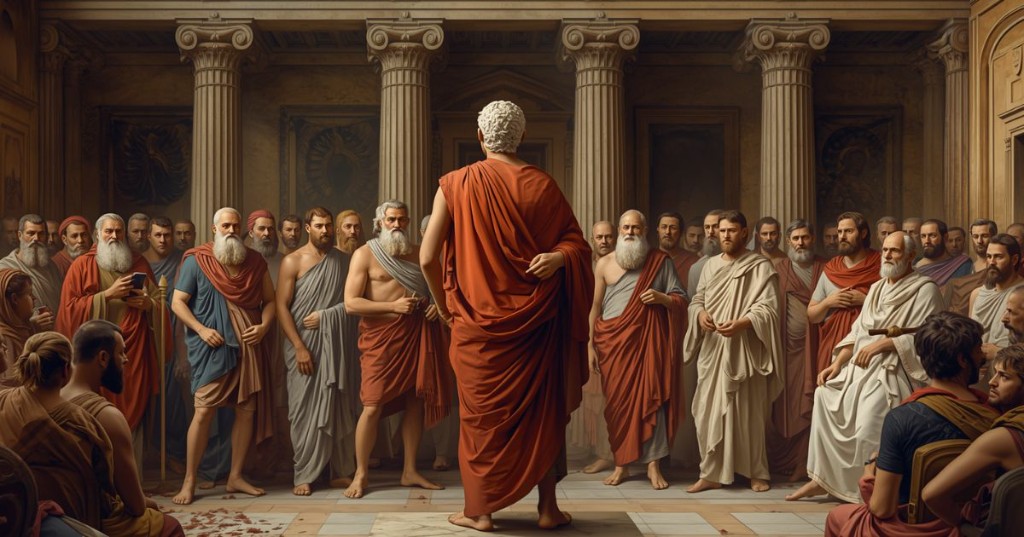
Socrates is not grieved by the condemnation. The vote was closer than he expected; thirty ballots the other way would have acquitted him, and Meletus alone would have failed without Anytus and Lycon. Meletus proposes death. Socrates asks what penalty fits a life spent exhorting Athens to virtue rather than pursuing wealth and office. Maintenance in the Prytaneum, he says, would be just; an Olympic victor gets less good done. He will not propose an evil penalty out of fear. Imprisonment, exile, and silenced exile all fail: other cities would drive him out, and he cannot hold his tongue because daily discourse about virtue is the greatest human good and the unexamined life is not worth living. His friends offer thirty minae as surety. To those who condemned him he says he would rather die speaking as he did than live by weeping and begging. The difficulty is not to avoid death but to avoid unrighteousness; his accusers have been overtaken by the faster runner. He prophesies that killing him will not silence examination: younger accusers will hound them, and Athens will gain an evil name for murdering a man others call wise. To those who would have acquitted him he notes a wonder: his divine sign, which usually stops him from error, said nothing all day. If death were evil, it would have warned him. Death may be dreamless sleep, which is gain, or a journey to true judges and poets and heroes, where questioning continues and no one is put to death for asking. No evil can happen to a good man in life or after death. He asks his friends to trouble his sons as he troubled Athens if they care for riches over virtue or pretend to be something when they are nothing. The hour of departure has arrived: he goes to die, they to live. Which is better, God only knows.

In this chapter: Terms Characters Key Quotes Themes Modern Story

Why This Matters

Connect literature to life

Skill: Distinguishing Negotiable from Non-Negotiable Values

After the verdict, pressure shifts from persuasion to survival tactics. Socrates refuses exile with silence because the unexamined life is not worth living, tells condemners that unrighteousness is harder to outrun than death, and ends by asking friends to hold his sons to the same standard he held Athens. The chapter teaches you which values still govern you once the outcome is fixed, and which compromises would make the loss mean something worse than the verdict itself.

Share it with friends

Previous Chapter
Original text
complete·2,724 words

Chapter 10

Facing Death with Dignity

There are many reasons why I am not grieved, O men of Athens, at the vote of condemnation. I expected it, and am only surprised that the votes are so nearly equal; for I had thought that the majority against me would have been far larger; but now, had thirty votes gone over to the other side, I should have been acquitted. And I may say, I think, that I have escaped Meletus. I may say more; for without the assistance of Anytus and Lycon, any one may see that he would not have had a fifth part of the votes, as the law requires, in which case he would have incurred a fine of a thousand drachmae.

And so he proposes death as the penalty. And what shall I propose on my part, O men of Athens? Clearly that which is my due. And what is my due? What return shall be made to the man who has never had the wit to be idle during his whole life; but has been careless of what the many care for—wealth, and family interests, and military offices, and speaking in the assembly, and magistracies, and plots, and parties. Reflecting that I was really too honest a man to be a politician and live, I did not go where I could do no good to you or to myself; but where I could do the greatest good privately to every one of you, thither I went, and sought to persuade every man among you that he must look to himself, and seek virtue and wisdom before he looks to his private interests, and look to the state before he looks to the interests of the state; and that this should be the order which he observes in all his actions. What shall be done to such an one? Doubtless some good thing, O men of Athens, if he has his reward; and the good should be of a kind suitable to him. What would be a reward suitable to a poor man who is your benefactor, and who desires leisure that he may instruct you? There can be no reward so fitting as maintenance in the Prytaneum, O men of Athens, a reward which he deserves far more than the citizen who has won the prize at Olympia in the horse or chariot race, whether the chariots were drawn by two horses or by many. For I am in want, and he has enough; and he only gives you the appearance of happiness, and I give you the reality. And if I am to estimate the penalty fairly, I should say that maintenance in the Prytaneum is the just return.

Perhaps you think that I am braving you in what I am saying now, as in what I said before about the tears and prayers. But this is not so. I speak rather because I am convinced that I never intentionally wronged any one, although I cannot convince you—the time has been too short; if there were a law at Athens, as there is in other cities, that a capital cause should not be decided in one day, then I believe that I should have convinced you. But I cannot in a moment refute great slanders; and, as I am convinced that I never wronged another, I will assuredly not wrong myself. I will not say of myself that I deserve any evil, or propose any penalty. Why should I? because I am afraid of the penalty of death which Meletus proposes? When I do not know whether death is a good or an evil, why should I propose a penalty which would certainly be an evil? Shall I say imprisonment? And why should I live in prison, and be the slave of the magistrates of the year—of the Eleven? Or shall the penalty be a fine, and imprisonment until the fine is paid? There is the same objection. I should have to lie in prison, for money I have none, and cannot pay. And if I say exile (and this may possibly be the penalty which you will affix), I must indeed be blinded by the love of life, if I am so irrational as to expect that when you, who are my own citizens, cannot endure my discourses and words, and have found them so grievous and odious that you will have no more of them, others are likely to endure me. No indeed, men of Athens, that is not very likely. And what a life should I lead, at my age, wandering from city to city, ever changing my place of exile, and always being driven out! For I am quite sure that wherever I go, there, as here, the young men will flock to me; and if I drive them away, their elders will drive me out at their request; and if I let them come, their fathers and friends will drive me out for their sakes.

Some one will say: Yes, Socrates, but cannot you hold your tongue, and then you may go into a foreign city, and no one will interfere with you? Now I have great difficulty in making you understand my answer to this. For if I tell you that to do as you say would be a disobedience to the God, and therefore that I cannot hold my tongue, you will not believe that I am serious; and if I say again that daily to discourse about virtue, and of those other things about which you hear me examining myself and others, is the greatest good of man, and that the unexamined life is not worth living, you are still less likely to believe me. Yet I say what is true, although a thing of which it is hard for me to persuade you. Also, I have never been accustomed to think that I deserve to suffer any harm. Had I money I might have estimated the offence at what I was able to pay, and not have been much the worse. But I have none, and therefore I must ask you to proportion the fine to my means. Well, perhaps I could afford a mina, and therefore I propose that penalty: Plato, Crito, Critobulus, and Apollodorus, my friends here, bid me say thirty minæ, and they will be the sureties. Let thirty minæ be the penalty; for which sum they will be ample security to you.

Not much time will be gained, O Athenians, in return for the evil name which you will get from the detractors of the city, who will say that you killed Socrates, a wise man; for they will call me wise, even although I am not wise, when they want to reproach you. If you had waited a little while, your desire would have been fulfilled in the course of nature. For I am far advanced in years, as you may perceive, and not far from death. I am speaking now not to all of you, but only to those who have condemned me to death. And I have another thing to say to them: you think that I was convicted because I had no words of the sort which would have procured my acquittal—I mean, if I had thought fit to leave nothing undone or unsaid. Not so; the deficiency which led to my conviction was not of words—certainly not. But I had not the boldness or impudence or inclination to address you as you would have liked me to do, weeping and wailing and lamenting, and saying and doing many things which you have been accustomed to hear from others, and which, as I maintain, are unworthy of me. I thought at the time that I ought not to do anything common or mean when in danger: nor do I now repent of the style of my defence; I would rather die having spoken after my manner, than speak in your manner and live. For neither in war nor yet at law ought I or any man to use every way of escaping death. Often in battle there can be no doubt that if a man will throw away his arms, and fall on his knees before his pursuers, he may escape death; and in other dangers there are other ways of escaping death, if a man is willing to say and do anything. The difficulty, my friends, is not to avoid death, but to avoid unrighteousness; for that runs faster than death. I am old and move slowly, and the slower runner has overtaken me, and my accusers are keen and quick, and the faster runner, who is unrighteousness, has overtaken them. And now I depart hence condemned by you to suffer the penalty of death,—they too go their ways condemned by the truth to suffer the penalty of villainy and wrong; and I must abide by my award—let them abide by theirs. I suppose that these things may be regarded as fated,—and I think that they are well.

And now, O men who have condemned me, I would fain prophesy to you; for I am about to die, and in the hour of death men are gifted with prophetic power. And I prophesy to you who are my murderers, that immediately after my departure punishment far heavier than you have inflicted on me will surely await you. Me you have killed because you wanted to escape the accuser, and not to give an account of your lives. But that will not be as you suppose: far otherwise. For I say that there will be more accusers of you than there are now; accusers whom hitherto I have restrained: and as they are younger they will be more inconsiderate with you, and you will be more offended at them. If you think that by killing men you can prevent some one from censuring your evil lives, you are mistaken; that is not a way of escape which is either possible or honourable; the easiest and the noblest way is not to be disabling others, but to be improving yourselves. This is the prophecy which I utter before my departure to the judges who have condemned me.

Friends, who would have acquitted me, I would like also to talk with you about the thing which has come to pass, while the magistrates are busy, and before I go to the place at which I must die. Stay then a little, for we may as well talk with one another while there is time. You are my friends, and I should like to show you the meaning of this event which has happened to me. O my judges—for you I may truly call judges—I should like to tell you of a wonderful circumstance. Hitherto the divine faculty of which the internal oracle is the source has constantly been in the habit of opposing me even about trifles, if I was going to make a slip or error in any matter; and now as you see there has come upon me that which may be thought, and is generally believed to be, the last and worst evil. But the oracle made no sign of opposition, either when I was leaving my house in the morning, or when I was on my way to the court, or while I was speaking, at anything which I was going to say; and yet I have often been stopped in the middle of a speech, but now in nothing I either said or did touching the matter in hand has the oracle opposed me. What do I take to be the explanation of this silence? I will tell you. It is an intimation that what has happened to me is a good, and that those of us who think that death is an evil are in error. For the customary sign would surely have opposed me had I been going to evil and not to good.

Let us reflect in another way, and we shall see that there is great reason to hope that death is a good; for one of two things—either death is a state of nothingness and utter unconsciousness, or, as men say, there is a change and migration of the soul from this world to another. Now if you suppose that there is no consciousness, but a sleep like the sleep of him who is undisturbed even by dreams, death will be an unspeakable gain. For if a person were to select the night in which his sleep was undisturbed even by dreams, and were to compare with this the other days and nights of his life, and then were to tell us how many days and nights he had passed in the course of his life better and more pleasantly than this one, I think that any man, I will not say a private man, but even the great king will not find many such days or nights, when compared with the others. Now if death be of such a nature, I say that to die is gain; for eternity is then only a single night. But if death is the journey to another place, and there, as men say, all the dead abide, what good, O my friends and judges, can be greater than this? If indeed when the pilgrim arrives in the world below, he is delivered from the professors of justice in this world, and finds the true judges who are said to give judgment there, Minos and Rhadamanthus and Aeacus and Triptolemus, and other sons of God who were righteous in their own life, that pilgrimage will be worth making. What would not a man give if he might converse with Orpheus and Musaeus and Hesiod and Homer? Nay, if this be true, let me die again and again. I myself, too, shall have a wonderful interest in there meeting and conversing with Palamedes, and Ajax the son of Telamon, and any other ancient hero who has suffered death through an unjust judgment; and there will be no small pleasure, as I think, in comparing my own sufferings with theirs. Above all, I shall then be able to continue my search into true and false knowledge; as in this world, so also in the next; and I shall find out who is wise, and who pretends to be wise, and is not. What would not a man give, O judges, to be able to examine the leader of the great Trojan expedition; or Odysseus or Sisyphus, or numberless others, men and women too! What infinite delight would there be in conversing with them and asking them questions! In another world they do not put a man to death for asking questions: assuredly not. For besides being happier than we are, they will be immortal, if what is said is true.

Wherefore, O judges, be of good cheer about death, and know of a certainty, that no evil can happen to a good man, either in life or after death. He and his are not neglected by the gods; nor has my own approaching end happened by mere chance. But I see clearly that the time had arrived when it was better for me to die and be released from trouble; wherefore the oracle gave no sign. For which reason, also, I am not angry with my condemners, or with my accusers; they have done me no harm, although they did not mean to do me any good; and for this I may gently blame them.

Still I have a favour to ask of them. When my sons are grown up, I would ask you, O my friends, to punish them; and I would have you trouble them, as I have troubled you, if they seem to care about riches, or anything, more than about virtue; or if they pretend to be something when they are really nothing,—then reprove them, as I have reproved you, for not caring about that for which they ought to care, and thinking that they are something when they are really nothing. And if you do this, both I and my sons will have received justice at your hands.

The hour of departure has arrived, and we go our ways—I to die, and you to live. Which is better God only knows.

Scroll vertically to read the full passage. Use Scroll to continue to move down roughly one screen inside the reader.

Master this chapter. Complete your experience

Purchase the complete book to access all chapters and support classic literature

Buy at Powell'sBuy on Amazon

Available in paperback, hardcover, and e-book formats

Now let's explore the literary elements.

Key Quotes & Analysis

"daily to discourse about virtue, and of those other things about which you hear me examining myself and others, is the greatest good of man, and that the unexamined life is not worth living,"

— Socrates

Context: Explaining why he cannot accept exile on condition of silence

This is not a self-help slogan. It is his reason for refusing a life that stops questioning. Philosophy is not optional equipment for him. It is the condition of a life worth keeping.

In Today's Words:

If I stop examining myself and others, the life you are offering me is not worth living.

"The difficulty, my friends, is not to avoid death, but to avoid unrighteousness; for that runs faster than death."

— Socrates

Context: Addressing the jury after the death sentence, reframing what truly overtakes a person

Death caught him because he is old and slow. His accusers were caught first by unrighteousness. The moral order he describes does not spare anyone.

In Today's Words:

Anyone can dodge death if they will do anything. The hard part is not becoming unjust.

"The hour of departure has arrived, and we go our ways—I to die, and you to live. Which is better God only knows."

— Socrates

Context: The final sentence of the Apology

He does not claim victory or martyrdom in the last line. He leaves the comparison open and hands the answer to God.

In Today's Words:

We are both walking into the unknown. I just know which road I take.

Thematic Threads

Class

In This Chapter

Socrates refuses to perform the expected lower-status behavior of begging for mercy, instead asserting his value to society

Development

Continues from earlier chapters where he challenged class-based assumptions about wisdom and virtue

In Your Life:

You might recognize this when you're expected to act grateful for poor treatment because of your job or economic position

Identity

In This Chapter

Socrates maintains his identity as a questioner and teacher even facing death, refusing to abandon who he is to save his life

Development

Culmination of his consistent refusal throughout the trial to be anyone other than himself

In Your Life:

You see this when pressure mounts to compromise your core values to keep a job or relationship

Social Expectations

In This Chapter

He completely defies expectations about how condemned men should behave, creating shock by suggesting rewards instead of punishment

Development

Final rebellion against social scripts that have constrained him throughout the trial

In Your Life:

You might face this when others expect you to react to bad news or consequences in a specific way

Personal Growth

In This Chapter

Socrates frames even death as potential learning opportunity, either peaceful rest or chance to question historical figures

Development

Shows his commitment to growth and learning extends beyond life itself

In Your Life:

You could apply this when facing major life changes that seem entirely negative but might contain hidden opportunities

Human Relationships

In This Chapter

He speaks separately to accusers and supporters, tailoring his message to what each group needs to hear

Development

Demonstrates sophisticated understanding of different relationships and responsibilities

In Your Life:

You see this when you need to address different groups who have different stakes in a situation you're facing

You now have the context. Time to form your own thoughts.

Discussion Questions

  1. 1

    Instead of begging for mercy or proposing exile, Socrates suggests Athens should give him free meals for life. What message is he sending about his own worth and his work?

    analysis • surface
  2. 2

    Socrates warns his accusers that killing him will bring them more problems, not fewer. Why does he think silencing critics backfires?

    analysis • medium
  3. 3

    Think about someone you know who faced serious consequences with dignity rather than desperation. What did their response accomplish that begging or anger wouldn't have?

    application • medium
  4. 4

    Socrates finds two ways death could be good for him: peaceful sleep or continuing his work in another realm. How does reframing consequences change your power in difficult situations?

    application • deep
  5. 5

    Socrates asks his friends to hold his sons accountable the same way he held Athens accountable. What does this reveal about how he views his life's purpose, even facing death?

    reflection • deep

Critical Thinking Exercise

10 minutes

Practice the Dignity Response

Think of a current situation where you're facing consequences or criticism. Write two responses: first, what you want to say when you're angry or defensive. Second, rewrite it using Socrates' approach: acknowledge the situation, maintain your values, focus on what you can control, and consider what message you want to send about who you are.

Consider:

  • •What can you still control in this situation, even if you can't control the outcome?
  • •What would a dignified response accomplish that fighting or begging wouldn't?
  • •How might accepting consequences gracefully open doors that resistance would close?

Journaling Prompt

Write about a time when you handled consequences well or wish you had handled them differently. What did you learn about maintaining your values under pressure?

Previous
Dignity Over Desperation
Contents
Keep exploring

Continue Exploring

Study guides, teaching tools, themes, and the full library.More ways to read The Apology: study guides, teaching tools, and the wider library.

  • The Apology Study Guide
  • Teaching Resources
  • Essential Life Index
  • Browse by Theme
  • All Books

You Might Also Like

The Republic cover

The Republic

Plato

Also by Plato

Jane Eyre cover

Jane Eyre

Charlotte Brontë

Explores personal growth

Great Expectations cover

Great Expectations

Charles Dickens

Explores personal growth

The Strange Case of Dr Jekyll and Mr Hyde cover

The Strange Case of Dr Jekyll and Mr Hyde

Robert Louis Stevenson

Explores personal growth

Browse all 47+ books

Share This Chapter

Know someone who'd enjoy this? Spread the wisdom!

TwitterFacebookLinkedInEmail

Go further with Prestige

Unlock study guides and downloads, early access, and exclusive content — and support free access for everyone.

Subscribe to PrestigeCreate free account
Intelligence Amplifier
Intelligence Amplifier™Powering Wide Reads

Exploring human-AI collaboration through books, essays, and philosophical dialogues. Classic literature transformed into navigational maps for modern life.

2025 Books

→ The Amplified Human Spirit→ The Alarming Rise of Stupidity Amplified→ San Francisco: The AI Capital of the World
Visit intelligenceamplifier.org
hello@widereads.com

WideReads Originals

→ You Are Not Lost→ The Last Chapter First→ The Lit of Love→ Wealth and Poverty→ 10 Paradoxes in the Classics · coming soon
Arvintech
arvintechAmplify your Mind
Visit at arvintech.com

Navigate

  • Home
  • Library
  • Essential Life Index
  • How It Works
  • Subscribe
  • Account
  • About
  • Contact
  • Authors
  • Suggest a Book
  • Landings

Made For You

  • Trending
  • Students
  • Educators
  • Families
  • Readers
  • Literary Analysis
  • Finding Purpose
  • Letting Go
  • Recovering from a Breakup
  • Corruption
  • Gaslighting in the Classics

Newsletter

Weekly insights from the classics. Amplify Your Mind.

Legal

  • Privacy Policy
  • Terms of Service
  • Cookie Policy
  • Accessibility

Why Public Domain?

We focus on public domain classics because these timeless works belong to everyone. No paywalls, no restrictions—just wisdom that has stood the test of centuries, freely accessible to all readers.

Public domain books have shaped humanity's understanding of love, justice, ambition, and the human condition. By amplifying these works, we help preserve and share literature that truly belongs to the world.

A Pilgrimage

Powell's City of Books

Portland, Oregon

If you ever find yourself in Portland, walk to the corner of Burnside and 10th. The building takes up an entire city block. Inside is over a million books, new and used on the same shelf, organized by color-coded rooms with names like the Rose Room and the Pearl Room. You can lose an afternoon. You can lose a weekend. You will find a book you have been looking for your whole life, and three you did not know existed.

It is a pilgrimage. We cannot find a bookstore like it anywhere on earth. If you read the classics, and you ever get the chance, go. It belongs on every reader's bucket list.

Visit powells.com

We are not in any way affiliated with Powell's. We are just a very big fan.

© 2026 Wide Reads™. All Rights Reserved.

Intelligence Amplifier™ and Wide Reads™ are proprietary trademarks of Arvin Lioanag.

Copyright Protection: All original content, analyses, discussion questions, pedagogical frameworks, and methodology are protected by U.S. and international copyright law. Unauthorized reproduction, distribution, web scraping, or use for AI training is strictly prohibited. See our Copyright Notice for details.

Disclaimer: The information provided on this website is for general informational and educational purposes only and does not constitute professional, legal, financial, or technical advice. While we strive to ensure accuracy and relevance, we make no warranties regarding completeness, reliability, or suitability. Any reliance on such information is at your own risk. We are not liable for any losses or damages arising from use of this site. By using this site, you agree to these terms.