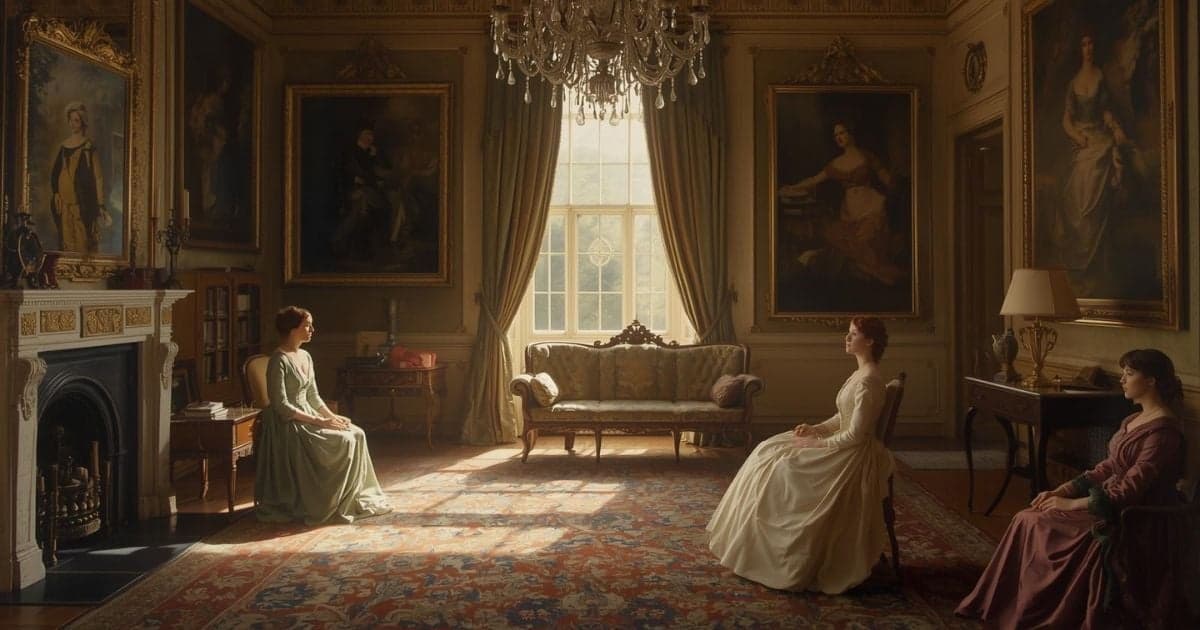
Elizabeth tours Pemberley expecting Darcy absent and finds the estate, and everyone who keeps it, arguing against every story she has believed about its master. She enters Pemberley Woods in a flutter and at the first view feels that to be mistress of Pemberley might be something. The house delights her, taste without gaudiness, though she recollects her uncle and aunt could never have been welcomed there as visitors.
Mrs. Reynolds shows the rooms; Wickham's miniature shocks Elizabeth; Darcy is absent but expected tomorrow, and Elizabeth rejoices they came today. The housekeeper's praise astonishes her: no cross word since he was four, sweetest temper as a boy, best landlord and best master, affable to the poor. Elizabeth almost stares: can this be Mr. Darcy? In the gallery she studies the portrait's smile until a gentler sensation than she has ever known softens the memory of his regard and the insult of his proposal at Hunsford.
On the lawn Mr. Darcy appears a day early; they blush, he speaks with altered civility, and leaves abruptly after repeated awkward questions. Elizabeth is overpowered by shame: had they been ten minutes sooner, she would never have been seen visiting his estate uninvited, and his altered civility only deepens the puzzle. When they meet again on the walk he asks to be introduced to the Gardiners, invites her uncle to fish, walks beside her while explaining steward business brought him ahead of his party, names Bingley among tomorrow's visitors, and requests leave to introduce his sister at Lambton.
The Gardiners find him polite, attentive, and nothing like the proud man Elizabeth described. Her uncle calls him perfectly well-behaved; her aunt agrees the housekeeper's praise now seems plausible. Elizabeth vindicates his conduct toward Wickham in guarded terms, relating the pecuniary history without naming her authority. Mrs. Gardiner notes the housekeeper's flaming praise and the puzzle of Wickham's story. Elizabeth ends the day thinking with wonder of his civility and, above all, of his wishing her to be acquainted with his sister. She cannot yet name love, but she can no longer read him only through Wickham's story or the sharp contempt she voiced at Kent.