Chapter 62
A Father's Desperate Love
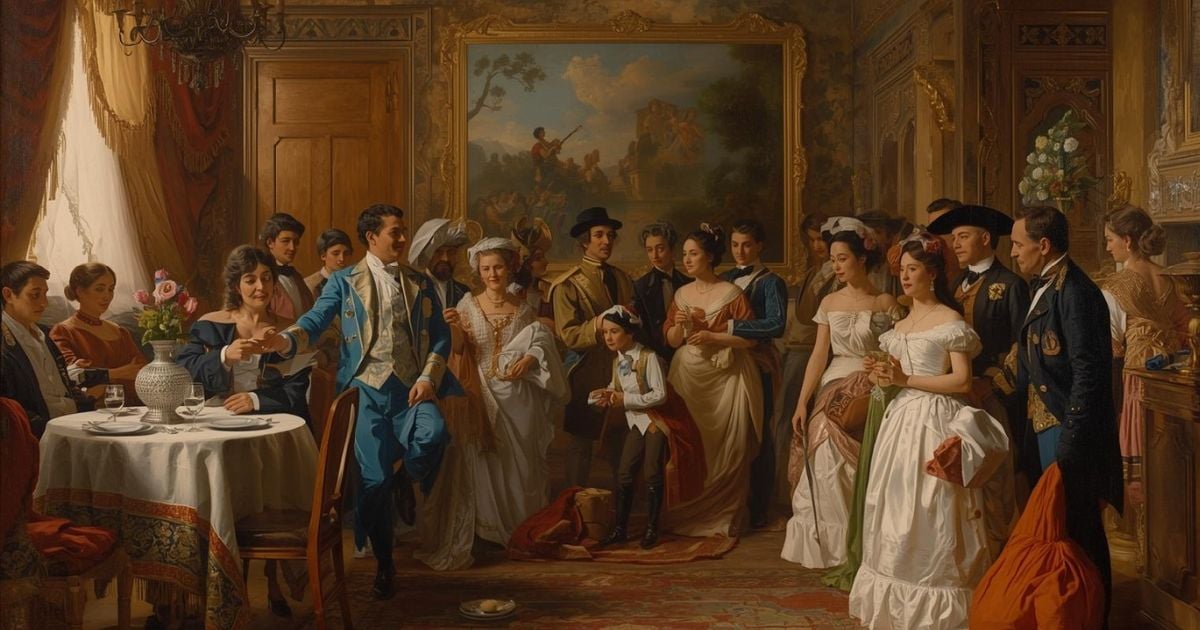
Padre Damaso Explains Vainly were the rich wedding presents heaped upon a table; neither the diamonds in their cases of blue velvet, nor the piña embroideries, nor the rolls of silk, drew the gaze of Maria Clara. Without reading or even seeing it the maiden sat staring at the newspaper which gave an account of the death of Ibarra, drowned in the lake. Suddenly she felt two hands placed over her eyes to hold her fast and heard Padre Damaso's voice ask merrily, "Who am I? Who am I?" Maria Clara sprang from her seat and gazed at him in…
Public-domain chapter text, formatted for reading.
Master this chapter. Complete your experience
Purchase the complete book to access all chapters and support classic literature
Available in paperback, hardcover, and e-book formats
Now let's explore the literary elements.
Key Quotes & Analysis
"Who am I? Who am I?"
Context: Surprising Maria Clara before her wedding
Playful godfather tone collides with grief. Merriment opens the scene that will unmask his love.
In Today's Words:
Damaso covers Maria Clara's eyes merrily asking who am I who am I as he arrives for the wedding. The same pattern still appears when corrupt institutions punish honesty, reward flattery, and teach people to mistake cruelty for order or tradition. The same pattern still appears when corrupt institutions punish honesty, reward flattery, and teach
"protect my father and break off my marriage!"
Context: Kneeling before Damaso
Ultimatum born of reported death. She trades wedding for convent to shield father and lost love.
In Today's Words:
Maria Clara begs her godfather to protect her father and break off her marriage to Linares. The same pattern still appears when corrupt institutions punish honesty, reward flattery, and teach people to mistake cruelty for order or tradition. The same pattern still appears when corrupt institutions punish honesty, reward flattery, and teach people to mistake
"I love you as one loves his own daughter!"
Context: Confessing motives behind his cruelty
Destructive love finally named. Colonial paternalism admits obsession without legitimacy.
In Today's Words:
Damaso weeps that he loves Maria Clara as one loves his own daughter while explaining his acts. The same pattern still appears when corrupt institutions punish honesty, reward flattery, and teach people to mistake cruelty for order or tradition. The same pattern still appears when corrupt institutions punish honesty, reward flattery, and teach people to
"The nunnery or death!"
Context: Refusing Linares after Ibarra's reported drowning
Grief hardens into vow. Marriage to another man becomes unthinkable once love is pronounced dead.
In Today's Words:
Maria Clara tells Damaso she chooses the nunnery or death rather than wed Linares now. The same pattern still appears when corrupt institutions punish honesty, reward flattery, and teach people to mistake cruelty for order or tradition. The same pattern still appears when corrupt institutions punish honesty, reward flattery, and teach people to mistake cruelty
Thematic Threads
Control
In This Chapter
Damaso's confession reveals how his every action was designed to control Maria Clara's future while believing he was protecting her
Development
Evolved from subtle manipulation to complete revelation of systematic control disguised as paternal care
In Your Life:
You might recognize this when someone consistently overrides your choices 'for your own good.'
Identity
In This Chapter
Maria Clara's ultimatum—convent or death—represents her final attempt to reclaim agency over her own identity
Development
Culmination of her journey from passive acceptance to desperate assertion of self-determination
In Your Life:
You might face this when external pressures force you to choose between authenticity and survival.
Class
In This Chapter
Damaso's justification reveals how colonial class structure makes even love relationships about power and racial hierarchy
Development
Deepened from social observation to personal confession of how class fears drove every decision
In Your Life:
You might see this when family members push you toward 'safer' choices based on class anxieties.
Sacrifice
In This Chapter
Both characters sacrifice everything—Damaso his conscience, Maria Clara her happiness—for what they believe is a greater good
Development
Transformed from noble ideal to mutual destruction through competing definitions of sacrifice
In Your Life:
You might experience this when your sacrifices for others become a source of resentment rather than love.
Truth
In This Chapter
Damaso's forced confession shows how truth emerges only when all other options are exhausted
Development
Evolved from hidden motivations to painful revelation under extreme pressure
In Your Life:
You might encounter this when crisis finally forces honest conversations that should have happened years earlier.
You now have the context. Time to form your own thoughts.
Discussion Questions
This is not a test. Five prompts guide you through the chapter, from how it opens to how it closes, so you notice context and rhythm rather than facts to memorize. Sit with each question in your own words. When you see "One way to read it," treat it as a starting point, not the only answer.
- 1
Why does Maria Clara fix on the newspaper about Ibarra's death?
analysis • surfaceOne way to read it
Wedding gifts mean nothing once her love is pronounced drowned. Grief replaces the marriage her father arranged.
- 2
What does Damaso mean by saying he committed wrongs solely for Maria Clara?
analysis • mediumOne way to read it
He blocked Ibarra to spare her colonial humiliation and danger for native sons. Control masqueraded as protection.
- 3
Why does she choose the nunnery or death rather than Linares?
application • mediumOne way to read it
With Ibarra dead, marriage to another man is spiritual betrayal. Convent or tomb preserves her inner vow.
- 4
How does Damaso's final prayer change your view of him?
application • deepOne way to read it
He admits divine punishment and begs harm fall on him not her. Love is real yet twisted by colonial pride.
- 5
When have you seen someone harm others while insisting they were only protecting a loved one?
reflection • deepOne way to read it
Parents sabotaging relationships, managers 'protecting' workers by silencing them, or partners isolating mates mirror Damaso's destructive care.
Critical Thinking Exercise
Map Your Protection vs. Control Patterns
Think of a relationship where someone claims to protect you by making decisions for you, or where you do this for someone else. Draw two columns: 'What They Say They're Protecting Me From' and 'What I'm Actually Losing.' Then write what genuine protection would look like - giving tools and information instead of removing choices.
Consider:
- •Real protection builds your capacity to handle challenges, not your dependence on the protector
- •Notice the difference between sharing concerns and making ultimatums
- •Ask yourself: who benefits more from this 'protection' - you or them?
Journaling Prompt
Write about a time when someone's attempt to protect you actually limited your growth. How did it feel? What would you have preferred they do instead?
Coming Up Next...
Chapter 63: Christmas Eve Reunion and Final Sacrifice
On Christmas Eve wounded Basilio will descend from the mountain to seek mad Sisa; at the balete grove mother and son will reunite briefly before she dies and the fugitive Ibarra appears High on a mountain slope Basilio, healed among hunters but still lame, asks to descend on Christmas Eve and give his mother the gift of a living son. The grandfather blesses him.