Chapter 30
The Church Spectacle
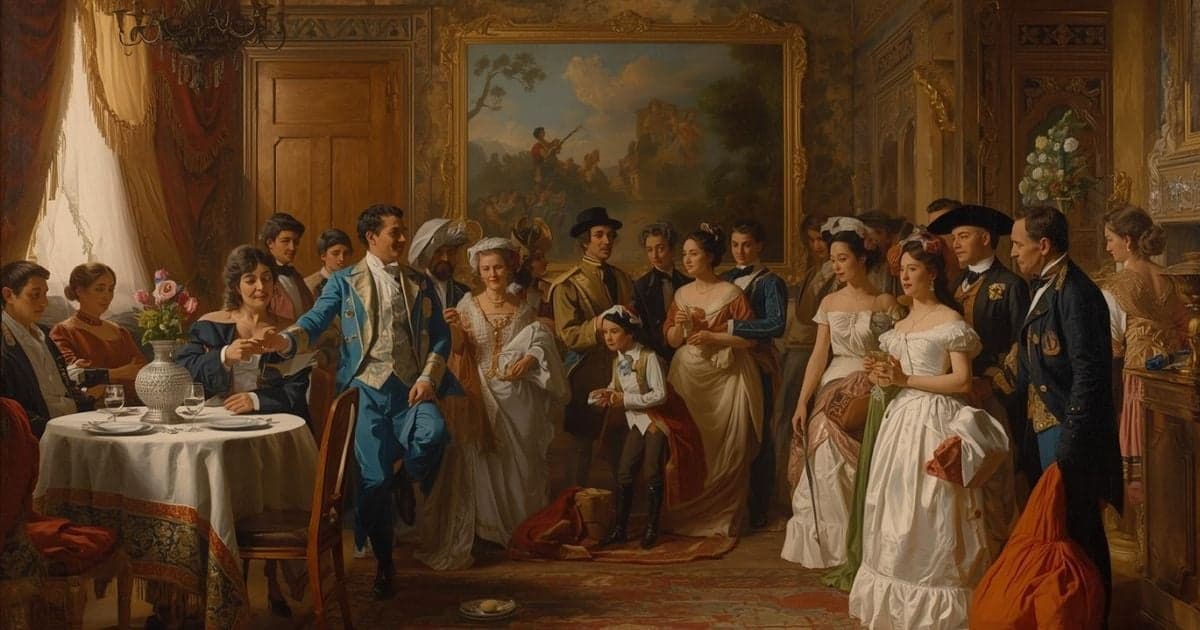
In the Church From end to end the huge barn that men dedicate as a home to the Creator of all existing things was filled with people. Pushing, crowding, and crushing one another, the few who were leaving and the many who were entering filled the air with exclamations of distress. Even from afar an arm would be stretched out to dip the fingers in the holy water, but at the critical moment the surging crowd would force the hand away. Then would be heard a complaint, a trampled woman would upbraid some one, but the pushing would continue. Some…
Public-domain chapter text, formatted for reading.
Master this chapter. Complete your experience
Purchase the complete book to access all chapters and support classic literature

Available in paperback, hardcover, and e-book formats
Now let's explore the literary elements.
Key Quotes & Analysis
"Two hundred and fifty pesos for a sermon!"
Context: Commenting on Damaso's fee
Economic absurdity punctures piety: one speech costs more than entertainment that lasts three nights.
In Today's Words:
The sage calculates aloud what the town pays Padre Damaso to preach once. The same pattern still appears when corrupt institutions punish honesty, reward flattery, and teach people to mistake cruelty for order or tradition. The same pattern still appears when corrupt institutions punish honesty, reward flattery, and teach people to mistake cruelty for order
"the color of slime"
Context: Describing holy water after thousands have touched it
Blessed water turns foul from crowd contact. Symbol matches institutional decay beneath pageantry.
In Today's Words:
Rizal notes the font water has become slimy from endless fingers dipping during the packed mass. The same pattern still appears when corrupt institutions punish honesty, reward flattery, and teach people to mistake cruelty for order or tradition. The same pattern still appears when corrupt institutions punish honesty, reward flattery, and teach people to mistake
"A civil-guard dressed as a comedian!"
Context: Mistaking the alcalde's uniform
Authority looks like last night's theater. Colonial power is performance common people read correctly.
In Today's Words:
A countryman thinks the governor is an actor because his gold braid resembles stage costume. The same pattern still appears when corrupt institutions punish honesty, reward flattery, and teach people to mistake cruelty for order or tradition. The same pattern still appears when corrupt institutions punish honesty, reward flattery, and teach people to mistake cruelty
"Attention, brother!"
Context: Preparing to preach
The bully friar commands the sacristan as performance begins. Anticipation crowns Damaso before words land.
In Today's Words:
Damaso tells his assistant to ready the massive sermon volume as he mounts the pulpit. The same pattern still appears when corrupt institutions punish honesty, reward flattery, and teach people to mistake cruelty for order or tradition. The same pattern still appears when corrupt institutions punish honesty, reward flattery, and teach people to mistake cruelty
Thematic Threads
Class
In This Chapter
The expensive sermon costs 250 pesos while families struggle, with seating arrangements reflecting social hierarchy
Development
Deepening from earlier chapters showing how economic inequality shapes every social interaction
In Your Life:
Notice how money determines access and treatment in healthcare, education, and community events
Performance
In This Chapter
Everyone from the alcalde to churchgoers puts on elaborate displays of devotion and status
Development
Introduced here as religious theater, building on earlier social pretenses
In Your Life:
Recognize when you're performing roles at work or family events instead of being authentic
Authority
In This Chapter
Religious and civil authorities use pageantry to maintain power and distance from ordinary people
Development
Expanding from individual corrupt officials to institutional corruption
In Your Life:
Question whether leaders' elaborate presentations serve you or just reinforce their position
Isolation
In This Chapter
Ibarra stands apart from the crowd's fevered devotion, unable to participate in the collective delusion
Development
Growing from his earlier social awkwardness to deeper alienation from community norms
In Your Life:
Sometimes maintaining your integrity means accepting that you won't fit in with group dynamics
Waste
In This Chapter
Resources that could feed families for months are spent on one sermon and religious spectacle
Development
Introduced here, highlighting misplaced priorities in resource allocation
In Your Life:
Notice when organizations spend lavishly on appearances while cutting essential services or support
You now have the context. Time to form your own thoughts.
Discussion Questions
This is not a test. Five prompts guide you through the chapter, from how it opens to how it closes, so you notice context and rhythm rather than facts to memorize. Sit with each question in your own words. When you see "One way to read it," treat it as a starting point, not the only answer.
- 1
Why does Rizal call the church a huge barn filled with pushing crowds?
analysis • surfaceOne way to read it
He deflates sacred architecture to bodily reality. Worship becomes crush, heat, and smell, not serenity.
- 2
What point is Tasio making by comparing the sermon fee to comedy?
analysis • mediumOne way to read it
The town pays more for one friar speech than multi-night entertainment. Spiritual price gouging exploits the poor.
- 3
How does the alcalde being mistaken for Prince Villardo comment on colonial authority?
application • mediumOne way to read it
Power dresses as theater and confuses peasants already watching plays. Authority and entertainment blur.
- 4
Why does Damaso wink at Ibarra before preaching?
application • deepOne way to read it
The gesture previews personal vendetta inside sacred space. Damaso treats the pulpit as weapon, not ministry.
- 5
When have you seen people go through religious or civic ritual without believing in it?
reflection • deepOne way to read it
Youth moistening fingers in holy water or attending mandatory ceremonies for appearance echo Rizal's crowded church.
Critical Thinking Exercise
Spot the Performance Theater
Think of a situation in your life where people spend time, money, or energy on elaborate displays rather than addressing real needs. Map out who benefits from the spectacle, who pays the costs, and what the original purpose was supposed to be. Then identify one small way you could focus on substance instead of show.
Consider:
- •Look for situations where the ritual has become more important than the result
- •Notice who has power to set the rules of the performance
- •Consider what would happen if someone quietly opted out of the theater
Journaling Prompt
Write about a time when you felt pressure to perform devotion, enthusiasm, or agreement in a group setting. How did you handle it, and what would you do differently now?
Coming Up Next...
Chapter 31: The Sermon
Padre Damaso finally takes the pulpit for his expensive sermon. What he says will shock some listeners and reveal the true nature of colonial religious authority. The opening of The Sermon will tighten the family's position faster than anyone at Norland expected, and the next scene will test whether good intentions survive polite pressure.