Wide Reads
Literature MattersLife IndexEducators
Sign in
Where to Begin
Middlemarch - Unexpected Encounters and Social Boundaries

George Eliot

Middlemarch

Unexpected Encounters and Social Boundaries

Home›Books›Middlemarch›Chapter 43
Previous
43 of 86
Next

Summary

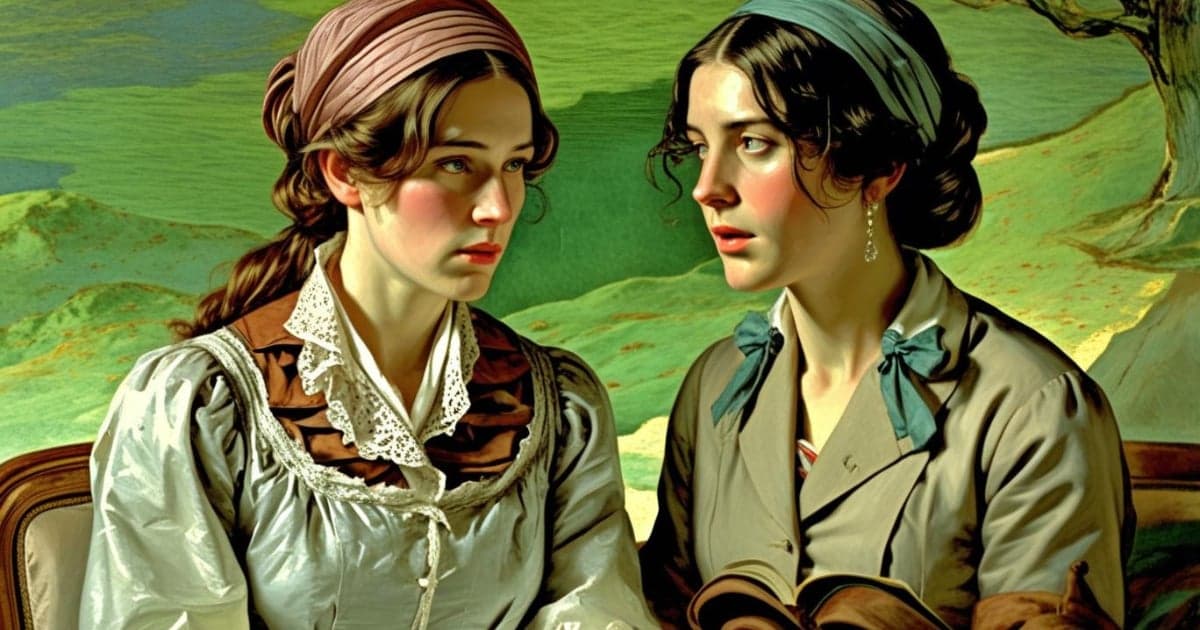
Two days after the scene in the Yew-tree Walk, Dorothea drives into Middlemarch alone — ostensibly on shopping errands — to find Lydgate and learn whether her husband had asked for a fuller account of his illness, and whether there had been any depressing new symptoms he was concealing from her. She feels "almost guilty in asking for knowledge about him from another, but the dread of being without it — the dread of that ignorance which would make her unjust or hard — overcame every scruple." Lydgate is not at home. She asks for Mrs. Lydgate and is admitted. On the way in, she hears through an open window a few notes from a man's voice and then a piano bursting into roulades — which break off suddenly when the servant goes to announce her. Eliot lingers over the contrast between the two women: Rosamond's "infantine blondness and wondrous crown of hair-plaits, her pale-blue dress of a fit and fashion so perfect that no dressmaker could look at it without emotion, her small hands duly set off with rings, and that controlled self-consciousness of manner which is the expensive substitute for simplicity," against Dorothea's thin white woollen dress, always in the shape of a pelisse hanging out of fashion, her simply parted hair and candid eyes. To Rosamond, Dorothea is one of those "county divinities not mixing with Middlemarch mortality" — and Rosamond is not without satisfaction that Mrs. Casaubon should have an opportunity of studying her. Dorothea enters and greets Rosamond — she is aware of a gentleman standing at a wide angle, seeing him only as "a coated figure." Will Ladislaw comes forward. He had already taken up his hat before she entered. She colors with surprise but gives him her hand with a smile of unmistakable pleasure. He offers to go fetch Lydgate at the Hospital; Dorothea says it would be quicker to send the carriage. Then, as Will moves toward the door, Dorothea's mind "flashed in an instant over many connected memories." She changes course: she will go herself. She thanks Rosamond, leaves the room "hardly conscious of what was immediately around her," and lets Will lead her to the carriage in silence. They say good-by without speaking. During the five-minute drive to the Hospital, Dorothea understands what happened to her. Her sudden departure came from "the sense that there would be a sort of deception in her voluntarily allowing any further intercourse between herself and Will which she was unable to mention to her husband." And now, alone in the carriage, the notes of the man's voice and the piano she had barely registered return to her — Will, singing with Rosamond, in Lydgate's absence. She thinks, with some wonder, that Will was passing his time with Mrs. Lydgate in her husband's absence. And then she remembers that he had also passed time with her under like circumstances — so why should there be any unfitness? But Casaubon had perhaps given signs she should have understood. "Perhaps I have been mistaken in many things," said poor Dorothea, while the tears came rolling. The image of Will, so clear before, is "mysteriously spoiled." Will, left behind in the Lydgate drawing-room, is mortified. For the first time, Dorothea has not been supremely occupied with him; worse, she has seen him under circumstances that make him appear not supremely occupied with her. "He felt thrust to a new distance from her, amongst the circles of Middlemarchers who made no part of her life." He returns to Rosamond and says, with irritation, that it is always fatal to have music interrupted — he hopes to come another day and finish the rendering of 'Lungi dal caro bene.' Rosamond says she quite envies his acquaintance with Mrs. Casaubon — is she very clever? Will says, with delightful pettishness: "Really, I never thought about it." Rosamond presses him. He says: "When one sees a perfect woman, one never thinks of her attributes — one is conscious of her presence." When Lydgate returns, Rosamond tells him at once. "Do you know, I think he adores Mrs. Casaubon." "Poor devil!" says Lydgate, pinching his wife's ears. Rosamond begins "to know a great deal of the world" — discovering that women, even after marriage, might make conquests and enslave men. "How delightful to make captives from the throne of marriage with a husband as crown-prince by your side." Her romance is for now chiefly centered on that crown-prince. She tells Lydgate what Mrs. Casaubon wanted: to ask about her husband's health. "But I think she is going to be splendid to our New Hospital," says Lydgate. "I think she will give us two hundred a-year."

Coming Up in Chapter 44

Dorothea walks with Lydgate around the hospital grounds, hears about the medical opposition he is facing, and immediately offers to subscribe two hundred a year. She mentions it to Casaubon that evening.

Share it with friends

Previous ChapterNext Chapter
GO ADS FREE — JOIN US
Original text
complete·2,661 words
L

III.

“This figure hath high price: ’t was wrought with love
Ages ago in finest ivory;
Nought modish in it, pure and noble lines
Of generous womanhood that fits all time
That too is costly ware; majolica
Of deft design, to please a lordly eye:
The smile, you see, is perfect—wonderful
As mere Faience! a table ornament
To suit the richest mounting.”

1 / 14

Master this chapter. Complete your experience

Purchase the complete book to access all chapters and support classic literature

Read Free on GutenbergBuy at Powell'sBuy on Amazon

As an Amazon Associate, we earn a small commission from qualifying purchases at no additional cost to you.

Available in paperback, hardcover, and e-book formats

GO ADS FREE — JOIN US

Why This Matters

Connect literature to life

Skill: Detecting Protective Deception

This chapter teaches how to recognize when we're hiding information under the guise of protecting others, but actually avoiding difficult conversations ourselves.

Practice This Today

This week, notice when you're tempted to handle something 'behind the scenes' - then ask yourself if you're truly protecting someone or just avoiding an uncomfortable discussion.

GO ADS FREE — JOIN US

Now let's explore the literary elements.

Key Quotes & Analysis

"She felt almost guilty in asking for knowledge about him from another, but the dread of being without it—the dread of that ignorance which would make her unjust or hard—overcame every scruple."

— Narrator

Context: Describing Dorothea's internal conflict about seeking medical information about her husband

This reveals Dorothea's moral struggle between respecting her husband's privacy and her need to understand his condition. Her fear of being 'unjust or hard' shows how much she values being a good wife, even when it conflicts with her desire for truth.

In Today's Words:

She felt bad about going behind his back, but not knowing was worse - she was afraid she'd be unfair to him if she didn't understand what was really going on.

"Poor Dorothea needed to lay up stores of patience."

— Narrator

Context: After describing her husband's new secretive behavior and methods

This simple statement captures the emotional toll of living with someone who's withdrawing from you. The word 'stores' suggests patience is a finite resource that can be depleted.

In Today's Words:

Dorothea was going to need all the patience she could get.

"The smile, you see, is perfect—wonderful As mere Faience! a table ornament To suit the richest mounting."

— Narrator

Context: Opening metaphor comparing beautiful objects to people who exist mainly for display

This sets up the chapter's theme about appearances versus reality. Like decorative pottery, people can be valued more for how they look than for their substance, especially women in Victorian society.

In Today's Words:

Look at that perfect smile - beautiful as expensive china, designed to impress the wealthy.

Thematic Threads

Social Expectations

In This Chapter

All three characters worry about how their innocent interactions might appear to society

Development

Building from earlier themes about reputation and propriety

In Your Life:

You might recognize this when you avoid certain friendships or activities because of how others might judge them

Class Consciousness

In This Chapter

Will feels his social position makes him appear opportunistic when socializing with the wealthy

Development

Deepening exploration of how class differences create barriers between genuine connections

In Your Life:

You might feel this tension when your income or background differs significantly from your friends or romantic interests

Concealment

In This Chapter

Dorothea hides her medical inquiry from Casaubon while feeling guilty about the deception

Development

Continuing theme of characters keeping secrets to avoid conflict

In Your Life:

You might recognize this when you hide purchases, friendships, or concerns from family members to avoid arguments

Power Dynamics

In This Chapter

Rosamond realizes that married women can still inspire devotion and wield romantic influence

Development

Rosamond's growing awareness of her own social and romantic power

In Your Life:

You might notice this when you realize how your attention or approval affects others, even in committed relationships

Authentic Connection

In This Chapter

Will and Dorothea's genuine care for each other is complicated by social positioning and appearances

Development

Ongoing tension between true feeling and social acceptability

In Your Life:

You might experience this when real friendships or attractions are constrained by workplace rules, family expectations, or social norms

GO ADS FREE — JOIN US

You now have the context. Time to form your own thoughts.

Discussion Questions

  1. 1

    What awkward situation does Dorothea walk into at the Lydgates' house, and how does each person react?

    analysis • surface
  2. 2

    Why does Dorothea feel guilty about seeking information about her husband's health, and how does this guilt affect her behavior with Will?

    analysis • medium
  3. 3

    Think about a time when you tried to protect someone by hiding information from them. What complications did this create that you hadn't expected?

    application • medium
  4. 4

    If you were Will, how would you handle Dorothea's obvious discomfort without making the situation worse for everyone involved?

    application • deep
  5. 5

    What does this chapter reveal about how trying to protect people through secrecy often backfires and creates the very problems we're trying to avoid?

    reflection • deep

Critical Thinking Exercise

10 minutes

Map Your Secret-Keeping Patterns

Think of three situations where you're currently hiding information to 'protect' someone - at work, in your family, or with friends. For each situation, write down what you're hiding, why you think they can't handle it, and what complications this secrecy is actually creating. Then consider: what would happen if you were directly honest instead?

Consider:

  • •Are you protecting them, or avoiding a difficult conversation for yourself?
  • •What signals might they already be picking up that something's wrong?
  • •How is maintaining this secret affecting your relationship with this person?

Journaling Prompt

Write about a time when someone hid something from you 'for your own good.' How did it feel when you found out? What would you have preferred they do instead?

GO ADS FREE — JOIN US

Coming Up Next...

Chapter 44: Finding Purpose in Opposition

Dorothea walks with Lydgate around the hospital grounds, hears about the medical opposition he is facing, and immediately offers to subscribe two hundred a year. She mentions it to Casaubon that evening.

Continue to Chapter 44
Previous
The Weight of Mortality
Contents
Next
Finding Purpose in Opposition

Continue Exploring

Middlemarch Study GuideTeaching ResourcesEssential Life IndexBrowse by ThemeAll Books
Social Class & StatusLove & RelationshipsMoral Dilemmas & Ethics

You Might Also Like

Jane Eyre cover

Jane Eyre

Charlotte Brontë

Explores personal growth

Great Expectations cover

Great Expectations

Charles Dickens

Explores personal growth

The Strange Case of Dr Jekyll and Mr Hyde cover

The Strange Case of Dr Jekyll and Mr Hyde

Robert Louis Stevenson

Explores personal growth

Don Quixote cover

Don Quixote

Miguel de Cervantes Saavedra

Explores personal growth

Browse all 47+ books
GO ADS FREE — JOIN US

Share This Chapter

Know someone who'd enjoy this? Spread the wisdom!

TwitterFacebookLinkedInEmail

Read ad-free with Prestige

Get rid of ads, unlock study guides and downloads, and support free access for everyone.

Subscribe to PrestigeCreate free account
Intelligence Amplifier
Intelligence Amplifier™Powering Wide Reads

Exploring human-AI collaboration through books, essays, and philosophical dialogues. Classic literature transformed into navigational maps for modern life.

2025 Books

→ The Amplified Human Spirit→ The Alarming Rise of Stupidity Amplified→ San Francisco: The AI Capital of the World
Visit intelligenceamplifier.org
hello@widereads.com

WideReads Originals

→ You Are Not Lost→ The Last Chapter First→ The Lit of Love→ Wealth and Poverty→ 10 Paradoxes in the Classics · coming soon
Arvintech
arvintechAmplify your Mind
Visit at arvintech.com

Navigate

  • Home
  • Library
  • Essential Life Index
  • How It Works
  • Subscribe
  • Account
  • About
  • Contact
  • Authors
  • Suggest a Book
  • Landings

Made For You

  • Students
  • Educators
  • Families
  • Readers
  • Literary Analysis
  • Finding Purpose
  • Letting Go
  • Recovering from a Breakup
  • Corruption
  • Gaslighting in the Classics

Newsletter

Weekly insights from the classics. Amplify Your Mind.

Legal

  • Privacy Policy
  • Terms of Service
  • Cookie Policy
  • Accessibility

Why Public Domain?

We focus on public domain classics because these timeless works belong to everyone. No paywalls, no restrictions—just wisdom that has stood the test of centuries, freely accessible to all readers.

Public domain books have shaped humanity's understanding of love, justice, ambition, and the human condition. By amplifying these works, we help preserve and share literature that truly belongs to the world.

A Pilgrimage

Powell's City of Books

Portland, Oregon

If you ever find yourself in Portland, walk to the corner of Burnside and 10th. The building takes up an entire city block. Inside is over a million books, new and used on the same shelf, organized by color-coded rooms with names like the Rose Room and the Pearl Room. You can lose an afternoon. You can lose a weekend. You will find a book you have been looking for your whole life, and three you did not know existed.

It is a pilgrimage. We cannot find a bookstore like it anywhere on earth. If you read the classics, and you ever get the chance, go. It belongs on every reader's bucket list.

Visit powells.com

We are not in any way affiliated with Powell's. We are just a very big fan.

© 2026 Wide Reads™. All Rights Reserved.

Intelligence Amplifier™ and Wide Reads™ are proprietary trademarks of Arvin Lioanag.

Copyright Protection: All original content, analyses, discussion questions, pedagogical frameworks, and methodology are protected by U.S. and international copyright law. Unauthorized reproduction, distribution, web scraping, or use for AI training is strictly prohibited. See our Copyright Notice for details.

Disclaimer: The information provided on this website is for general informational and educational purposes only and does not constitute professional, legal, financial, or technical advice. While we strive to ensure accuracy and relevance, we make no warranties regarding completeness, reliability, or suitability. Any reliance on such information is at your own risk. We are not liable for any losses or damages arising from use of this site. By using this site, you agree to these terms.