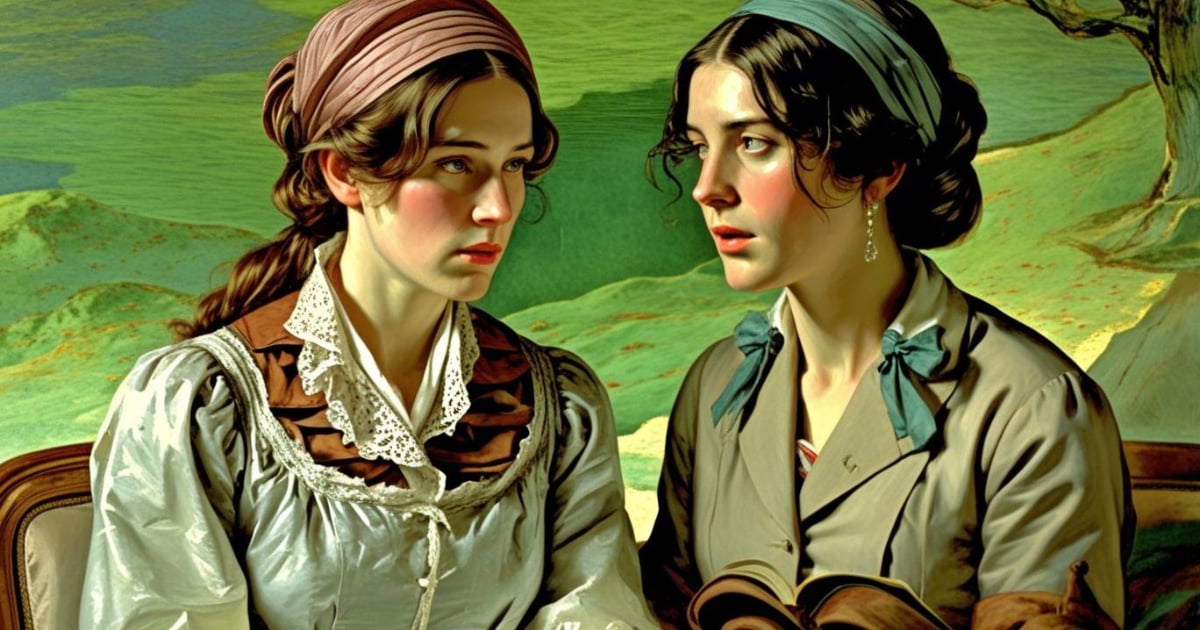
Chapter 02
Mr. Casaubon's Scholarly Proposal
“‘Dime; no ves aquel caballero que hacia nosotros viene sobre un caballo rucio rodado que trae puesto en la cabeza un yelmo de oro?’ ‘Lo que veo y columbro,’ respondio Sancho, ‘no es sino un hombre sobre un as no pardo como el mio, que trae sobre la cabeza una cosa que relumbra.’ ‘Pues ese es el yelmo de Mambrino,’ dijo Don Quijote.”—CERVANTES. “‘Seest thou not yon cavalier who cometh toward us on a dapple-gray steed, and weareth a golden helmet?’ ‘What I see,’ answered Sancho, ‘is nothing but a man on a gray ass like my own, who carries…
Public-domain chapter text, formatted for reading.
Master this chapter. Complete your experience
Purchase the complete book to access all chapters and support classic literature
Available in paperback, hardcover, and e-book formats
Now let's explore the literary elements.
Key Quotes & Analysis
"Surely, it is better to spend money in finding out how men can make the most of the land which supports them all, than in keeping dogs and horses only to gallop over it."
Context: Replying to Brooke's mockery of Chettam's agricultural experiments at dinner
Dorothea speaks with more energy than expected of a young lady because she wants reform to matter more than sport. Casaubon notices her anew when she defends serious use of wealth.
In Today's Words:
She said it was better to fund research on how people actually live off the land than to pour money into horses and hounds for riding over it. In a room full of men who treated her opinions as decoration, that sentence was the first time she sounded like someone with a public mind.
"I feed too much on the inward sources; I live too much with the dead."
Context: His first long speech at dinner, explaining why he needs a careful evening reader
Casaubon presents his scholarship as communion with the dead rather than engagement with the living. Dorothea hears grandeur where others might hear isolation.
In Today's Words:
He told the dinner table he fed on inward sources and lived among the dead, as if scholarship were a monastery. The sentence sounded noble to Dorothea, but it also meant he wanted a careful reader for his evenings, not conversation with the living. A modern listener might hear a man recruiting an assistant while calling it spiritual vocation.
"We must keep the germinating grain away from the light."
Context: Defending Dorothea's privacy when Sir James presses her about refusing to ride
The metaphor flatters Dorothea by treating her motives as sacred and fragile. She mistakes eloquent withdrawal for deep understanding of her inner life.
In Today's Words:
When Sir James kept pressing Dorothea to explain why she refused the horse, Casaubon told the table not to inquire too curiously into motives and said germinating grain must stay away from the light. Dorothea colored with pleasure, sure she had found a man who understood her inner life. Celia, if she had cared, might have called it eloquent evasion dressed as wisdom.
"How very ugly Mr. Casaubon is!"
Context: Alone with Dorothea in the drawing room after dinner
Celia states the obvious physical fact Dorothea refuses to see. The sisters' quarrel exposes how idealization has already begun.
In Today's Words:
Celia said plainly what the room could see: Casaubon was very ugly. Dorothea fired back that he looked distinguished, like Locke, and accused her sister of judging souls by complexion. The quarrel showed idealization had already begun, because Dorothea was defending a pamphlet and a fantasy, not the tired face at the table.
Thematic Threads
Identity
In This Chapter
Dorothea defines herself through her desire to contribute to important work, seeing Casaubon's scholarship as her path to significance
Development
Deepens from Chapter 1 restless seeking; now she thinks she has found her answer
In Your Life:
You might catch yourself defining who you are through someone else's achievements or purposes
Class
In This Chapter
Intellectual pursuits become a form of social currency - Casaubon's learning gives him status that attracts Dorothea
Development
Builds on Chapter 1's social expectations - showing how class operates through cultural capital
In Your Life:
You might find yourself drawn to people whose knowledge or credentials make you feel more legitimate
Social Expectations
In This Chapter
Both characters are performing roles - the eager student and the wise mentor - rather than being authentic
Development
Continues from Chapter 1 but now shows how expectations shape romantic attraction
In Your Life:
You might catch yourself playing a role in relationships instead of showing up as yourself
Human Relationships
In This Chapter
Their connection is based on what each can provide the other rather than genuine understanding or affection
Development
Introduced here as the central relationship dynamic
In Your Life:
You might recognize relationships in your life built more on mutual benefit than mutual care
Personal Growth
In This Chapter
Dorothea believes associating with Casaubon will develop her intellectually and morally
Development
Evolves from Chapter 1's vague yearning into a specific plan for self-improvement
In Your Life:
You might look for growth through other people instead of developing your own capabilities
You now have the context. Time to form your own thoughts.
Discussion Questions
This is not a test. Five prompts guide you through the chapter, from how it opens to how it closes, so you notice context and rhythm rather than facts to memorize. Sit with each question in your own words. When you see "One way to read it," treat it as a starting point, not the only answer.
- 1
When Mr. Brooke dismisses Dorothea with 'Young ladies don't understand political economy,' how does this reveal the social constraints she faces despite her intelligence?
analysis • surfaceOne way to read it
Brooke's casual dismissal shows how women's minds were systematically undervalued in Victorian society. Dorothea has just made a thoughtful argument about agricultural improvement, but her gender makes her insights irrelevant to the men present.
- 2
Why does Casaubon's metaphor about keeping 'the germinating grain away from the light' so powerfully attract Dorothea when he defends her privacy?
analysis • mediumOne way to read it
His elevated, almost mystical language makes him seem to understand her inner spiritual life. After being patronized by Brooke and pestered by Sir James, Casaubon appears to respect the sacred nature of her thoughts and motivations.
- 3
How might someone today fall into Dorothea's trap of mistaking intellectual pretension for genuine wisdom in a potential partner?
application • mediumOne way to read it
Modern parallels include being impressed by academic credentials, sophisticated vocabulary, or cultural references without examining whether the person actually has emotional depth or compatible values. Surface markers of intelligence can mask fundamental incompatibility.
- 4
If you were Celia watching your sibling become infatuated with someone clearly wrong for them, how would you handle the situation?
application • deepOne way to read it
Like Celia, direct criticism often backfires and makes the infatuated person more defensive. Gentle questions that help them examine their own feelings, rather than attacking the unsuitable person, might be more effective in the long run.
- 5
What does Dorothea's instant elevation of Casaubon to heroic status reveal about how loneliness can distort our judgment of others?
reflection • deepOne way to read it
Her intellectual isolation makes her desperately grateful for anyone who seems to take her mind seriously. She projects her own noble aspirations onto Casaubon rather than seeing him clearly, filling the void of understanding she craves.
Critical Thinking Exercise
Test Your Connections
Think of a relationship where you feel really valued - could be work, friendship, family, or romantic. Now imagine that relationship without the main thing you provide (your skills, your listening ear, your support, your admiration). Write down what you think would remain. Then do the same exercise in reverse: what would be left if the other person couldn't give you what you typically get from them?
Consider:
- •Strong relationships survive when the usual benefits are temporarily unavailable
- •It's normal for relationships to involve some mutual benefit - the question is whether that's ALL they involve
- •People can genuinely care about you AND appreciate what you provide - both can be true
Journaling Prompt
Write about a time when you realized someone valued you more for what you could do than who you were. How did you handle it, and what did you learn about building more genuine connections?
Coming Up Next...
Chapter 3: When Good Intentions Meet Reality
Casaubon extends his visit and outlines the vast scope of his great work: a Key to all mythologies that would show every religious system as a corruption of one original revelation. Dorothea listens as if she were watching a living Augustine. Before he leaves he hints, with diplomatic precision, at the disadvantage of loneliness. Everyone in the room can read the implication except Dorothea, who is already past hoping and into deciding..