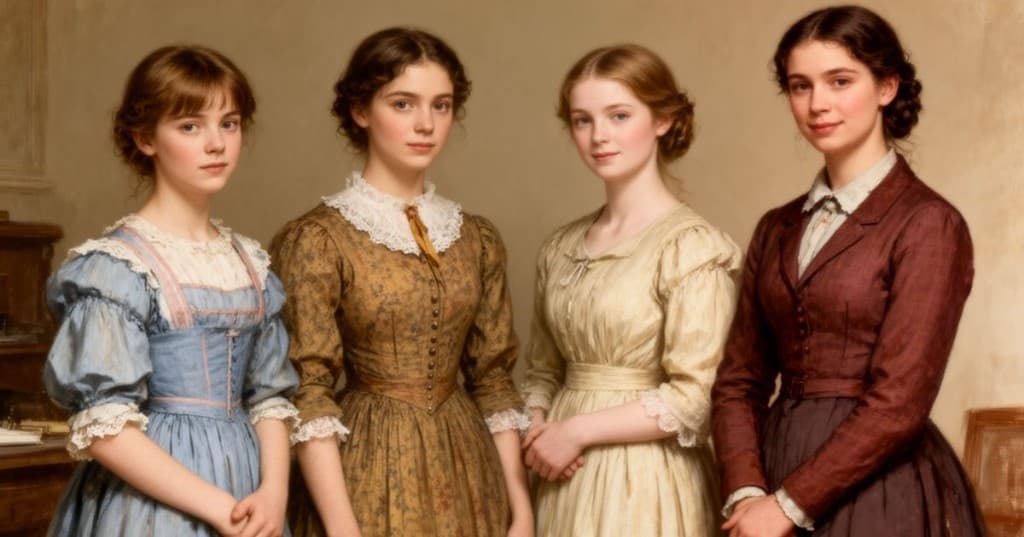
Chapter 27
Jo's First Publishing Success
CHAPTER TWENTY-SEVEN LITERARY LESSONS Fortune suddenly smiled upon Jo, and dropped a good luck penny in her path. Not a golden penny, exactly, but I doubt if half a million would have given more real happiness then did the little sum that came to her in this wise. Every few weeks she would shut herself up in her room, put on her scribbling suit, and ‘fall into a vortex’, as she expressed it, writing away at her novel with all her heart and soul, for till that was finished she could find no peace. Her ‘scribbling suit’ consisted of a…
Public-domain chapter text, formatted for reading.
Master this chapter. Complete your experience
Purchase the complete book to access all chapters and support classic literature
Available in paperback, hardcover, and e-book formats
Now let's explore the literary elements.
Key Quotes & Analysis
"Fortune suddenly smiled"
Context: Jo discovers the prize opportunity
Luck arrives as information, not inheritance, and Jo must act on it herself.
In Today's Words:
Luck showed up unexpectedly. Opportunities still appear as listings, contests, and introductions while you are bored in the wrong room. Readiness means having a story ready when the door opens. The same pressure appears today when people perform a version of themselves that looks impressive on paper but drains the energy needed for real competence and connection.
"hundred-dollar prize"
Context: The newspaper contest that hooks Jo
A concrete goal turns fantasy into deadline and word count.
In Today's Words:
A cash prize was attached to the submission. Deadlines and money still convert daydreams into drafts. Clear stakes beat vague ambition. The same pressure appears today when people perform a version of themselves that looks impressive on paper but drains the energy needed for real competence and connection.
"sensational story"
Context: The genre the paper wants
Jo must write to market before she can write to art, a tension she will never fully escape.
In Today's Words:
They wanted drama and shock. Writers still balance what sells with what they respect. First paychecks often require writing someone else's appetite. The same pressure appears today when people perform a version of themselves that looks impressive on paper but drains the energy needed for real competence and connection.
"Criticism is the best test"
Context: Marmee after the editor's harsh letter
She reframes rejection as data, protecting Jo from quitting at the first bruise.
In Today's Words:
Critique is how you measure the work fairly. Feedback still hurts and still teaches. The first published piece is the start of revision, not the end of doubt. The same pressure appears today when people perform a version of themselves that looks impressive on paper but drains the energy needed for real competence and connection.
Thematic Threads
Class
In This Chapter
Jo's writing career is driven by financial necessity—she writes 'rubbish' because it pays, not because it fulfills her artistic vision
Development
Evolved from earlier genteel poverty to active income generation through compromise
In Your Life:
You might recognize this when you take work that pays the bills but slowly erodes what you actually care about
Identity
In This Chapter
Jo struggles between her identity as a serious writer and her role as family provider, ultimately choosing financial responsibility over artistic integrity
Development
Deepened from earlier chapters where Jo's writing was purely personal expression
In Your Life:
You might face this tension between who you want to be professionally and what circumstances force you to become
Personal Growth
In This Chapter
Jo learns painful lessons about criticism and public reception—that success doesn't equal understanding and that financial reward can come at the cost of artistic soul
Development
Continued growth through harsh experience rather than gentle guidance
In Your Life:
You might discover that achieving what you thought you wanted brings unexpected complications and hollow victories
Social Expectations
In This Chapter
Publishers, critics, and readers all have different expectations for Jo's work, forcing her to navigate conflicting demands that ultimately please no one
Development
Expanded from family expectations to public and professional pressures
In Your Life:
You might find yourself trying to satisfy multiple stakeholders with incompatible demands, satisfying none completely
You now have the context. Time to form your own thoughts.
Discussion Questions
This is not a test. Five prompts guide you through the chapter, from how it opens to how it closes, so you notice context and rhythm rather than facts to memorize. Sit with each question in your own words. When you see "One way to read it," treat it as a starting point, not the only answer.
- 1
Why does Jo hide the submission until it is mailed?
analysis • surfaceOne way to read it
She fears family doubt and wants the attempt judged on results, not debated beforehand.
- 2
Why is the prize money so meaningful to Jo?
analysis • mediumOne way to read it
It is the first proof strangers will pay for her writing, which matters more than the amount itself.
- 3
How does Marmee respond to the editor's criticism?
application • mediumOne way to read it
She calls criticism a useful test that reveals blind spots and urges Jo to learn rather than quit.
- 4
What tension exists between sensational story and Jo's values?
application • deepOne way to read it
She writes what the market wants and then faces moral critique, beginning her lifelong negotiation between art and sale.
- 5
When has success and criticism arrived in the same week for you?
reflection • deepOne way to read it
Strong answers describe a win followed by feedback that forced growth instead of ending the effort.
Critical Thinking Exercise
Map Your Compromise Points
Think about an area of your life where financial pressure or practical necessity conflicts with your values or vision. Draw a simple line with 'My Ideal Vision' on one end and 'Survival Mode' on the other. Mark where you currently operate and identify three specific compromise points along that line. For each point, write what you gain and what you lose.
Consider:
- •Which compromises feel temporary versus permanent?
- •What would need to change for you to move closer to your ideal vision?
- •How do you recognize when you've compromised too much?
Journaling Prompt
Write about a time when financial pressure led you to make a choice that conflicted with your values. What did you learn from that experience, and how would you handle a similar situation now?
Coming Up Next...
Chapter 28: The Reality of Marriage
While Jo navigates the literary world, Meg embarks on her own new adventure as she adjusts to married life and discovers that domestic happiness requires different skills than she expected.