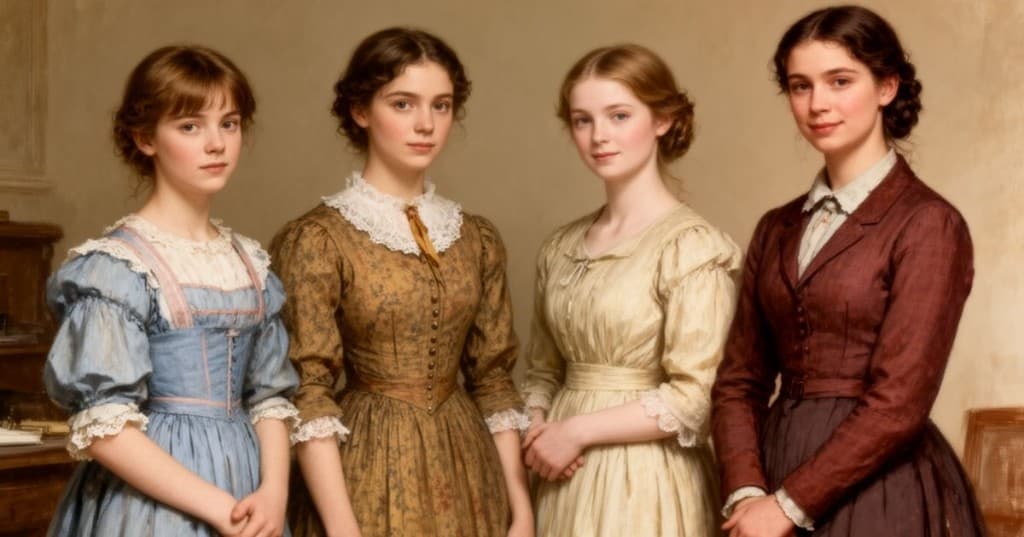
Chapter 11
The Vacation Experiment
CHAPTER ELEVEN EXPERIMENTS “The first of June! The Kings are off to the seashore tomorrow, and I’m free. Three months’ vacation—how I shall enjoy it!” exclaimed Meg, coming home one warm day to find Jo laid upon the sofa in an unusual state of exhaustion, while Beth took off her dusty boots, and Amy made lemonade for the refreshment of the whole party. “Aunt March went today, for which, oh, be joyful!” said Jo. “I was mortally afraid she’d ask me to go with her. If she had, I should have felt as if I ought to do it, but…
Public-domain chapter text, formatted for reading.
Master this chapter. Complete your experience
Purchase the complete book to access all chapters and support classic literature

Available in paperback, hardcover, and e-book formats
Now let's explore the literary elements.
Key Quotes & Analysis
"Three months’ vacation"
Context: Meg celebrates the start of summer freedom
The sisters treat vacation as pure escape before learning that unstructured time has its own costs.
In Today's Words:
Three whole months off sounds like heaven. Students and workers still count down to break as if rest alone will fix exhaustion. Freedom feels glorious until nobody is steering the day. The same pressure appears today when people perform a version of themselves that looks impressive on paper but drains the energy needed for real competence and connection.
"all play and no work is as bad as all work and no play"
Context: Marmee frames the vacation experiment
She refuses the false choice between grind and idleness and names balance as the real goal.
In Today's Words:
Only having fun is as unhealthy as only working. Burnout culture and binge-rest culture are twins. A life with no contribution goes flat just as surely as a life with no relief. The same pressure appears today when people perform a version of themselves that looks impressive on paper but drains the energy needed for real competence and
"blanc mange was lumpy"
Context: Jo's disastrous dinner party for Laurie
The detail turns ambition into comedy and shows how quickly performance outruns skill.
In Today's Words:
The fancy dessert came out wrong. Hosting still punishes beginners who try to look effortless before they have practiced. One visible failure can teach more than a week of theory. The same pressure appears today when people perform a version of themselves that looks impressive on paper but drains the energy needed for real competence and connection.
"It’s all my fault, I forgot him"
Context: Jo discovers the canary dead because she neglected his cage
Neglect born of self-indulgence hurts a dependent creature, making the experiment's cost moral as well as comic.
In Today's Words:
She admits she forgot to care for what depended on her. When people check out of responsibility, pets, kids, and coworkers still need feeding. Guilt arrives fast when play replaces basic duty. The same pressure appears today when people perform a version of themselves that looks impressive on paper but drains the energy needed for real competence and
Thematic Threads
Work
In This Chapter
The sisters learn that meaningful work creates satisfaction and competence, while avoiding responsibility leads to chaos and incompetence
Development
Builds on earlier themes of duty and contribution, now showing the positive psychology of purposeful work
In Your Life:
You might notice feeling more satisfied on busy, productive days than on completely free ones
Class
In This Chapter
Amy's fantasy of being an 'elegant lady of leisure' reveals how class aspirations can be based on misunderstanding what actually creates happiness
Development
Continues exploring how the sisters navigate between working-class reality and middle-class aspirations
In Your Life:
You might catch yourself romanticizing lifestyles that would actually leave you feeling empty or purposeless
Identity
In This Chapter
Each sister discovers her identity is tied to her contributions and responsibilities, not just her personal desires
Development
Deepens from earlier chapters showing how identity forms through action and service to others
In Your Life:
You might realize you feel most like yourself when you're helping others or doing meaningful work
Personal Growth
In This Chapter
Growth comes through facing challenges and responsibilities, not through avoiding them
Development
Reinforces the pattern that comfort zones limit development while meaningful challenges promote it
In Your Life:
You might notice you learn and grow more during difficult periods than during easy ones
Human Relationships
In This Chapter
Shared responsibilities and mutual care create stronger bonds than individual pleasure-seeking
Development
Builds on family dynamics to show how relationships thrive through interdependence rather than independence
In Your Life:
You might find your relationships are stronger when you're working together toward common goals rather than just enjoying each other's company
You now have the context. Time to form your own thoughts.
Discussion Questions
This is not a test. Five prompts guide you through the chapter, from how it opens to how it closes, so you notice context and rhythm rather than facts to memorize. Sit with each question in your own words. When you see "One way to read it," treat it as a starting point, not the only answer.
- 1
What does each sister hope to gain from Marmee's vacation experiment?
analysis • surfaceOne way to read it
Meg wants ease and beauty, Jo wants adventure and reading, Beth wants uninterrupted music, and Amy wants elegant idleness, each imagining freedom from the chores that currently shape their days.
- 2
Why does the experiment fail before the dinner party disaster?
analysis • mediumOne way to read it
Without required work the sisters grow bored, lonely, and irritable, sneak in small tasks to feel useful, and discover that unstructured time does not automatically feel like joy.
- 3
How does Jo's dinner for Laurie combine ambition and inexperience?
application • mediumOne way to read it
She chooses a fancy menu to prove leisure can be elegant but lacks Hannah's skill, so timing, portions, and basic care all collapse under performance pressure.
- 4
What does Pip's death add to the chapter's lesson?
application • deepOne way to read it
It turns comic failure into moral weight, showing that neglecting dependents while chasing self-indulgence has real consequences beyond lumpy dessert.
- 5
When have you discovered that doing nothing was harder than you expected?
reflection • deepOne way to read it
Strong answers describe a break that felt aimless or guilty until some small task, person, or routine restored a sense of purpose.
Critical Thinking Exercise
Design Your Ideal Week
Create two weekly schedules: one with complete freedom from all responsibilities (like the March sisters tried), and another that balances rest with meaningful activities. Compare what each week would actually feel like to live through, not just what sounds appealing on paper.
Consider:
- •What activities give you energy versus drain you?
- •How much unstructured time feels refreshing versus overwhelming?
- •What responsibilities actually contribute to your sense of purpose?
Journaling Prompt
Write about a time when you had more freedom than usual (vacation, time off, easy period at work) but found yourself feeling restless or unfulfilled. What was missing, and how would you structure that time differently now?
Coming Up Next...
Chapter 12: Camp Laurence
The girls' newfound appreciation for work and responsibility will be put to the test when Laurie invites them to join his grandfather's military-style summer camp. New adventures and challenges await as the March sisters venture beyond their familiar home.