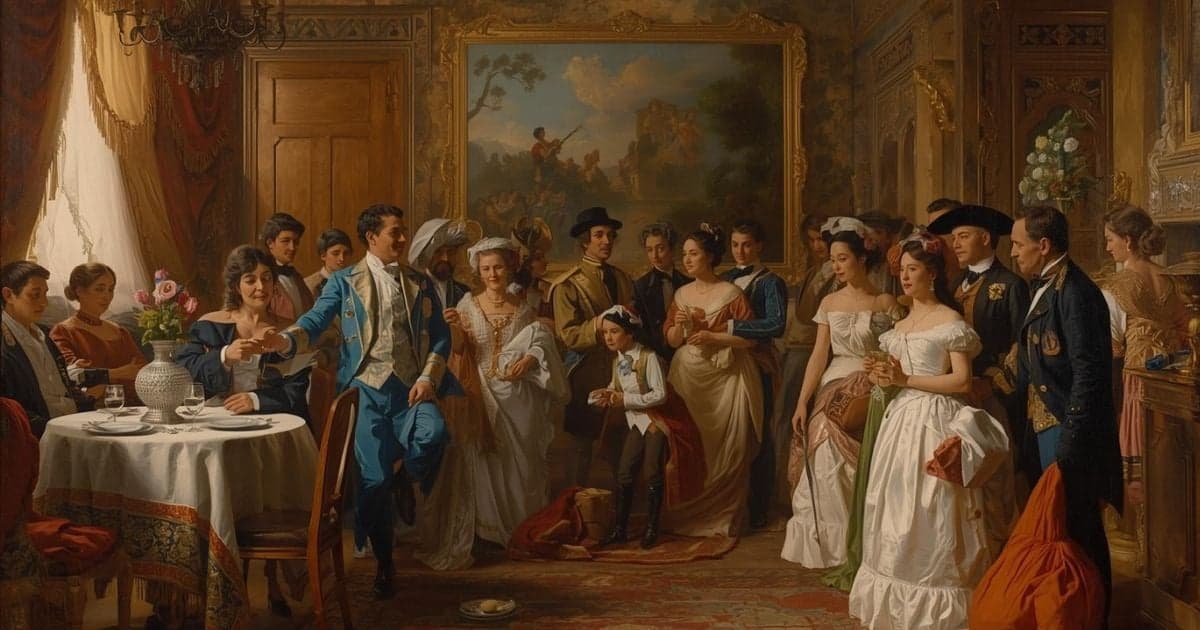
Chapter 38
The Heart's True Direction
Éponine had followed Marius to the barricade, her heart torn between desperate love and the terrible knowledge that he would never be hers. She had delivered Cosette's letter, watching his face light up with joy that would never be for her. Now, as bullets flew through the narrow streets and the insurgents prepared for their final stand, she found herself beside him in the darkness. Her father and the other criminals had fled, but she remained. Not for the revolution, not for justice or liberty, but for love. When she saw the soldier taking aim at Marius, her body moved…
Master this chapter. Complete your experience
Purchase the complete book to access all chapters and support classic literature

Available in paperback, hardcover, and e-book formats
Now let's explore the literary elements.
Key Quotes & Analysis
"And then, do you know, Monsieur Marius, I believe I was a little in love with you."
Context: Her dying confession to Marius after taking the bullet meant for him
This understated confession reveals both her humility and the depth of her feelings, using 'a little' to minimize what was actually her entire world
In Today's Words:
I think I might have loved you more than I ever let on. Hugo maps how law, poverty, and reputation trap people long after punishment ends. The line still names a pattern you can spot in hiring, housing, policing, and family life whenever dignity is withheld from someone society has already condemned.
"I am going to die... That's nice. I have never seen a man die before."
Context: Her matter-of-fact observation about her own approaching death
Shows both the harsh realities of her street life and a childlike curiosity about death, mixing tragedy with innocence
In Today's Words:
This is it for me... At least it's something I've never experienced before. Hugo maps how law, poverty, and reputation trap people long after punishment ends. The line still names a pattern you can spot in hiring, housing, policing, and family life whenever dignity is withheld from someone society has already condemned.
"Éponine had followed Marius to the barricade, her heart torn between desperate love and the terrible knowledge that he would never be hers."
Context: Passage from The Heart's True Direction
Hugo uses concrete detail to show how institutions and neighbors shape a person's options.
In Today's Words:
In today's language, the passage says: Éponine had followed Marius to the barricade, her heart torn between desperate love and the terrible knowledge that he would never be hers. Hugo maps how law, poverty, and reputation trap people long after punishment ends. The line still names a pattern you can spot in hiring, housing, policing, and family life whenever dignity is withheld from someone society has already condemned.
"She had delivered Cosette's letter, watching his face light up with joy that would never be for her."
Context: Passage from The Heart's True Direction
Hugo uses concrete detail to show how institutions and neighbors shape a person's options.
In Today's Words:
In today's language, the passage says: She had delivered Cosette's letter, watching his face light up with joy that would never be for her. Hugo maps how law, poverty, and reputation trap people long after punishment ends. The line still names a pattern you can spot in hiring, housing, policing, and family life whenever dignity is withheld from someone society has already condemned.
Thematic Threads
Redemption Through Love
In This Chapter
Éponine's criminal background is transcended by her capacity for selfless love
Development
Her love for Marius gradually transforms her from manipulator to protector to martyr
In Your Life:
Consider how caring for others can bring out your best self, regardless of past mistakes
The Invisibility of Sacrifice
In This Chapter
Marius remains unaware of Éponine's feelings and protection until her final moments
Development
Hugo builds tension through the reader's awareness of what Marius cannot see
In Your Life:
Notice the quiet ways people support you—colleagues who cover for you, friends who listen without judgment
Social Class and Worth
In This Chapter
A street girl proves more noble than many of higher social standing
Development
Éponine's final act challenges assumptions about who deserves respect and recognition
In Your Life:
Don't judge people's worth by their background or current circumstances—everyone has potential for greatness
You now have the context. Time to form your own thoughts.
Discussion Questions
This is not a test. Five prompts guide you through the chapter, from how it opens to how it closes, so you notice context and rhythm rather than facts to memorize. Sit with each question in your own words. When you see "One way to read it," treat it as a starting point, not the only answer.
- 1
What made Éponine's sacrifice meaningful despite Marius not returning her feelings?
analysis • deepOne way to read it
Hugo's chapter supports this reading directly. In this pivotal chapter, Éponine makes the ultimate sacrifice for Marius, taking a bullet meant for him during the barricade fighting. Her unrequited love drives her to protect the man who loves another, transforming her from a manipulative street girl into a figure of tragic nobility. The question asks you to connect that narrative pressure to lived experience: where do you see the same pattern in workplaces, families, courts, or public policy today? Use the text as evidence, not as a moral slogan.
- 2
How might your life be different if you better noticed the people who quietly support you?
reflection • mediumOne way to read it
Hugo's chapter supports this reading directly. In this pivotal chapter, Éponine makes the ultimate sacrifice for Marius, taking a bullet meant for him during the barricade fighting. Her unrequited love drives her to protect the man who loves another, transforming her from a manipulative street girl into a figure of tragic nobility. The question asks you to connect that narrative pressure to lived experience: where do you see the same pattern in workplaces, families, courts, or public policy today? Use the text as evidence, not as a moral slogan.
- 3
What prevents us from seeing the devotion of others until it's too late, and how can we change this?
application • deepOne way to read it
Hugo's chapter supports this reading directly. In this pivotal chapter, Éponine makes the ultimate sacrifice for Marius, taking a bullet meant for him during the barricade fighting. Her unrequited love drives her to protect the man who loves another, transforming her from a manipulative street girl into a figure of tragic nobility. The question asks you to connect that narrative pressure to lived experience: where do you see the same pattern in workplaces, families, courts, or public policy today? Use the text as evidence, not as a moral slogan.
- 4
How does The Heart's True Direction show the conflict between rigid justice and compassionate mercy?
analysis • deepOne way to read it
Hugo's chapter supports this reading directly. In this pivotal chapter, Éponine makes the ultimate sacrifice for Marius, taking a bullet meant for him during the barricade fighting. Her unrequited love drives her to protect the man who loves another, transforming her from a manipulative street girl into a figure of tragic nobility. The question asks you to connect that narrative pressure to lived experience: where do you see the same pattern in workplaces, families, courts, or public policy today? Use the text as evidence, not as a moral slogan.
- 5
What social or economic trap does Hugo expose in The Heart's True Direction, and who profits from keeping it in place?
reflection • mediumOne way to read it
Hugo's chapter supports this reading directly. In this pivotal chapter, Éponine makes the ultimate sacrifice for Marius, taking a bullet meant for him during the barricade fighting. Her unrequited love drives her to protect the man who loves another, transforming her from a manipulative street girl into a figure of tragic nobility. The question asks you to connect that narrative pressure to lived experience: where do you see the same pattern in workplaces, families, courts, or public policy today? Use the text as evidence, not as a moral slogan.
Critical Thinking Exercise
Mapping Your Invisible Guardians
Think about your daily life and identify three people who might be supporting or protecting you in ways you don't fully recognize. Consider: Who makes your life easier? Who shields you from problems? Who remembers details about your well-being?
Consider:
- •Look beyond obvious relationships to coworkers, neighbors, or acquaintances
- •Consider both emotional support and practical help
- •Think about people who might be making sacrifices you don't see
- •Reflect on whether your attention goes mainly to those who demand it rather than those who give quietly
Journaling Prompt
Write about a time when you realized someone had been caring for you in ways you hadn't noticed. How did this recognition change your relationship with them?
Coming Up Next...
Chapter 39: Love Blooms in Secret Gardens
As the night deepens, the barricade faces its final assault. Marius, devastated by Éponine's sacrifice, must confront what her death means for his own survival and his love for Cosette.