Chapter 10
Stephen Blackpool
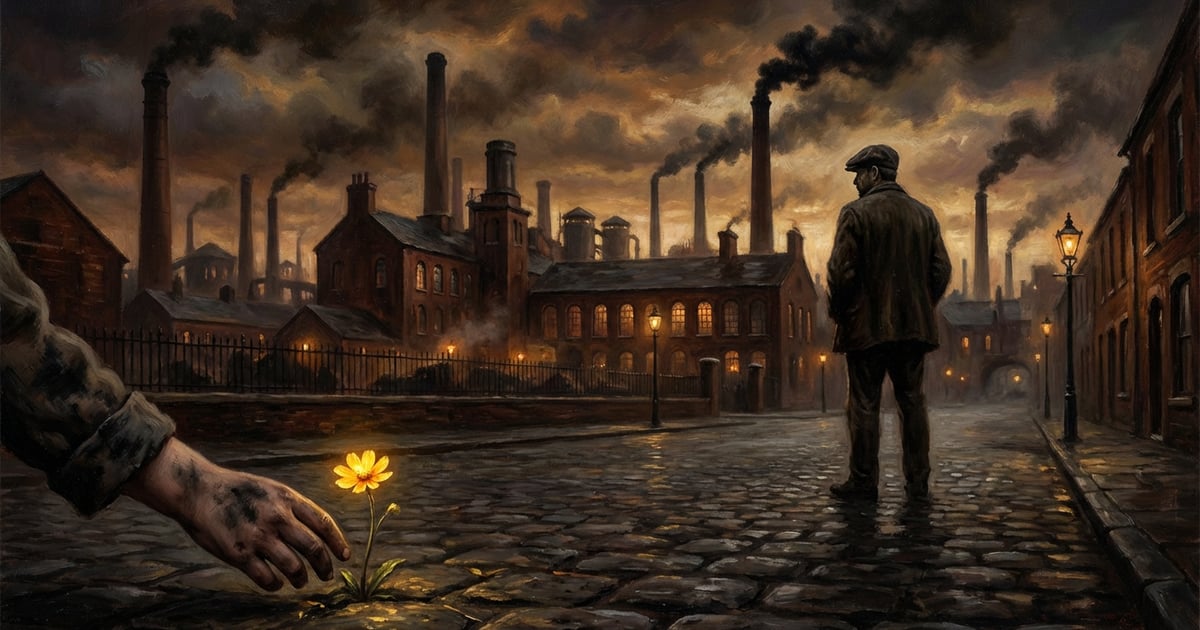
I ENTERTAIN a weak idea that the English people are as hard-worked as any people upon whom the sun shines. I acknowledge to this ridiculous idiosyncrasy, as a reason why I would give them a little more play. In the hardest working part of Coketown; in the innermost fortifications of that ugly citadel, where Nature was as strongly bricked out as killing airs and gases were bricked in; at the heart of the labyrinth of narrow courts upon courts, and close streets upon streets, which had come into existence piecemeal, every piece in a violent hurry for some one man’s…
Public-domain chapter text, formatted for reading.
Master this chapter. Complete your experience
Purchase the complete book to access all chapters and support classic literature
Available in paperback, hardcover, and e-book formats
Now let's explore the literary elements.
Key Quotes & Analysis
"somebody else had become possessed of his roses, and he had become possessed of the same somebody else’s thorns in addition to his own."
Context: Stephen's marriage
Love stolen.
In Today's Words:
Marriage stole the roses he loved and left him thorns that belonged to someone else as well as his own. A modern Stephen might be bound to an addict partner while loving another quietly, punished for a bond he did not choose. Life distributed beauty to another and debt to him.
"He was a good power-loom weaver, and a man of perfect integrity."
Context: Introducing Stephen
Worth stated in craft and character.
In Today's Words:
He is an excellent weaver and a man of perfect integrity, yet the narrator must insist because the town will not see it. Performance reviews list units per hour, not the decency that keeps a shop floor humane. Skill and character stay invisible until tragedy makes them news, and Stephen enters the novel as proof that worth and metrics diverge from the first paragraph.
"I come to the muddle many times and agen, and I never get beyond it.’ They had walked some distance, and were near their own homes."
Context: From this chapter's narrative
A verified line from the chapter text spanning its arc.
In Today's Words:
He repeats that he comes to the muddle again and again and never gets beyond it. Each attempt to seek lawful help returns to the same locked center. That is how bureaucracies feel when every form sends you back to the beginning without changing your home, and Stephen's repetition is not stupidity but accurate reporting from inside a system that offers detail without relief.
"Then she sat swaying her body to and fro, and making gestures with her unnerved arm, which seemed intended as the accompaniment to a fit of laughter, though her face was stolid and drowsy."
Context: From this chapter's narrative
A verified line from the chapter text spanning its arc.
In Today's Words:
The wife returns swaying, gestures like laughter without joy, face dull. At home she is more frightening than the mill because there is no supervisor to call. A worker sits in silence, covers her with a blanket, and learns honor can look like endurance without hope, the kind that keeps you human when the marriage offers no respectable exit and the town will never count that labor.
Thematic Threads
Industrial dehumanization
In This Chapter
Hands as hands and stomachs; Stephen's inner life unfathomable to metrics
Development
Worker storyline begins
In Your Life:
You may know competent people whose private burdens never appear in performance reviews.
Class and power
In This Chapter
Workers' quarter vs factory lights; Stephen's trapped home
Development
Introduced alongside Gradgrind household
In Your Life:
You may see how poverty narrows choices respectable people pretend are simple.
Emotional suppression
In This Chapter
Stephen and Rachael limit public closeness
Development
Restrained love as survival strategy
In Your Life:
You may recognize relationships that must stay hidden to protect someone.
You now have the context. Time to form your own thoughts.
Discussion Questions
This is not a test. Five prompts guide you through the chapter, from how it opens to how it closes, so you notice context and rhythm rather than facts to memorize. Sit with each question in your own words. When you see "One way to read it," treat it as a starting point, not the only answer.
- 1
Why does Dickens call Coketown factory workers the Hands and say some people would have preferred Providence to make them only hands, or hands and stomachs?
analysis • surfaceOne way to read it
The name reduces people to labor and appetite. Stephen is introduced as proof the reduction is false: he is a skilled weaver of perfect integrity with an inner life the factory cannot read. Dickens asks you to see the worker before the metric.
- 2
Why do Stephen and Rachael agree that honest friends should not walk together too often, even though their truthfulness to each other is sacred?
analysis • mediumOne way to read it
Decency has learned what gossip costs. Stephen is married, Rachael is careful for them both, and public closeness would harm even her reputation. Their restraint is not coldness but survival in a narrow world.
- 3
Where have you seen someone excel at work while carrying a private trap, such as an impossible marriage, family crisis, or debt, that never appeared on a review or schedule?
application • mediumOne way to read it
Think of the reliable coworker with perfect attendance whose home life is breaking, or the service worker praised for efficiency while managing catastrophe off the clock. Systems count output, not the thorns someone else planted in their life.
- 4
Stephen tells Rachael that her word is a bright good law, better than some real ones, and then says everything is a muddle he never gets beyond. What is he naming about law and marriage in his life?
application • deepOne way to read it
He lives honorably inside a bond that gives him someone else's thorns along with his own. Real law offers no clean exit, while Rachael's care gives him the only guidance that feels just. Muddle is not stupidity; it is accurate report from a trap respectability pretends is simple.
- 5
When Stephen's drunken wife returns, he shrinks from her, sits with his face in his hands, and moves only once all night to cover her. What does that final gesture reveal about his character?
reflection • deepOne way to read it
He does not excuse her or pretend the scene is bearable. He still chooses compassion over cruelty in the dark. That is honor without exit: decency that survives when no respectable path remains and no factory ledger will ever record the cost.
Critical Thinking Exercise
Find the Unmeasured Life
Think of a coworker, neighbor, or service worker you know mostly through their role. List what the role shows and what it hides. Ask what a 'muddle' might look like from their side.
Consider:
- •What metrics define them publicly
- •What decency costs when choices are narrow
- •Who provides the Rachael-like support you never see
Journaling Prompt
Write about a time you discovered someone was living honorably inside a situation with no clean exit.
Coming Up Next...
Chapter 11: No Way Out
Stephen goes to Mr. Bounderby to ask how a poor man can be rid of a wife who keeps returning, and learns there is no way out that the law will give him The mills wake again, and Dickens pauses over Stephen at his loom. Steam power can be weighed to the pound; the worker's inner life cannot..