Wide Reads
Literature MattersLife IndexEducators
Sign in
Where to Begin

The Hero's Dangerous Success — Gulliver's Travels

Gulliver's Travels - The Hero's Dangerous Success

Jonathan Swift

Gulliver's Travels

The Hero's Dangerous Success

Home›Books›Gulliver's Travels›Chapter 5: The Hero's Dangerous Success
Previous
5 of 39
Next

Analysis by the Wide Reads editorial team·Reviewed against the source text·Updated December 11, 2025

Summary

The Hero's Dangerous Success

Gulliver's Travels by Jonathan Swift

0:000:00
Listen to Next Chapter

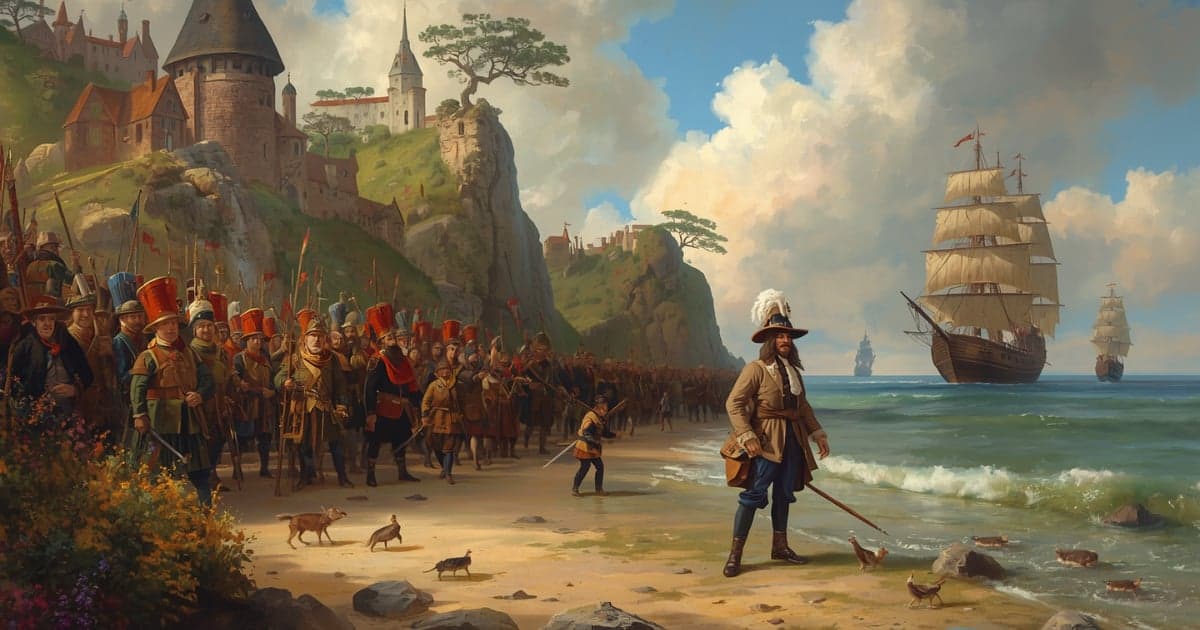
The Blefuscu fleet is anchored 800 yards away across a channel six feet deep at high water. Gulliver spies it from behind a hillock through his pocket perspective glass: 50 men of war plus transports. He orders the strongest available cables, twisted to triple thickness, and iron bars bent into hooks. Half an hour before high water he wades in wearing only his leathern jerkin. The 30,000 Blefuscudians watching from shore leap from their ships and swim to land. He fastens a hook to the prow of every vessel. Arrows pour down onto his hands and face. He pulls out his spectacles and straps them to his nose to protect his eyes, and works on. The ships will not move: all anchored. He lets go the cable, draws his knife, and cuts every anchor line receiving about 200 shots in the face and hands while he does it. Then he picks up the knotted end and walks home to Lilliput dragging 50 warships behind him. The Blefuscudians set up a scream of grief and despair. The Emperor is waiting on shore with the whole court. While Gulliver was submerged to his neck they could not see him and assumed the fleet was approaching in a hostile manner. When the channel shallows and Gulliver emerges holding the cable, he cries out: Long live the most puissant king of Lilliput. He is made a nardac on the spot, the highest honour in the empire. The Emperor then asks Gulliver to go back for the rest of the fleet and reduce Blefuscu to a province, destroy the Big, Endian exiles, and force the entire world to break their eggs at the small end. Gulliver refuses: he will never be an instrument of bringing a free and brave people into slavery. The wisest ministers agree. The Emperor never forgives him. A conspiracy against Gulliver begins forming in the council. Three weeks later Blefuscu sends ambassadors to negotiate peace. Gulliver helps broker it. The ambassadors visit him privately and invite him to their kingdom. When Flimnap and Bolgolam learn of the meeting they inform the Emperor that Gulliver's contact with the ambassadors amounts to an act of disaffection. This is the first time, Gulliver notes, that he began to form any clear idea of what courts and ministers actually are. He returns home at midnight to cries of Burglum at his door. The Empress's apartment is on fire: a maid of honour fell asleep while reading a romance and a candle caught. The court has ladders and buckets, but the buckets are the size of large thimbles and the fire is beyond them. Gulliver wishes he had brought his coat, which could have smothered it, but he left it behind in his hurry. He is out of options when he suddenly recalls that the evening before he had drunk deeply of glimigrim wine and had not, as he puts it, discharged himself of any part of it since. The heat of the fire cooperates. He urinates on the flames with precision and extinguishes them in three minutes. He goes home at dawn without pausing to congratulate the Emperor, aware that by the fundamental law of the realm it is a capital offence to make water within the precincts of the palace. The Emperor sends word that a pardon will be drawn up. It never arrives. Gulliver is privately told that the Empress, conceiving the greatest abhorrence of what he has done, has moved to the far side of the court and vowed revenge.

In this chapter: Terms Characters Key Quotes Themes Modern Story

Why This Matters

Connect literature to life

Skill: Reading Power Dynamics

Every system you enter has a hidden rule: the more capable you prove yourself, the more you threaten the people above you who depend on your compliance rather than your competence. Gulliver captures an entire fleet, saves the palace, and refuses to commit genocide, and each act of genuine service makes him more dangerous to the people he served, until the acts themselves become the charges against him. The pattern in advance: when your best work starts being cited as the problem, you are not failing; you are watching a system protect itself from you, and knowing the difference changes every decision you make next.

Coming Up in Chapter 6

The political intrigue against Gulliver intensifies as his enemies at court begin plotting his downfall. His refusal to be the emperor's perfect weapon will soon have deadly consequences.

Share it with friends

PreviousPrevious ChapterNextNext Chapter
Original text
2,450 wordscomplete

Chapter 05

The Hero's Dangerous Success

The author, by an extraordinary stratagem, prevents an invasion. A high title of honour is conferred upon him. Ambassadors arrive from the emperor of Blefuscu, and sue for peace. The empress’s apartment on fire by an accident; the author instrumental in saving the rest of the palace. The empire of Blefuscu is an island situated to the north-east of Lilliput, from which it is parted only by a channel of eight hundred yards wide. I had not yet seen it, and upon this notice of an intended invasion, I avoided appearing on that side of the coast, for fear of…

Public-domain chapter text, formatted for reading.

Master this chapter. Complete your experience

Purchase the complete book to access all chapters and support classic literature

Buy at Powell'sBuy on Amazon

Available in paperback, hardcover, and e-book formats

Now let's explore the literary elements.

Key Quotes & Analysis

"I therefore let go the cord, and leaving the hooks fixed to the ships, I resolutely cut with my knife the cables that fastened the anchors, receiving about two hundred shots in my face and hands."

— Narrator (Gulliver)

Context: The critical moment in the fleet capture: the ships would not move while anchored, so Gulliver cuts every anchor cable under sustained arrow fire

Swift buries the real act of heroism in a subordinate clause. Gulliver does not merely pull the fleet: he cuts himself free of the anchors under 200 shots to the face while standing in open water. The understatement, 'resolutely cut', is the point. This is what actual courage looks like, stripped of the ceremony that follows it.

In Today's Words:

So I let go of the rope, left the hooks in place, and cut every anchor cable by hand while taking two hundred shots to the face and hands. The same pressure appears whenever you walk into a room that already decided the rules before you arrived, and your size or status does not matter.

"I would never be an instrument of bringing a free and brave people into slavery."

— Gulliver

Context: When the Emperor demands he destroy Blefuscu completely

This moment defines Gulliver's character and seals his fate. He chooses moral principle over political advantage, knowing it will cost him. Swift shows how integrity threatens corrupt power structures.

In Today's Words:

I'm not going to help you destroy innocent people just because you want more power. The same pressure appears whenever you walk into a room that already decided the rules before you arrived, and your size or status does not matter until you learn who controls the floor.

"His majesty desired I would take some other opportunity of bringing all the rest of his enemy's ships into his ports."

— Narrator

Context: The Emperor's reaction to Gulliver's refusal to continue the attack

The Emperor's polite language masks his fury and disappointment. This diplomatic phrasing shows how power disguises its demands, but the threat is clear.

In Today's Words:

The boss was clearly angry that I wouldn't cross the line he wanted me to cross. The same pressure appears whenever you walk into a room that already decided the rules before you arrived, and your size or status does not matter until you learn who controls the floor.

"I was privately assured, that the empress, conceiving the greatest abhorrence of what I had done, removed to the most distant side of the court."

— Narrator

Context: After Gulliver saves the palace by urinating on the fire

Despite saving her home, the Empress is disgusted by the method. This shows how good intentions and results mean nothing if the process offends those in power.

In Today's Words:

Even though I solved the problem, she was grossed out by how I did it and started avoiding me. The same pressure appears whenever you walk into a room that already decided the rules before you arrived, and your size or status does not matter until you learn who controls the floor.

Thematic Threads

Power

In This Chapter

Gulliver's military success gives him influence that immediately threatens the emperor's absolute control

Development

Evolved from earlier themes about size and perspective to show how capability creates political danger

In Your Life:

Your expertise at work can make you threatening to managers who prefer compliant mediocrity

Moral Courage

In This Chapter

Gulliver refuses to enable genocide despite pressure and personal risk

Development

Introduced here as Gulliver faces his first major ethical test in Lilliput

In Your Life:

Standing up for what's right often costs you more than staying silent

Bureaucratic Absurdity

In This Chapter

Saving the palace by urinating on it becomes a legal violation because it breaks protocol

Development

Builds on earlier observations about Lilliputian politics to show how rules matter more than results

In Your Life:

Following proper channels can be more important than solving actual problems in many organizations

Success as Liability

In This Chapter

Gulliver's greatest achievements become sources of suspicion and eventual persecution

Development

New theme showing how capability creates enemies in corrupt systems

In Your Life:

Being too good at your job can make you a target for those who feel threatened by competence

Political Retaliation

In This Chapter

Court officials immediately begin plotting against Gulliver after his refusal to enable conquest

Development

Introduced here as the consequence of moral stands in power structures

In Your Life:

Speaking truth to power often results in subtle punishment and exclusion from opportunities

You now have the context. Time to form your own thoughts.

Discussion Questions

This is not a test. Five prompts guide you through the chapter, from how it opens to how it closes, so you notice context and rhythm rather than facts to memorize. Sit with each question in your own words. When you see "One way to read it," treat it as a starting point, not the only answer.

  1. 1

    Why does Gulliver's military success immediately create problems for him at court?

    ▶One way to read it

    The Emperor then asks Gulliver to go back for the rest of the fleet and reduce Blefuscu to a province, destroy the Big, Endian exiles, and force the entire world to break their eggs at the small end. In context, the question points to a concrete beat in "The Hero's Dangerous Success", not a general theme about travel or satire.

    analysis • surface
  2. 2

    What does Gulliver's refusal to enslave Blefuscu reveal about his moral boundaries?

    ▶One way to read it

    He lets go the cable, draws his knife, and cuts every anchor line receiving about 200 shots in the face and hands while he does it. In context, the question points to a concrete beat in "The Hero's Dangerous Success", not a general theme about travel or satire.

    analysis • medium
  3. 3

    How does the fire incident demonstrate the absurdity of Lilliputian laws and customs?

    ▶One way to read it

    The Empress's apartment is on fire: a maid of honour fell asleep while reading a romance and a candle caught. In context, the question points to a concrete beat in "The Hero's Dangerous Success", not a general theme about travel or satire.

    application • medium
  4. 4

    Why do Flimnap and Bolgolam interpret Gulliver's diplomatic meeting as treason?

    ▶One way to read it

    When Flimnap and Bolgolam learn of the meeting they inform the Emperor that Gulliver's contact with the ambassadors amounts to an act of disaffection. That closing pressure is what Swift wants you to carry: not a moral label, but a clear picture of who controlled the room when why do flimnap and bolgolam interpret gulliver's diplomatic meeting as treason.

    application • deep
  5. 5

    What irony exists in Gulliver saving the palace but facing punishment for his method?

    ▶One way to read it

    While Gulliver was submerged to his neck they could not see him and assumed the fleet was approaching in a hostile manner. That closing pressure is what Swift wants you to carry: not a moral label, but a clear picture of who controlled the room when what irony exists in gulliver saving the palace but facing punishment for his method.

    reflection • deep

Critical Thinking Exercise

10 minutes

Map Your Own Power Dynamics

Think of a situation where you've been successful at work, school, or in your family. Draw a simple map showing who benefited from your success and who might have felt threatened by it. Then identify what happened when you had to make a choice between going along with something you disagreed with versus standing your ground.

Consider:

  • •Success often shifts power relationships in ways you don't immediately see
  • •The people who celebrate your wins may turn on you when your values conflict with their goals
  • •Even saving the day can backfire if you don't follow the unwritten rules

Journaling Prompt

Write about a time when doing the right thing or speaking up created unexpected problems for you. What would you do differently now, knowing what you know about how power works?

Coming Up Next...

Chapter 6: The Lilliputian Way of Life

The political intrigue against Gulliver intensifies as his enemies at court begin plotting his downfall. His refusal to be the emperor's perfect weapon will soon have deadly consequences.

Continue to Chapter 6
Previous
Politics, Perspective, and Petty Wars
Contents
Next
The Lilliputian Way of Life
Keep exploring

Continue Exploring

Study guides, teaching tools, themes, and the full library.More ways to read Gulliver's Travels: study guides, teaching tools, and the wider library.

  • Gulliver's Travels Study Guide
  • Teaching Resources
  • Essential Life Index
  • Browse by Theme
  • All Books

Life-skill deep dives in Gulliver's Travels

  • Avoiding Righteous IsolationExplore keeping a better standard without contempt for imperfect people through Gulliver
  • Detecting Mission DriftSee when institutions keep noble language while prolonging problems in Gulliver
  • Detecting Rational CrueltyExplore measured policy language hiding harm through Gulliver
  • Reading Incentive InversionExplore who gets paid when poverty, sickness, or crisis never ends through Gulliver
  • Reading Power DynamicsMap who controls the environment when you arrive as an outsider in Gulliver
  • Reading the Outside MirrorUse outsider observation as diagnosis in Gulliver

You Might Also Like

Heart of Darkness cover

Heart of Darkness

Joseph Conrad

Explores society & class

Hard Times cover

Hard Times

Charles Dickens

Explores society & class

Candide cover

Candide

Voltaire

Explores society & class

Great Expectations cover

Great Expectations

Charles Dickens

Explores society & class

Browse all 106+ books

Share This Chapter

Know someone who'd enjoy this? Spread the wisdom!

TwitterFacebookLinkedInEmail

Go further with Prestige

Unlock study guides and downloads, early access, and exclusive content — and support free access for everyone.

Subscribe to PrestigeCreate free account
Intelligence Amplifier
Intelligence Amplifier™Powering Wide Reads

Exploring human-AI collaboration through books, essays, and philosophical dialogues. Classic literature transformed into navigational maps for modern life.

2025 Books

→ The Amplified Human Spirit→ The Alarming Rise of Stupidity Amplified→ San Francisco: The AI Capital of the World
Visit intelligenceamplifier.org
hello@widereads.com

WideReads Originals

→ You Are Not Lost→ The Last Chapter First→ The Lit of Love→ Wealth and Poverty→ Wisdom for the Wounded
Arvintech
arvintechAmplify your Mind
Visit at arvintech.com

Navigate

  • Home
  • Library
  • Essential Life Index
  • How It Works
  • Subscribe
  • Account
  • About
  • Contact
  • Authors
  • Suggest a Book
  • Landings

Made For You

  • Trending
  • Students
  • Educators
  • Families
  • Readers
  • Literary Analysis
  • Finding Purpose
  • Letting Go
  • Recovering from a Breakup
  • Corruption
  • Gaslighting in the Classics

Newsletter

Weekly insights from the classics. Amplify Your Mind.

Legal

  • Privacy Policy
  • Terms of Service
  • Editorial Standards
  • Cookie Policy
  • Accessibility

Why Public Domain?

We focus on public domain classics because these timeless works belong to everyone. No paywalls, no restrictions—just wisdom that has stood the test of centuries, freely accessible to all readers.

Public domain books have shaped humanity's understanding of love, justice, ambition, and the human condition. By amplifying these works, we help preserve and share literature that truly belongs to the world.

A Pilgrimage

Powell's City of Books

Portland, Oregon

If you ever find yourself in Portland, walk to the corner of Burnside and 10th. The building takes up an entire city block. Inside is over a million books, new and used on the same shelf, organized by color-coded rooms with names like the Rose Room and the Pearl Room. You can lose an afternoon. You can lose a weekend. You will find a book you have been looking for your whole life, and three you did not know existed.

It is a pilgrimage. We cannot find a bookstore like it anywhere on earth. If you read the classics, and you ever get the chance, go. It belongs on every reader's bucket list.

Visit powells.com

We are not in any way affiliated with Powell's. We are just a very big fan.

© 2026 Wide Reads™. All Rights Reserved.

Intelligence Amplifier™ and Wide Reads™ are proprietary trademarks of Arvin Lioanag.

Copyright Protection: All original content, analyses, discussion questions, pedagogical frameworks, and methodology are protected by U.S. and international copyright law. Unauthorized reproduction, distribution, web scraping, or use for AI training is strictly prohibited. See our Copyright Notice for details.

Disclaimer: The information provided on this website is for general informational and educational purposes only and does not constitute professional, legal, financial, or technical advice. While we strive to ensure accuracy and relevance, we make no warranties regarding completeness, reliability, or suitability. Any reliance on such information is at your own risk. We are not liable for any losses or damages arising from use of this site. By using this site, you agree to these terms.