The Autobiography of Benjamin Franklin
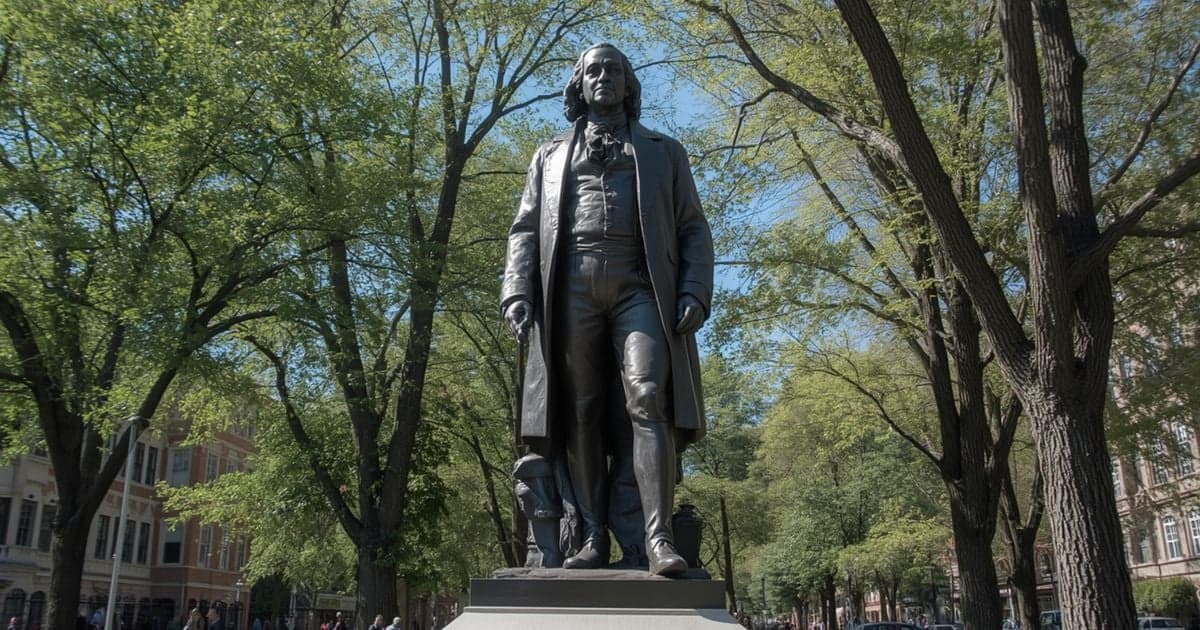
Benjamin Franklin
0:000:00
0:00 / 0:00

Prestige · $2.99/month
Chapter audio, theme analysis, and downloads
Benjamin Franklin
0:00 / 0:00
From the Chronicles · 2 installments
He sits down at Twyford in 1771 to write his son a letter and ends up writing the memoir that invented modern self-improvement. Benjamin Franklin opens by admitting he will probably gratify his vanity, then spends the next pages showing exactly how a tallow chandler's youngest son escaped Boston, walked into Philadelphia with one Dutch dollar and a loaf under his arm, and turned printing ink into a civic empire. The memoir is unfinished. It stops mid-sentence in colonial politics. That is part of the point: the method outlasts the manuscript.
Franklin is the printer-statesman who treats life as an experiment you can log. James, his tyrannical brother, is the apprenticeship that teaches him to run: Franklin takes the beatings, writes anonymous columns that become the talk of the town, and finally runs the paper alone the week James sits in jail for printing what the government would rather nobody read. Deborah Read is the practical marriage that holds while he travels. Hugh Meredith is the partner who almost sinks the shop before Franklin buys him out. The Junto is the club of tradesmen who meet on Friday nights to improve themselves and their city, then turn that habit into a lending library the whole town can borrow from. Poor Richard is the pseudonym that turns maxims into household currency. The thirteen virtues are not a sermon. They are a weekly scorecard: Temperance, Silence, Order, Resolution, Frugality, Industry, Sincerity, Justice, Moderation, Cleanliness, Tranquility, Chastity, Humility, with Humility added last after a Quaker friend tells him he has grown proud of how humble he has become. He marks failures in a little book and rotates one virtue at a time because he knows perfection is a system, not a mood.
Boston gives him Silence Dogood and a reason to leave before anyone in the print shop learns who actually wrote her. Philadelphia gives him Keimer's erratic print shop, then his own Gazette, then the almanac that teaches a continent to quote aphorisms it half-believes it invented. London nearly keeps him as a compositor forever, boarding cheap and reading everything he can borrow. Return brings the library subscription, the volunteer fire company built from one bad blaze, the academy that becomes a university, the stove, the kite, and the post office that finally makes mail reliable across the colonies. Part Two resumes in Passy with the moral perfection plan and the institutions that still bear his fingerprints. Part Three and Four carry him into science, colonial defence, and assembly politics, raising a militia without waiting for a distant governor's permission, until the pen stops with the proprietary dispute still unresolved.
Franklin never pretends he was born virtuous. He lists the means that worked: reading when others slept, choosing friends who sharpen you, turning private habit into public infrastructure. The vanity confession is not false modesty. It is the first lesson. You cannot improve what you will not measure, and you cannot measure what you refuse to name. A man who tracked his own faults in ink has less patience for anyone claiming a finished character.
The letter to his son is already the pressure. Building a Personal Improvement System is the thirteen-virtue chart and the weekly rotation: one habit at a time, logged honestly, because character is practice not performance. Learning Through Apprenticeship is the brother's shop, the escape, and London compositor work: skill acquired by doing, then owned. Reading Social Capital is the Junto's Friday questions and the library subscription that turns private readers into a public. Turning Ideas Into Civic Institutions is the fire company, the academy, and Poor Richard's almanac: one man's habit becoming a city's infrastructure. Practicing Honest Self-Assessment is the opening vanity confession and the marked virtue book: improvement starts where flattery stops. Living Frugality and Industry is the early ledger, the bread under the arm, and the refusal to confuse busyness with purpose.
He ends mid-sentence in assembly politics, but the chart is already on the table. Wide Reads puts summaries, quotes, and audio on all ten chapters, from a Boston apprentice's escape to a scorecard that still reads like a system you could start tonight.
Use Franklin's thirteen-virtue chart and weekly rotation: one habit at a time, logged honestly, because character is practice not performance.
From a child I was fond of reading, and all the little money that came into my hands was ever laid out…
Benjamin Franklin is an old man when he starts writing his life story. He admits vanity is one reaso...
The chapter opens where the last one left off: James's friends try to keep the newspaper alive by us...
The chapter begins with Franklin's Philadelphia reading group debating poetry. Ralph tricks him into...
Franklin walks out of Keimer's print shop after a loud public argument in the street. It looks like ...
Published 1793
Benjamin Franklin (1706-1790) was born in Boston, the fifteenth of seventeen children in a tallow chandler's household. He had two years of formal schooling, then went to work in his brother James's print shop, where he learned to set type, write satire under the name Silence Dogood, and finally run away to Philadelphia at seventeen.
Franklin became a printer, publisher, postmaster, inventor, scientist, and diplomat, but his autobiography is most useful for the habits beneath the titles. He founded the Junto, a mutual-improvement club, and designed the thirteen-virtue method, a weekly self-tracking system built because he knew character came from repetition, not declaration. His civic projects, the lending library, volunteer fire company, academy, and hospital, show how private discipline becomes public good. As a statesman he helped draft the Declaration of Independence and signed the Constitution at eighty-one.
Franklin wrote the autobiography in bursts between 1771 and 1790, first for his son William, later revised at friends' request as a manual for self-made life. Published after his death, it became one of the most influential memoirs in English, the ancestor of every modern book about habits and getting ahead without pretending the climb was effortless.
Franklin speaks to the exact moment a habit tracker stops working and you cannot say why: the goal you have restated a dozen times, the streak that resets every Monday, the sense that self-improvement has become its own kind of performance. He wrote before "personal growth" was a section in a bookshop, and he built a system blunt enough to survive a bad week.
Plot, characters, and themes — plus audio, source text, and patterns you can use after class
Two ways in
Chapter by chapter, with audio. The meaning arrives because you experienced it — not because someone listed bullet points.
Start with this.
The actual words the author wrote, alongside every summary. Use the guide, then step into the source.
Then step into the source.
Either way, the door opens inward.
— and most of all, Why does this matter?
Purchase the complete book to access all chapters and support classic literature
Available in paperback, hardcover, and e-book formats
Free to read • No account required

Weekly insights from the classics. Amplify Your Mind.
We focus on public domain classics because these timeless works belong to everyone. No paywalls, no restrictions—just wisdom that has stood the test of centuries, freely accessible to all readers.
Public domain books have shaped humanity's understanding of love, justice, ambition, and the human condition. By amplifying these works, we help preserve and share literature that truly belongs to the world.
© 2026 Wide Reads™. All Rights Reserved.
Intelligence Amplifier™ and Wide Reads™ are proprietary trademarks of Arvin Lioanag.
Copyright Protection: All original content, analyses, discussion questions, pedagogical frameworks, and methodology are protected by U.S. and international copyright law. Unauthorized reproduction, distribution, web scraping, or use for AI training is strictly prohibited. See our Copyright Notice for details.
Disclaimer: The information provided on this website is for general informational and educational purposes only and does not constitute professional, legal, financial, or technical advice. While we strive to ensure accuracy and relevance, we make no warranties regarding completeness, reliability, or suitability. Any reliance on such information is at your own risk. We are not liable for any losses or damages arising from use of this site. By using this site, you agree to these terms.
Deep dives
Sit with the Junto's Friday questions and the library subscription that turns private readers into a public.
Social capital grows when meetings have an agenda sharper than small talk.
Watch the fire company, the academy, and Poor Richard's almanac: one man's habit becoming a city's infrastructure.
I propos'd to render the benefit from books more common, by commencing a public subscription library.
Trending search questions mapped to the six lessons in this memoir: what readers actually ask Google about the thirteen virtues, Franklin's escape from his brother's print shop, the Junto, and the civic institutions he founded.
Franklin sits down at Twyford in 1771 to write his son a letter and ends up writing the memoir that invented modern self-improvement. A tallow chandler's youngest son escapes a brutal apprenticeship in Boston, walks into Philadelphia with one Dutch dollar and a loaf under his arm, and turns a print shop into a civic empire: a library, a fire company, an academy, and a weekly chart for tracking his own character. The memoir stops mid-sentence in colonial politics, unfinished by design as much as by circumstance.
Temperance, Silence, Order, Resolution, Frugality, Industry, Sincerity, Justice, Moderation, Cleanliness, Tranquility, Chastity, and Humility, tracked on a chart where Franklin marked a dot for every daily failure and rotated his focus one virtue at a time. Humility was added last, after a Quaker friend pointed out that Franklin was becoming proud of how humble he had become. He never claims he mastered the list. He shows the marked-up page instead.
Explore Building a Personal Improvement SystemJames Franklin's print shop teaches Benjamin to set type, but also to take beatings from a brother who is also his legal master. When the authorities jail James over a political article and ban his newspaper, the shop prints on under Benjamin's name, and the fifteen-year-old briefly runs the paper himself. Once James is free, Benjamin uses the disguised ownership as leverage to break the indenture and slip out of Boston for Philadelphia, arriving broke and unknown.
Explore Learning Through ApprenticeshipThe Junto is the club of tradesmen Franklin gathers on Friday nights to trade questions on ethics, politics, and business rather than gossip. Its habit of pooling books among members becomes the seed of the Library Company of Philadelphia, the continent's first subscription library, and its Friday-night discipline becomes the template Franklin later reuses for the fire company and the philosophical society.
Explore Reading Social CapitalA lending library, the Union Fire Company, an academy that becomes the University of Pennsylvania, a hospital, a militia raised for frontier defence, and a city watch and street-paving scheme all trace back to habits Franklin first practised on himself. Each one starts as a private routine, reading at night, tracking a virtue, reinvesting in a shop, before he scales it into something the whole city can use.
Explore Turning Ideas Into Civic InstitutionsSix lessons run through the memoir: building a personal improvement system that logs failure honestly instead of performing success; learning a skill through apprenticeship, by doing the work under someone else before owning it yourself; turning reading and clubs into social capital that compounds over decades; scaling a private habit into a civic institution that outlasts the person who started it; practising honest self-assessment by naming the vanity or motive you would rather hide; and living frugality and industry as a daily ledger, not a slogan.
What makes him indispensable is that he never claimed the system made him good. He opens by admitting he is probably writing to gratify his own vanity, then hands you the actual chart: one virtue at a time, failures marked in ink, Humility added last because pride had been hiding inside virtue number twelve. A printer's son with two years of school, he treated character the way he treated a printing press, as a machine you could take apart and improve one part at a time.
Every founder with a habit app and a spreadsheet of key results is running a version of Franklin's ledger, usually without his honesty about the failures it recorded. The memoir still works because it never promises arrival. It stops mid-sentence in colonial politics, chart still open, because the method was always meant to outlast any single finished life.