
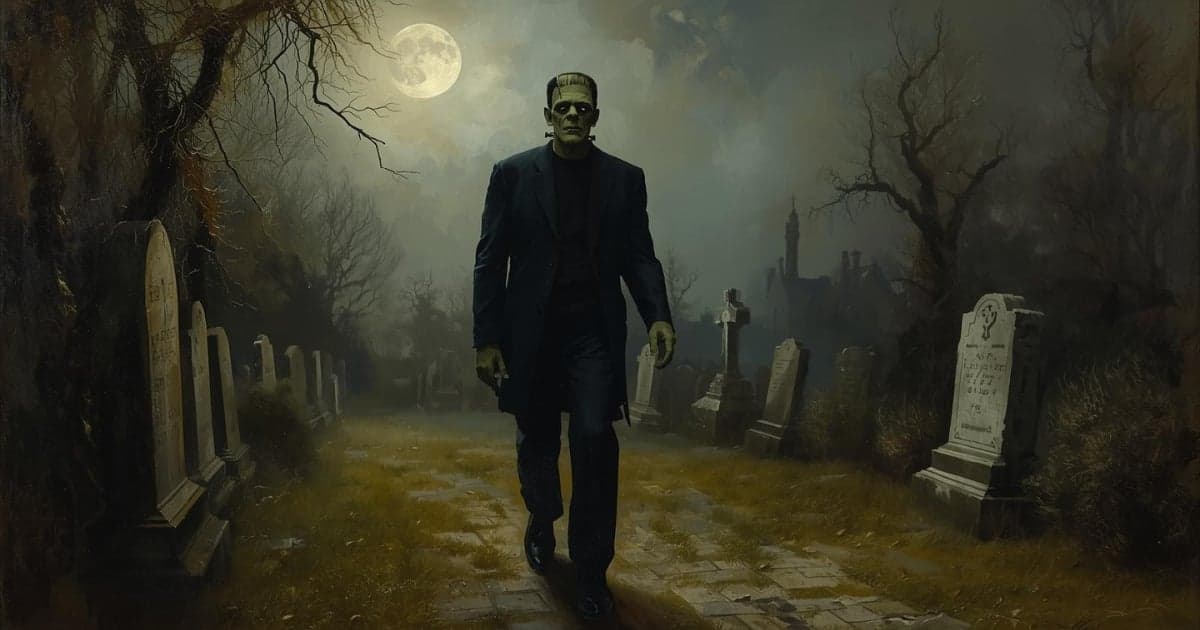
The Flight Before the Crime
Frankenstein is often retold as a warning about science that goes too far. Shelley writes an earlier failure. Victor Frankenstein spends two sleepless years assembling a body so that a new species will bless him as its creator and source. The moment a dull yellow eye opens, he leaves the room. Nothing violent has happened yet except life. The book's psychological core is that flight: a maker who can love a project and cannot bear the claim that follows when the work looks back, and a being who is then taught, face by face, that recognition will not come. The murders are what that education produces. They are not where the injury starts.
A New Species Will Bless Him
Victor's originating pressure is not a laboratory accident. It is a picture of gratitude. He wants to break the bounds of life and death and pour light into a dark world, and he wants the beings who receive that light to thank him. A creator, in that fantasy, does not stay to feed, name, or answer. He is the source. The species does the blessing. Care would spoil the pose, because care is a debt that runs the other way.
The house he comes from already knows a different version of making. His parents take in Elizabeth as a child and raise her beside him as companion and promised wife. They treat a life they did not generate as a person they will keep. Victor learns a colder lesson from the same childhood. He is the centre of a loving attention, and his father meets the one passion that is his own, the old alchemists, by calling Agrippa sad trash and offering no path in its place. The interest goes underground. Secrecy becomes proof that he is near a truth other people are too dull to see.
By Ingolstadt he has stopped writing home. He studies corpses in order to understand life, then decides the parts must be large, about eight feet, because small work would be too difficult. Scale belongs to the fantasy. A giant is closer to a monument than to a child. The workshop at the top of the lodgings is chosen because it has no witnesses. Creation, for him, is a speech about himself that must not be interrupted by the thing it addresses.
The Yellow Eye Ends the Dream
The November night is the break. The eye opens, the skin is yellow, the lips are black, and Victor's name for the success changes in a breath from triumph to catastrophe. He calls the being a wretch. He cannot look. He flees, sleeps, and dreams that a kiss given to Elizabeth becomes the corpse of his dead mother. Giving life and meeting the dead occupy one image. He wakes and the creature is by the bed, reaching, as if to detain him. He runs into the courtyard and will not go back.
This is the stake of the novel, and it arrives before William, before Justine, before any bargain on the ice. The work has done nothing but live and reach. The maker experiences that reach as an attack. A project can be loved while it is still material. The moment it can look back, it stops being a gift the maker gives himself and becomes a person who might need him. His defence is instant and bodily. He removes his eyes. Later he will remove his voice, his letters, and at last his presence from entire countries.
Clerval's arrival the next morning shows what a familiar face can still do. Henry's kindness brings Victor back into a human day, and it helps him bury the night. A long fever follows, in which the name of natural philosophy itself becomes sickening. He can accept a friend's care and still cannot speak the fact that would make the care accurate. The secret already works as a second self. It lets him be nursed as a victim of nerves rather than as a man who left a living being behind.
The Hovel Teaches a Self the Maker Never Planned
The creature's narrative is the development Victor refused to imagine. He wakes into pain, hunger, and light, with an adult body and no words. Fire teaches him by burning him. People run, or stone him. He hides against the De Lacey cottage and learns a family by watching it: Felix at work, Agatha in the house, the blind father, then Safie learning to read. He does not begin as a fiend. He begins as a student of other people's kindness, locked on the wrong side of the wall.
Paradise Lost, Plutarch, and The Sorrows of Werter finish a self the cottage only sketched. He reads Milton as true. Adam had a maker who spoke to him. He has a maker who wrote disgust in a journal and left. He tries Satan's part because envy fits the window, then finds that Satan at least fell from a rank. The journal in the coat is worse than either story. Victor had called the work odious before the being had done anything but exist. Language, gained in hope of being admitted, becomes the instrument that tells him he was refused in advance.
The blind father is the last unguarded offer. While De Lacey cannot see, he can hear a gentle voice and answer it. When the others return, the face ends the conversation, and Felix beats the guest. The creature burns the only school he has had. Later he saves a drowning girl and is shot for it. Near Geneva he hopes a child might not yet be trained in disgust. The child says he is a Frankenstein, and William dies in that recognition. The murder is hideous, and it uses the maker's own logic. If he cannot be kept, he can still make desolation. The family that would not have him has a name, and the name is vulnerable.
Silence Lets the Court Finish the Flight
Victor sees the creature in the storm over the place where William was found, and he knows. Justine is accused because a miniature of the dead mother was placed in her pocket. Elizabeth speaks for her. Justine, pressed by her confessor and by the charge, confesses falsely and is condemned. Victor tells himself the truth would sound like madness, so speech would not save her and might only destroy him. As a prediction about a courtroom, the fear is not foolish. As a moral position, it repeats the November flight in public. He withholds the one fact that would make the evidence mean something else, and he calls the withholding helplessness.
Justine's death shows a private defence recruiting an institution. The court does not know it is finishing Victor's refusal. It knows a locket, a servant, and a confession. That is enough for a hanging. His grief is real, and it is also useful. Suffering lets him stand with the family as a mourner rather than as the man who armed the killer and then declined to speak. From here the secret is an accomplice. Every later confidence would have to include Justine, so every later confidence becomes harder. A turned back has become a theory of who is allowed to know.
The Companion Is Asked For, Then Torn Apart
On the glacier the creature forces the talk the bedroom fled. Victor's first words still shrink him: devil, vile insect. The answer is a claim about development. He was benevolent and good. Misery made him a fiend. Make him happy, and he will be virtuous again. He does not ask Victor to become a father in the house. He asks for a female companion as despised as he is, and then exile in the wilds of South America. Victor hears the justice and agrees. The bargain is the nearest he comes to staying, and it is still a design for absence. He will make a second life so he does not have to share a city with the first.
In the Orkney hut he works in cold blood, no longer blinded by the first enthusiasm. A second creature might refuse the exile, hate her mate, or bear children. He looks up. The first creature is at the window. He tears the unfinished body apart in that sight. The promise was the last form of care he had offered, and he unmakes it as a private decision with an audience. The sentence on the way out is the one he will misread for the rest of the book. The creature will be with him on the wedding night.
He hears a threat against himself. He has always been the person in the fantasy, the one the species blesses or the demon hunts. Elizabeth, who writes to ask whether he wants the marriage or only the duty, is the life in the way. He patrols an inn and sends her to rest. The scream comes from the room he was not guarding. He still cannot imagine that the claim might fall on someone other than his own body. Clerval on the Irish shore, Elizabeth on the bed, and Alphonse a few days later die of a pursuit he organised by leaving, and then by breaking the only terms he had accepted.
Three Voices, and the Delay Is the Defence
The form of the book is part of its psychology. Walton writes to his sister Margaret from a ship he has wanted since a dying father forbade the sea. He failed as a poet, inherited money, and trained for years toward a pole he pictures as light and beauty. He wants a friend who will ratify the hunger. When the ice gives him Victor, he is so glad of the likeness that the warning arrives as the pleasure of being understood. The frame is a man at the start of the same wish, taking dictation from a man at the end of it.
Inside that letter, Victor tells his life. Inside Victor's tale, the creature tells his. The reader meets that eloquence only after long chapters of the maker's disgust, and only because Victor agreed to listen in a hut. Delay is the defence. Family, court, and crew are asked to live inside the maker's names for what he made. When the second voice arrives, it is already pleading against a verdict the structure delivered early. Shelley nests the abandoned voice inside the abandoner's, then nests both inside a third man who may yet repeat the wish.
What the form withholds matters as much as what it shows. Victor never gives the technical secret. The omission fears a copy, and it keeps the glory abstract. He can be the man who broke the bounds without becoming a recipe another Walton might follow. The creature is forced to be specific: straw, fire, the blind man's music, the books, the shot, the child. His story is evidence. Victor's is a confession that still chooses its own charge. He will be judged for ambition, which sounds like an excess of mind. He is slower to be judged for the morning he would not go back into the room.
The Ice Does Not Reconcile Them
After Elizabeth and his father are dead, Victor does not learn to stay. He learns to chase. At the graves he vows pursuit until one of them dies. The creature laughs in the dark and calls himself satisfied, because a life organised around revenge is a relation he can finally count on. Along the route he leaves marks and food, keeping the hunter alive for the hunt. The maker who would not remain is now not allowed to leave.
The ending does not repair the first flight. Victor dies on Walton's ship still cast as the warning. The creature comes aboard, weeps, and vows to burn himself at the northern edge of the world. Walton does not see the fire. The last image is a figure lost in darkness and distance. The grief does not cancel William, Justine, Clerval, or Elizabeth, and the warning is addressed to the next ambitious man, not to the being who needed a name. The wish to be blessed and the wish to be kept stay frozen past the point where speech could change anything.
Why It Resonates Now
The fear the book keeps returning to is not a general dread of knowledge. It is the dread of being claimed by what you were glad to start. A project can be loved while it still reflects the maker. The panic begins when it looks back and needs a morning after: a name, a witness, a person who will not call that need a catastrophe. Modern life is full of stories that start the clock at the damage instead of at the exit. Shelley starts earlier. The yellow eye is enough.
The story told afterward is the other pressure. A warning is a flattering shape for guilt. It lets the teller be the man who suffered for a great attempt, and it lets the listener feel serious without picturing the servant, the friend, or the wife who paid. Readers still reach for the word monster because it finishes the flight for them. If the being was monstrous at the first breath, then leaving the room was taste, not abandonment. The novel's unease is that the wish to be good and the later ruin are one history. Refusal came first.
Limits of This Reading
This reading can make the book sound like a case of a man who cannot tolerate need. That pattern is in the text. It is not a diagnosis. Shelley is writing a Gothic novel inside arguments about experiment, God, and the rights of beings who can reason. The mother's corpse in the kiss is a real image. Treating it as a complete theory of the family, as if one night explained Ingolstadt, overreads a shock the book leaves as shock.
Other readings hold. One keeps the science at the centre: a discoverer who will not govern the power he has taken. That account is not wrong. It starts too late if it begins at the murders and skips the flight, because the first failure is absence. Another hears the creature as the outcast body a household calls fiend the moment sight replaces voice, with Safie's exile beside his in the same cottage. A third reads the workshop through Shelley's own losses. Biography can light the dream. It cannot replace the plot, in which a man leaves a being and then stays silent while a servant hangs. The summary that science alone is the villain is cleaner than the rooms will bear.
Across the Shelf
The Strange Case of Dr Jekyll and Mr Hyde is the near book, and not because both end in a hunted body. Jekyll wants the experiment and a spare name so the public self need not sign the appetite. Victor wants the experiment and a flight so the public self need not stay with what the experiment became. Utterson and Walton receive the confession after it can no longer be lived. Hyde is a compartment of the maker. The creature is someone else, who assembles a mind from a cottage window and from Paradise Lost. Adam had a maker who remained long enough to speak, and Satan had a rank to lose. He is offered neither.