
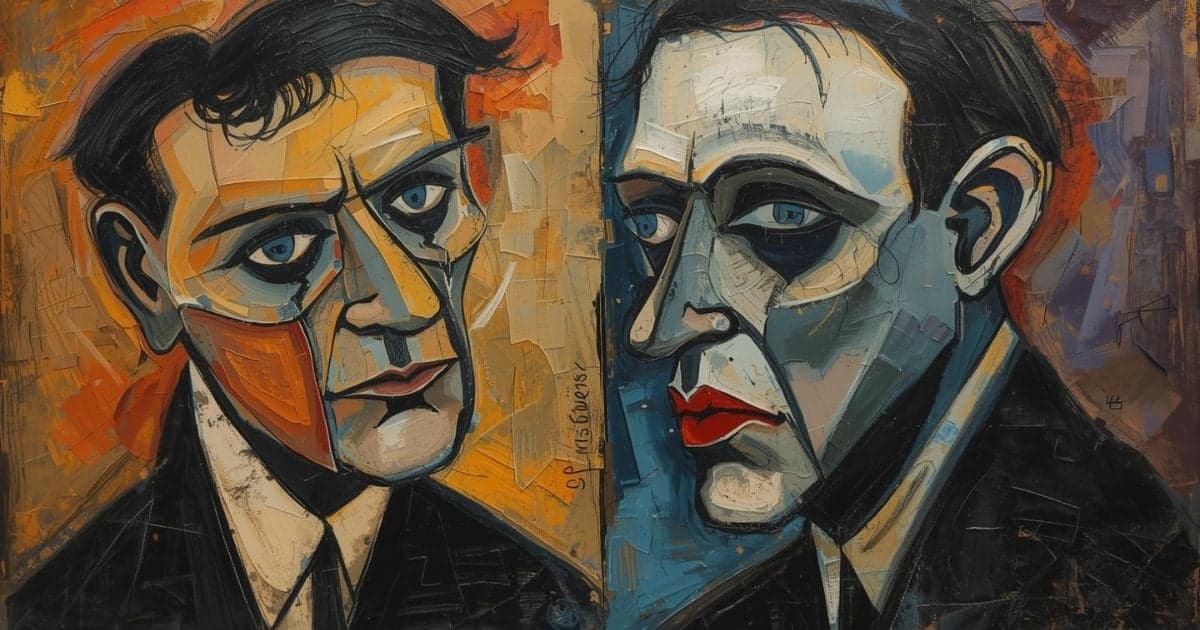
A Spare Name for the Same Appetite
The Strange Case of Dr Jekyll and Mr Hyde is often retold as a monster hidden inside a good doctor. Stevenson writes something colder. Henry Jekyll already lives as two purposes before he ever drinks. He wants the respect of the wise and good, and he wants pleasures he will not let that public face sign. The draught does not create the split. It gives the disowned appetite a smaller body, a separate address, and a name that can inherit the estate. The book's psychological core is disavowal: the wish to commit the act and keep the conscience unemployed, and the friends who file that wish as a legal problem until a face will no longer change back.
The Split Is a Habit Before It Is a Drug
Jekyll's confession begins with a fortune, excellent parts, and a hunger for a grave countenance. His fault, by his own account, is not a spectacular vice at the start. It is an impatient gaiety he cannot reconcile with the face he wants to wear in public. He hides the pleasures. Then he looks back and finds himself already committed to a profound duplicity. He insists he was no hypocrite in the cheap sense. Both sides were in dead earnest. The respectable labour and the secret indulgence each felt like the real man while it lasted.
That is the originating pressure, if a single wound is even the right picture. It is less a childhood injury than a moral ambition that cannot tolerate mixed motives. He would rather be purely just in one body and purely unjust in another than remain one person who wants both. The famous claim, that man is not truly one, but truly two, is not a discovery forced on him by the chemical. It is the theory he reaches for because a mixed life feels like failure. The drug is recruited to prove a story he is already living.
The move has a plain shape. Keep the valued self clean by housing the rest somewhere that self does not have to sign. Jekyll wants the pleasure and the acquittal in the same week. Hyde is where the acquittal is stored.
Hyde Is Smaller Because That Part Was Kept Smaller
The first look in the glass is not horror. Jekyll feels a leap of welcome. "This, too, was myself." The new body is younger, lighter, and stamped with a deformity no witness can point to. Enfield's phrase at the door is exact. Hyde gives a strong feeling of deformity, although the point will not be specified. The hatred he stirs is immediate and almost contentless. People recoil before they can file a charge.
Jekyll explains the smallness in a way the popular summary usually skips. The side he had indulged in hiding was the less grown side, so the body that expressed it was smaller. Hyde is not a giant of foreign evil. He is the stunted size of an appetite that was never allowed a full adult shape in public. When the draught shakes the doors of his disposition, what runs out is the part that was awake. He calls the drug neither diabolical nor divine. It does not import a devil. It opens a door the man had already built.
The welcome matters. A true alien would disgust him. Hyde feels natural because he is the appetite without the grave face. For a time Jekyll can remember the adventures and still wake as the doctor who does good in a hurry, as if repair could keep the ledger clean. The sentence he lives by is the one he later writes without embarrassment: it was Hyde, after all, and Hyde alone, that was guilty. That is not confusion. It is the design.
The Draught Shrinks the Interval of Choice
At first the change is chosen. He risks death, drinks, walks his own house as a stranger, and drinks again to come back. He furnishes rooms in Soho. He tells the servants that Hyde has power in the square. He writes a will that treats disappearance as a planned event. If Henry Jekyll is absent for three calendar months, Edward Hyde inherits without delay. The legal paper is a psychological one. It imagines a future in which the spare self may need the estate because the public self has gone missing.
Habit then shortens the gap between wanting and changing. After the murder of Sir Danvers Carew he swears the double life is finished. For more than two months he lives as the opened, charitable doctor. The peace does not hold, because the appetite was never only Hyde's. He falls again as an ordinary secret sinner, in his own person, and treats the slip as a return to the old days before the discovery. The balance breaks there. On a clear January day in Regent's Park he sits in the sun, compares his good will with other men's neglect, and the change comes over him in the middle of that self-praise. He did not go to the park to become Hyde. The respectable mood summoned the other body.
Later even the chemistry deserts the plan. He has London searched for the powder that still works. He decides the first supply was impure, and that the unknown impurity lent efficacy to the draught. The last of the old powders is what lets Henry Jekyll finish the statement. A tool that once offered a separate life has become a dwindling stock of permission. The interval of choice keeps shrinking until the name he wants to keep is something he can borrow for a few pages and no longer inhabit at will.
Utterson Files the Disgrace So the Friend Can Stay Intact
The novel's form is part of its psychology. We do not begin in the cabinet. We begin with Gabriel John Utterson, a lawyer who is hard on himself and easy on others, and who likes to say he lets his brother go to the devil in his own way. That sentence is a professional ethic and a defence. It lets him care for a friend without inspecting the friend's secrets, until a will makes inspection feel like duty.
Enfield's story of the child, the hundred pounds, and the cheque gives the empty name a body. Utterson opens the safe and rereads the will. He had thought the paper madness. Now he begins to fear it is disgrace. The fear is social before it is metaphysical. A respectable estate tied to a man who trampled a child is a scandal, and scandal is what Utterson is built to prevent. He hunts Hyde's face as if one look would settle the story. The face does not settle it. The deformity still has no point he can name.
After Carew, Jekyll hands him a letter, binds his honour that Hyde is done, and admits he has been thinking of his own character. Utterson's clerk, Guest, lays that hand beside a note of Jekyll's and finds them the same hand, differently sloped. The lawyer locks the paper away. When Hyde vanishes, Utterson decides Carew's death is more than paid for by the disappearance. That is the witness's own split. The murder can be filed as finished if the embarrassing name has left the square. The narration stays with this man for most of the book because respectable London prefers a case to a confession. Delay is not only suspense. It is the time a defence needs.
Lanyon Dies of a Fact That Will Not Stay a Theory
Hastie Lanyon is the friend who broke with Jekyll over work he calls unscientific balderdash. He is hearty, sure that method can tell knowledge from theatre. That certainty is his character and his limit. When Jekyll, trapped in Hyde's body, sends him to fetch a drawer and a powder, Lanyon obeys as a doctor and a gentleman. He then watches the man drink and become Henry Jekyll in the room.
The shock is not only fear of a trick. It is the collapse of a sorting system. If the colleague he can barely stand to name can stand up out of a body he loathes, then the line between a reputable mind and a criminal body was never a fact about nature. It was a social agreement. Lanyon tells Utterson he has had a shock and shall never recover. He asks to hear no more of a man he regards as dead. He dies of the sight, and he leaves the narrative sealed until Jekyll's death or disappearance. Even the man who saw the change participates in the delay. The letter is a last attempt to keep the fact inside a professional envelope.
The Sunday Window Shows a Face That Will Not Hold
The defences of the square fail in public before they fail in the cabinet. Utterson and Enfield stop at the door that began the story. They step into the court, hoping a friend's presence might reach Jekyll at the window. For a moment the doctor is there. Then the face gives way to abject terror and despair, and the window is shut. No chemical is shown. The two gentlemen only see that the person who can still be greeted as Jekyll cannot keep that expression in company. The respectable self has become a surface that lasts for a sentence.
Poole's night makes the same fact domestic. The servants gather like people who have already decided the house is wrong. The voice behind the red baize door is not the voice Poole has heard for twenty years. When the door is broken, the body on the floor is Edward Hyde in clothes far too large for him, the doctor's clothes, with a crushed phial in the hand and the smell of kernels in the air. There is no second corpse. The theory of two men who could live apart ends as one small body in a borrowed suit. The will's fantasy, that Hyde might step into Jekyll's place, arrives as a literal mismatch of size. The spare self cannot wear the life it was meant to inherit.
The Confession Tries to Keep the Credit of the Suffering
Jekyll's full statement is the ending, and it does not join the two names into one responsible person. It explains. He writes while the last powder still lets him think his own thoughts, and he knows this is the last time, short of a miracle. The document is brave as evidence and careful as a plea. Earlier, in a letter Utterson reads while Lanyon is dying, he has already asked to be held as the chief of sinners and the chief of sufferers also. Suffering, in that sentence, is asked to stand beside guilt so that guilt does not have to stand alone.
Memory will not support the clean split he wants the moral to keep. He says the two natures had memory in common. Jekyll remembers Hyde's adventures. Hyde treats Jekyll mainly as the place one hides, the way a bandit remembers a cavern. The asymmetry is disavowal in one picture. The public self keeps the memories and the remorse. The secret self keeps the acts and very little loyalty. A shared memory means the doctor cannot claim ignorance. He can only claim that the guilt belonged to the other name while he watched.
The book therefore does not close on a cure, or even on a lesson the hero is alive to practise. It closes on a statement written in a shrinking interval, read by a lawyer after the writer can no longer answer. Utterson is left with papers. The square is left with a scandal that can finally be told because the man who feared disgrace is gone. The attempt to live as two fails in the body. It survives as the shape of the confession, which still tries to sort sinner from sufferer after the chemistry has refused to sort them.
Why It Resonates Now
Readers still recognise the hope that a second name can carry an appetite the first name will not sign. The hope shows up wherever a public role is treated as the real person and the rest is filed as time apart: the professional who is generous in the role and cruel in the unnamed hours, the substance that is asked to make a forbidden mood feel as if it happened to someone else. Stevenson is not writing a pamphlet about drink. He is writing the moment when the permission runs out and the face in company will not hold.
The book's witnesses are current in the same way. Utterson would rather a disappearance pay for a murder than let a friend's character come apart in public. A file can be closed when the embarrassing name leaves, and the people who loved the respectable version can call the rest an influence that has been withdrawn. The novel's unease is that the influence was never a visitor. It was the part of the man that the grave face had been used to conceal.
Limits of This Reading
This reading can flatten the book into a case. It is a Gothic tale of a chemical double, written inside a habit of thought in which the self is already a war among members. Stevenson is not diagnosing a dissociative disorder. Jekyll's shared memory, his pleasure in the theory, and the impure salt are literary devices, not clinical signs. A medical reading that forgets the draught is a fantasy will sound more certain than the text.
Other readings keep different centres, and they should. One treats Hyde as a class body: Soho, the hatred of the crowd, the small man the respectable square can describe only as deformity. Another hears a sexual secret in the unnamed irregularities, the cheque, the will, and the sealed letters, a private life the plot punishes without specifying. The text never names that secret. To insist on it is to fill a blank Stevenson left. To deny that readers hear it is to ignore why the pleasures stay vague while the murder is shown in full. Reputation in professional London is not a metaphor for a private mood. It is the currency Jekyll is trying to protect. The drug plot is also a plot about a man who cannot afford to be mixed in public.
Across the Shelf
Frankenstein is the near book, and not because both are monster stories. Victor wants the glory of the making and the innocence of not owning what the creature does. Jekyll wants the experiment and a spare name for the pleasure and the violence. In both, a witness frame delays the maker's voice. Walton and Utterson are decent men asked to carry a confession they did not live. The creature and Hyde are not the same kind of being. One is built and abandoned. The other is a compartment of the maker. Read together, they show how a brilliant defence can sound like science: the maker explains the method in full, and the explanation is also a request to be judged as the sufferer of his own design.