Chapter 43
The Muleteer's Song and the Halter Trap
LIII. WHEREIN IS RELATED THE PLEASANT STORY OF THE MULETEER, TOGETHER WITH OTHER STRANGE THINGS THAT CAME TO PASS IN THE INN Ah me, Love’s mariner am I On Love’s deep ocean sailing; I know not where the haven lies, I dare not hope to gain it. One solitary distant star Is all I have to guide me, A brighter orb than those of old That Palinurus lighted. And vaguely drifting am I borne, I know not where it leads me; I fix my gaze on it alone, Of all beside it heedless. But over-cautious prudery, And coyness cold and…
Public-domain chapter text, formatted for reading.
Master this chapter. Complete your experience
Purchase the complete book to access all chapters and support classic literature
Available in paperback, hardcover, and e-book formats
Now let's explore the literary elements.
Key Quotes & Analysis
"Nay, he is the lord of many places,” replied Clara, “and that one in my heart which he holds so firmly shall never be taken from him"
Context: Dorothea assumes the singer is a muleteer
Clara renames rank in the language of love. The disguise hides a gentleman; the song exposes him.
In Today's Words:
No, he owns estates, and he holds the place in my heart that no one else will get The same dynamic turns up in offices, relationships, and public life today, wherever someone bends circumstances to fit a story they cannot put down The same dynamic turns up in offices, relationships, and public life today, wherever
"I have never spoken a word to him in my life; and for all that I love him so that I could not live without him."
Context: Confiding her secret to Dorothea at the hayloft hour
Their courtship happened through windows and signs alone. Absence and song carry what speech never could.
In Today's Words:
We have never spoken, yet I love him so much I could not live without him The same dynamic turns up in offices, relationships, and public life today, wherever someone bends circumstances to fit a story they cannot put down The same dynamic turns up in offices, relationships, and public life today, wherever someone bends
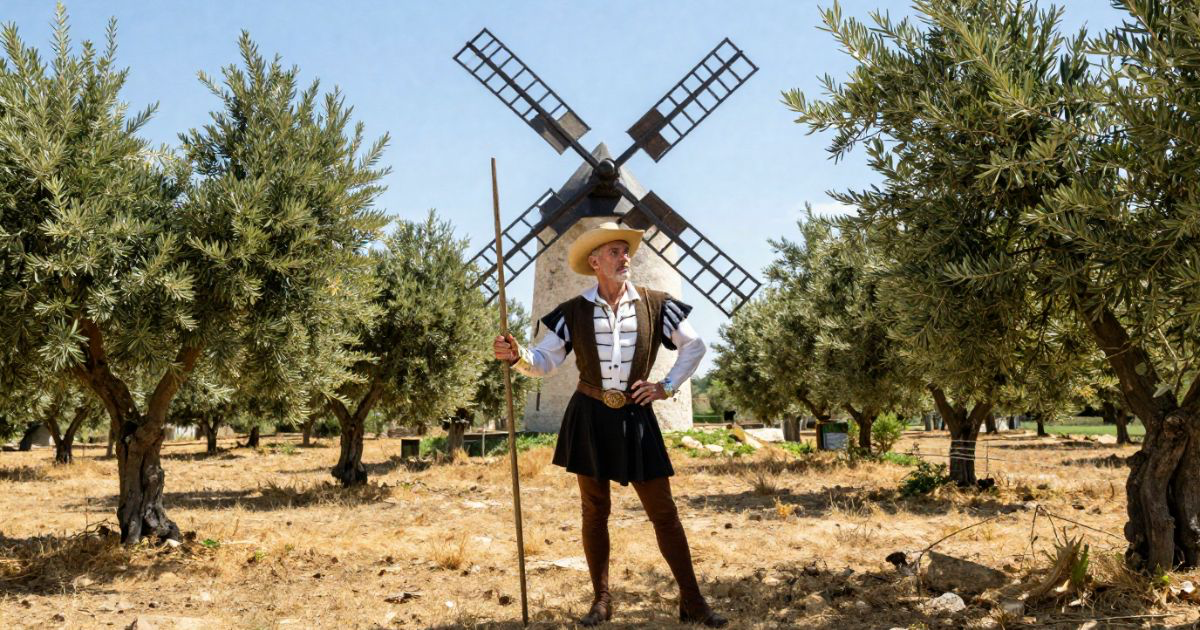
"Oh my lady Dulcinea del Toboso, perfection of all beauty, summit and crown of discretion"
Context: Mounting guard outside the inn while the women sleep
His vigil is entirely sincere and entirely misplaced. Earnest devotion makes him prey to the next joke.
In Today's Words:
Oh my lady Dulcinea, perfection of beauty and good sense The same dynamic turns up in offices, relationships, and public life today, wherever someone bends circumstances to fit a story they cannot put down The same dynamic turns up in offices, relationships, and public life today, wherever someone bends circumstances to fit a story they
"Knights, or squires, or whatever ye be, ye have no right to knock at the gates of this castle"
Context: Four armed travellers arrive at dawn while he hangs tied
Even in pain he plays castellan. Fantasy persists after the body has already paid the price.
In Today's Words:
Knights or squires, you have no right to knock at the gates of this castle The same dynamic turns up in offices, relationships, and public life today, wherever someone bends circumstances to fit a story they cannot put down The same dynamic turns up in offices, relationships, and public life today, wherever someone bends circumstances
Thematic Threads
When Love Has to Travel in Disguise
In This Chapter
The muleteer's song continues at dawn, and Dorothea wakes the Judge's daughter Clara so she will not miss the voice.
Development
This chapter pushes the pattern into visible action and consequence.
In Your Life:
You may recognize this pattern when stress removes the polite version of a situation.
Identity
In This Chapter
Characters defend who they are or who they pretend to be when challenged.
Development
Fantasy and reality collide around name, rank, and role.
In Your Life:
You might cling to a version of yourself that no longer matches your choices.
Class
In This Chapter
Rank, money, and reputation decide who is heard, protected, or punished.
Development
Social order shapes every rescue, betrayal, and humiliation here.
In Your Life:
You see this when status decides whose account of events becomes official.
You now have the context. Time to form your own thoughts.
Discussion Questions
This is not a test. Five prompts guide you through the chapter, from how it opens to how it closes, so you notice context and rhythm rather than facts to memorize. Sit with each question in your own words. When you see "One way to read it," treat it as a starting point, not the only answer.
- 1
Why does Clara recognize the muleteer's voice immediately and beg Dorothea not to wake her to hear it?
analysis • surfaceOne way to read it
Clara knows the singer is the Aragonese gentleman who courted her in Madrid and now follows her family's journey in disguise. Hearing his voice causes her physical trembling and emotional pain.
- 2
What makes Maritornes and the landlady's daughter decide to trick Don Quixote with the halter instead of just listening to his speeches?
analysis • mediumOne way to read it
Cervantes shows how Quixote's grandiose romantic language becomes comedy to practical people. His elaborate courtly speeches to 'demi-damsels' invite mockery rather than respect.
- 3
Where do you see people today following someone they love but cannot openly approach?
application • mediumOne way to read it
Social media stalking, attending events where an ex will be, or taking jobs near someone you're interested in. Like Clara's gentleman, people find indirect ways to stay close.
- 4
When might someone today face Clara's dilemma of loving someone their family would never accept?
application • deepOne way to read it
Dating across social classes, religions, or family expectations about career or background. Clara's fear that she's 'not fit to be even a servant' to his family echoes modern class anxieties.
- 5
What does the contrast between Clara's secret love and Don Quixote's public declarations reveal about different ways of experiencing romance?
reflection • deepOne way to read it
Clara's whispered confession shows real love's vulnerability and fear, while Quixote's loud speeches to the moon show fantasy love's performance. True feeling often hides; imagined feeling often displays itself.
Critical Thinking Exercise
Name the When Love Has to Travel in Disguise Move
Re-read the chapter summary and write down where when love has to travel in disguise first appears, who pays for it, and who benefits from keeping it going. Then write one sentence you could say to interrupt the pattern without shaming the person caught in it.
Consider:
- •Separate the person's worth from the pattern's cost
- •Notice who has power to stop or fuel the scene
- •Ask what truth would require someone to give up
Journaling Prompt
Write about a time when you saw when love has to travel in disguise in your own life. What finally made the pattern impossible to ignore?
Coming Up Next...
Chapter 44: Don Luis, the Landlord, and Mambrino's Basin
Don Quixote's bellowing wakes the inn; Maritornes cuts him loose, and the travellers demand to know why a man hangs from the hayloft door What follows unsettles everything settled here Maritornes cuts Don Quixote down from the halter, and he gallops off challenging anyone who says he was justly enchanted. Four servants arrive hunting Doña Clara's lover, the disguised Don Luis, and find him.