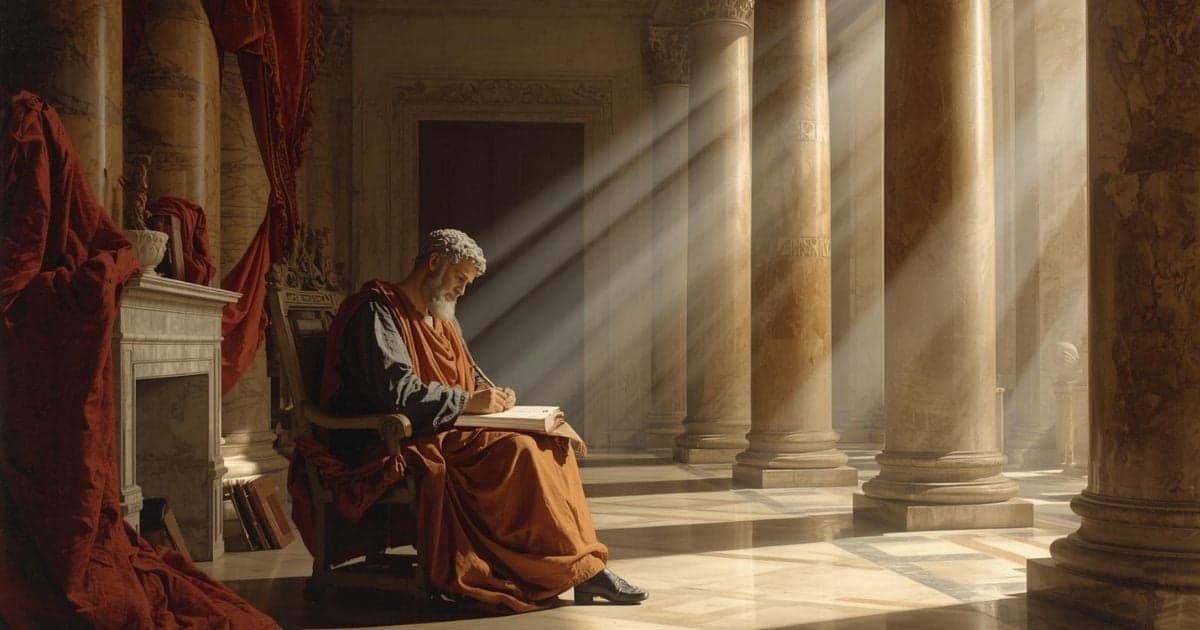
You can agree that God is good in theory and still want to throw the book when the wicked prosper.
That is Boethius at the opening of Book IV. He accepts Philosophy's ladder: happiness, the good, divine order. Then he points at the world from his cell. Virtue punished. Crime unpunished. The innocent disgraced, the cruel elevated. He is not posing a classroom problem. He is describing the political ruin that may kill him while his enemies celebrate.
Philosophy does not tell him to stop looking. She meets the scandal head-on with a series of paradoxes that feel outrageous until you follow the steps. Only the good truly have power, she argues, drawing on Plato's Gorgias, where to will evil is not to will at all: the wicked may move armies and sign decrees, but they cannot accomplish what they ultimately will, because they will happiness and destroy themselves chasing substitutes. Whoever gets what he wants without getting the good never had real power, only appetite dressed as command.
She insists that vice does not escape its account and reward does not skip the virtuous; the timing is hidden, not cancelled. The tyrant who looks strongest may be weakest in the only sense that matters. Then she turns the knife: the wrongdoer who succeeds is more wretched than the victim; the criminal who escapes punishment is worse off than the one who is punished. Not because pain is pleasant, but because unchecked vice eats the soul that must live with itself. Boethius answers the way honest people do: the logic may cohere, but the front page does not. Along the way she dismantles the idea that punishment is always visible as punishment. Sometimes the virtuous suffer because the world is broken; sometimes the wicked flourish because fortune is indifferent to merit. Philosophy does not pretend those facts away. She argues that the wicked man's success is not strength but a deeper kind of lack: he has what he wanted and still is not what he wanted to be. The good man, by contrast, cannot lose the one thing that matters most, because virtue is not a title fortune can revoke.
Philosophy supports the argument with stories that are not decoration. Ulysses loses his crew because Circe's pleasure turned men into beasts; the fable is a mirror for anyone who trades judgment for appetite and calls the result freedom. Examples of ruin pile up from history and myth: power without virtue ends in self-destruction even when the world applauds the rise. The applause is part of the trap, because it convinces the crowd and the tyrant alike that the ascent means approval from reality itself.
So she changes the lens. Providence is God's plan held complete in one eternal view: simple, whole, not hurried along a corridor of time. Fate is that plan unfolding here, event by event, in the world we actually live in. From inside a single event, justice looks random. From the whole, even what harms you may be discipline, correction, or the stripping away of what was never yours to keep. The distinction is not a trick to silence grief; it is a way to say that your chapter is real and still not the entire book. She compares the eternal view to a spectator who sees the whole play at once while the actors on stage experience only their scene. That image does not erase Boethius's pain. It gives him a reason not to let one scene rewrite his entire theology.
Her hardest claim comes last: every fortune, rightly understood, is good fortune for the soul aimed at the good. That does not call evil good. It does not ask Boethius to enjoy his cell. It says the outrage you feel is often the pain of seeing one chapter without the book, and that the wicked's apparent victory is a kind of poverty disguised as triumph. She even argues that Providence can use the wicked to improve the wicked, a claim that sounds impossible until you remember people who changed only after disaster stripped their illusions: seeing injustice clearly can turn some toward the good they had abandoned.
Book IV is long because the scandal is serious. Boethius keeps interrupting with the objection every honest reader feels: if this is true, why does the world look so unjust right now? Philosophy treats those interruptions as part of the cure, not a failure of faith. This chapter is for anyone who has watched the wrong person win. It does not offer a timetable for justice. It offers a way to refuse despair without lying to yourself: the story is larger than the scene you are in, and your task may still be to remain good inside it, even when you cannot yet see how the whole story resolves.
Coming Up in Chapter 5
Boethius accepts God's goodness and the hidden order of fortune, but one fear remains: if God foreknows everything, is human freedom only an illusion? The last book takes up fate, foreknowledge, and choice The last chapter asks the question that haunts every thoughtful person who has ever felt trapped: if the future is already known, does anything I do matter? Boethius has traveled a..