Chapter 20
Two Philosophers Debate at Sea
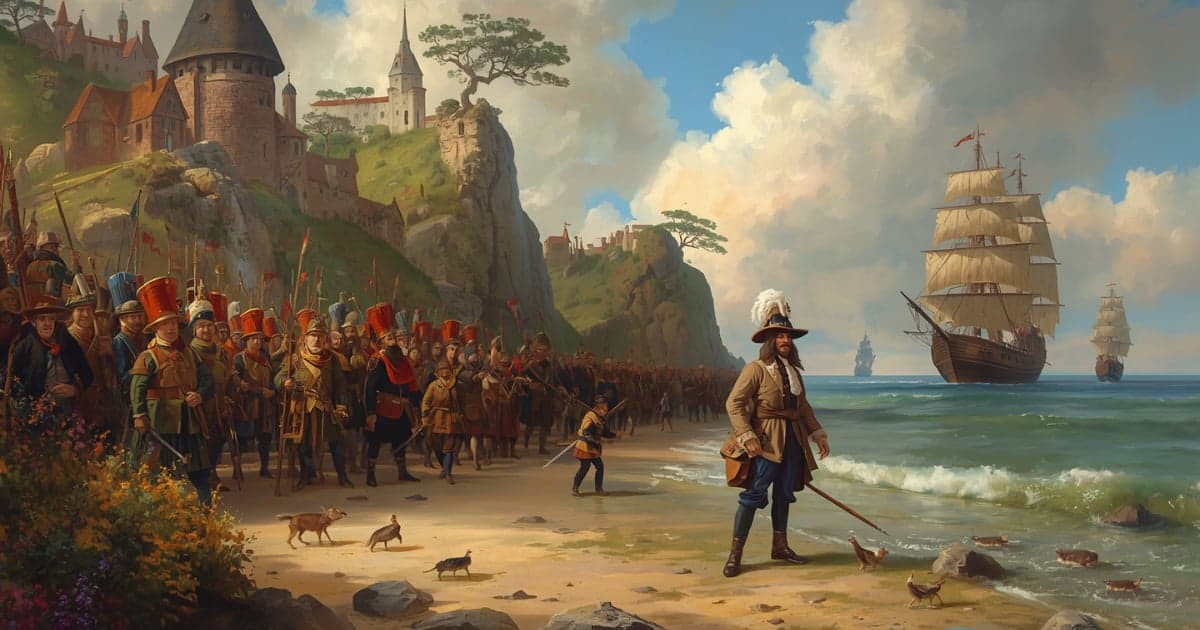
WHAT HAPPENED AT SEA TO CANDIDE AND MARTIN. The old philosopher, whose name was Martin, embarked then with Candide for Bordeaux. They had both seen and suffered a great deal; and if the vessel had sailed from Surinam to Japan, by the Cape of Good Hope, the subject of moral and natural evil would have enabled them to entertain one another during the whole voyage. Candide, however, had one great advantage over Martin, in that he always hoped to see Miss Cunegonde; whereas Martin had nothing at all to hope. Besides, Candide was possessed of money and jewels, and though…
Public-domain chapter text, formatted for reading.
Master this chapter. Complete your experience
Purchase the complete book to access all chapters and support classic literature
Available in paperback, hardcover, and e-book formats
Now let's explore the literary elements.
Key Quotes & Analysis
"I am a Manichean. I cannot help it; I know not how to think otherwise."
Context: When Candide questions his dark worldview during their philosophical debate
This reveals how our life experiences shape our fundamental beliefs about reality. Martin isn't choosing pessimism - his suffering has made it impossible for him to see the world any other way. It shows how trauma can become a lens through which we view everything.
In Today's Words:
When a comforting theory meets a brutal fact, I've been through too much to believe things work out for the best - I can't help seeing the dark side of everything. Voltaire keeps asking who benefits from the explanation. Ask who profits when suffering gets renamed as progress.
"He is so deeply concerned in the affairs of this world that he may be in me, as well as in everybody else; but I own to you that when I cast an eye on this globe, or rather on this little ball, I cannot help thinking that God has abandoned it to some maleficent being."
Context: Explaining his belief that evil forces control the world
Martin sees the earth as abandoned by good and controlled by malevolent forces. This perspective comes from someone who has witnessed too much suffering to believe in divine benevolence. He's not just pessimistic - he's developed a whole worldview to explain why bad things happen.
In Today's Words:
If you have ever been punished for trusting the official story, When I look at all the terrible things happening in the world, it feels like God gave up and left us to the devil. The joke is sharp because the pattern still runs modern institutions.
"You see that crime is sometimes punished; this rogue of a Dutch skipper has met with the fate he deserved."
Context: After witnessing the sea battle where the Dutch captain who robbed him drowns
Candide desperately wants to find meaning and justice in random events. He seizes on the captain's death as proof that the universe has moral order, ignoring the innocent victims. This shows how we cherry-pick evidence to support our preferred worldview.
In Today's Words:
When disaster arrives and someone still calls it necessary, Candide desperately wants to find meaning and justice in random events. He seizes on the captain's death as proof that the universe has moral order, ignoring the innocent victims. This shows how we cherry-pick evidence to support our preferred worldview. Practical wisdom starts when philosophy stops.
"It is true, but why should the passengers be doomed also to destruction? God punished the knave, the devil drowned the rest."
Context: Responding to Candide's claim that justice was served when the Dutch captain drowned
Martin immediately points out the flaw in Candide's reasoning - if this was divine justice, why did innocent people die too? This highlights how random tragedy is, and how neither pure optimism nor pessimism fully explains reality.
In Today's Words:
After kindness from a stranger you cannot explain, Okay, but what about all the innocent people who died with him? If God was punishing the bad guy, why did everyone else have to suffer too?. Candide's education is what happens when theory meets the road.
Thematic Threads
Class
In This Chapter
Candide's optimism is partly sustained by wealth while Martin's pessimism comes from genuine poverty and suffering
Development
Continues exploring how economic position shapes worldview and access to hope
In Your Life:
Your financial stress level affects whether you see opportunities or only obstacles in daily situations
Identity
In This Chapter
Both men define themselves through their philosophical positions—Martin the pessimist, Candide the optimist
Development
Shows how people become attached to their worldview as core identity
In Your Life:
You might resist changing your mind about important issues because it feels like losing part of who you are
Personal Growth
In This Chapter
The debate forces both men to articulate and defend their beliefs, revealing the limits of each perspective
Development
Growth through intellectual challenge and exposure to different viewpoints
In Your Life:
Arguing with someone who disagrees with you can clarify what you actually believe versus what you inherited
Human Relationships
In This Chapter
Candide and Martin's friendship survives their fundamental disagreement about reality
Development
Shows how relationships can transcend ideological differences
In Your Life:
You can maintain close relationships with people who see the world completely differently than you do
You now have the context. Time to form your own thoughts.
Discussion Questions
This is not a test. Five prompts guide you through the chapter, from how it opens to how it closes, so you notice context and rhythm rather than facts to memorize. Sit with each question in your own words. When you see "One way to read it," treat it as a starting point, not the only answer.
- 1
What happens in the opening of "Two Philosophers Debate at Sea" when Candide and his new companion Martin sail toward France, locked...?
analysis • surfaceOne way to read it
Voltaire opens by showing Candide and his new companion Martin sail toward France, locked in philosophical debate about... before Candide's naive faith is tested further.
- 2
Why does the middle of "Two Philosophers Debate at Sea" turn on But Martin counters grimly: if God punished the guilty captain, why...?
analysis • mediumOne way to read it
The chapter escalates when But Martin counters grimly: if God punished the guilty captain, why did the devil..., exposing the gap between Pangloss's theory and lived catastrophe.
- 3
Where do you see the framework filter in modern workplaces, politics, or family life?
application • mediumOne way to read it
One reading: the same pattern appears when institutions explain harm instead of reducing it.
- 4
If you were Candide in the closing pressure of "Two Philosophers Debate at Sea", what would you do differently?
application • deepOne way to read it
A practical response is to act on evidence before rebuilding a theory that makes the harm sound necessary.
- 5
What does "Two Philosophers Debate at Sea" suggest about trusting philosophies that cannot survive bad evidence?
reflection • deepOne way to read it
It suggests that any worldview that cannot absorb real suffering is protecting someone else's comfort.
Critical Thinking Exercise
Map Your Reality Filter
Think of a recent disappointment or setback in your life. Write down the story you told yourself about why it happened. Then imagine you're Martin (pessimistic) and rewrite the story. Finally, imagine you're Candide (optimistic) and rewrite it again. Notice how the same facts can support completely different narratives.
Consider:
- •Pay attention to which version feels most 'true' to you - that reveals your default filter
- •Notice what evidence each version emphasizes or ignores
- •Consider how each story would lead to different future actions
Journaling Prompt
Write about a time when someone close to you interpreted the same situation completely differently than you did. What experiences might have shaped each of your perspectives? How did those different interpretations affect what happened next?
Coming Up Next...
Chapter 21: Two Worldviews Clash at Sea
As Candide and Martin approach the French coast, their philosophical arguments continue. But France will test both their worldviews in unexpected ways, and Candide's quest for Cunegonde takes a surprising turn As Candide and Martin sail toward France, their contrasting worldviews come into sharp focus through casual conversation. Martin paints France as a collection of fools, schemers, and pretenders, describing Paris as chaos where.