
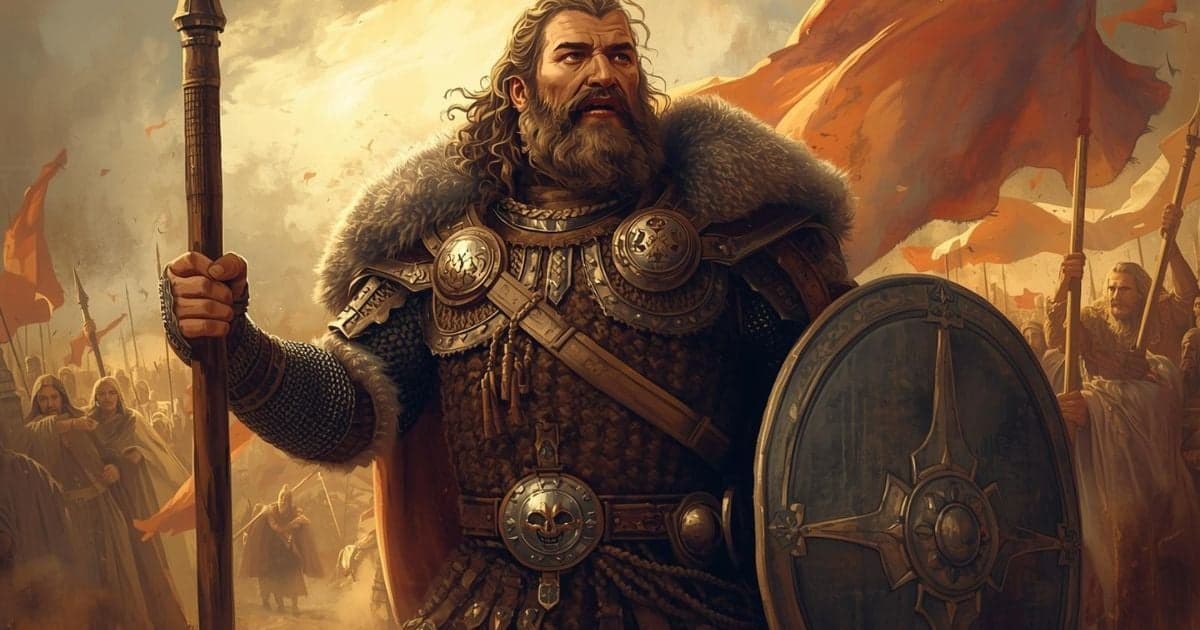
A Self That Stays Real Only If the Hall Can Retell It
Beowulf is often retold as a strong man who kills three monsters. It begins with a foundling sent out to sea already dead, and it ends with a people who have lost the man holding their enemies back. Between those burials, a warrior turns his life into a story other people can repeat: a name at a shore, a grip in a hall, a dive, fifty winters, a last fight he will not hand off. The psychological core is a self that stays real only while a hall can retell it, and the grief, the second attack, and the ageing body that collect the cost.
A Name Is Something the Hall Has to Keep Saying
Scyld arrives friendless and wretched. The poem does not give him a childhood to explain. It gives him a rise: he tears mead-benches from other peoples, takes tribute, and is called an excellent prince. A son is born to comfort a people who had been without rulers. In this telling that son is also named Beowulf. He is not the Geatish hero. He is the child sent as solace, proof that a line can start from nothing and still be spoken of. The hero comes later, from another shore, carrying a different debt.
Scyld's funeral is the poem's first theory of a person. The body goes out in a ship with treasure, and no one can say who receives that cargo. The living do not get a grave they can finish. They get a story that leaves. Identity here is not an inner feeling. It is what neighbours are forced to remember. The defence against vanishing is splendour, and it works only if someone is still alive to say the name.
The poem opens on a listen: the glory of the Spear-Danes is something the speaker has heard. Before any monster, the text is anxious about whether a life will be kept. If the hall stops saying the name, the man is already gone.
Heorot's Joy Is an Injury to What It Excludes
Hrothgar builds a hall so large that its fame travels. The harp sounds. A poet sings the making of the world. Grendel, kin of Cain, hears that joy from the moor and comes in the dark. He cannot be bought or folded into the gift-giving that makes a thane real. For twelve winters the Danes abandon Heorot at night. The building meant to hold a people becomes a room they lend to the thing that hates their noise.
Grendel is outside the cycle that turns strength into belonging: no ring, no cup, no story in which he is the man who stayed. From the fen, the song of creation is a boast that the world was made for the people inside. His raids are envy with a body, and a precise attack on the hall's defence. If joy can be heard, joy can be punished. The Danes feast by day and yield the night. A community can organise its life around not being present when the injury returns.
The twelve winters matter. This is not one shock. It is a reign. People learn the shape of the threat so well that the hall's emptiness starts to feel like wisdom. Beowulf's arrival is indecent by that standard. He offers to sleep in the room they have agreed to vacate.
The Boast Is a Contract the Self Can Be Held To
At the shore a coast-guard stops armed strangers and asks who they think they are. Beowulf does not threaten. He names his people, his king, and the errand: he has come to fight the monster that emptied the hall. The speech is a boast, and it is also a filing. A man who will not be spoken for does not get through the gate. You become safe to admit only when your story can be checked against a king.
Unferth understands that economy and tries to break it. He retells the swimming match with Breca as a failure, a young man who lost a contest and should not be trusted with Grendel. Beowulf answers with the record: sea-monsters, a dawn, nine nickers, and then the turn of the knife. Unferth has killed his own brothers, and the hall he sits in has lived twelve years with a horror he did not face. The taunt is not a critic's honesty. It is the sound of a man protecting a smaller self. If the stranger's story stands, Unferth's seat becomes a confession. Public attack is often how a person keeps a private failure from being the subject.
Wealhtheow carries the same contract in a cup. She puts a great collar on Beowulf and asks him to be mild with her sons. The gift is not a prize for a finished job. It is a claim on the future: a way of making a strong outsider responsible for children who cannot yet hold the room. His pledge to meet Grendel without a sword, or to die, fits that form. The boast is how a self that lives in other people's speech agrees to be tested.
The Arm on the Wall Does Not Close the Debt
Grendel comes, seizes a sleeping Geat, and meets a grip he cannot break. The arm is torn away. He flees to the mere to die. Heorot hangs the proof where everyone can see it. The hall does what halls do after a terror: it eats, it pays the men, it listens to a poet. The story the scop tells is not a simple victory song. It is Hildeburg, a queen set between Danes and Frisians, watching her kinsman and her own son burn because a peace sworn in a hall could not hold. The celebration quotes a feast that became a funeral.
That inset is the poem thinking in public. It keeps interrupting the hero's plot with an older plot in which the same defences failed: a marriage as truce, oaths sworn by people who still hate each other, gold offered where blood is still warm. The listeners are being shown a joy that does not know it is temporary. Sorrow is already on the way, and the benches do not know it.
Grendel's mother arrives as that sorrow with a direction. She does not want the hall's life in general. She wants a body for a body. She takes Aeschere, Hrothgar's closest counsellor, and she takes her son's arm back. The trophy was a way of saying the account was settled. She refuses the settlement. Grief here is not a mood that fades once the killer is dead. It is a second intelligence, and it knows which man the king cannot spare. The Danes had finally believed the night was theirs. The poem's hard claim is that a victory can be real and still be an invoice.
Under the Mere, the Hall's Weapons Stop Working
Hrothgar does not hand Beowulf a plan so much as a map of dread: water that burns, a path the hunted deer will not take, a country the hall's daylight cannot describe. Beowulf goes down alone. Unferth's sword, Hrunting, the court's famous blade, fails in the fight. The weapon that carries the hall's reputation cannot cut what lives under it. Beowulf finds a giant's sword on the wall, kills with that, and beheads Grendel's corpse. The blade melts in the blood. He comes back with a hilt and a head.
The hilt is the poem's most exact object. Hrothgar looks at it and reads a story of giants who warred against God and were destroyed by the flood. The tool that saved the young hero is already a relic of an earlier destruction. Strength, in this image, is borrowed from a world that was punished for strength. Hrothgar's warning follows at once, and it is not a compliment with manners added. He tells of Heremod, a king who had gifts and became stingy, violent to his own people, and hated at the end. He tells Beowulf that pride and hoarding can unmake a man, and that his own fifty years of rule did not save Heorot from a night visitor.
Hrothgar has lived the stretch Beowulf has not reached: you are no longer the man who arrived, and the hall still needs you to be that man. The melted blade says the same thing in metal. What worked in the mere cannot be carried home as a sword. Only the warning on the hilt remains.
Fifty Winters, Then One Cup From a Dead People
The poem then lets time pass. Beowulf goes home to Higelac, gives the gifts onward, and tells what happened, including a marriage he already expects to fail. Kings die. He rules the Geats for fifty winters. That stretch is the middle the fights keep trying to skip: a heroic self has to survive its own success without a new monster to prove it.
The dragon's hoard begins as a lament, not as greed. The last man of a people buries cups, helmets, and weapons because there is no one left to wear them. Treasure, in his speech, is company that has failed. For three hundred years a dragon sleeps on that failure. A servant, running from punishment, takes a single cup to buy mercy from a master. The theft is small, desperate, and enough. The dragon burns the land, including the hall of an old king.
Beowulf's choice to meet the dragon himself is the young contract reused when the body is no longer the right size. He goes in with eleven men. His sword, Nægling, breaks because his strength is greater than the blade. The tool fails for the opposite reason Hrunting failed. That sword was too much the hall's. This one cannot hold the man. He can still kill the dragon. He cannot survive the proof.
Wiglaf Stays, and the Ten Make a Future Out of Leaving
Ten thanes run. Wiglaf does not. He remembers land, weapons, and a place that Beowulf gave him. The mead-cup promise was easy when the hall was safe. In the fire it becomes a debt with a witness. He shames the others for speeches they made when speaking was cheap. His loyalty is gratitude that will not be revised once the lord is losing. Attachment here is proven when it stops being rewarding.
Beowulf's last clarity is not a speech about his fame alone. He wants to see the gold, and he wants a barrow on the headland that sailors can use. He gives Wiglaf the ring, the helmet, and the armour. He says he is the last of the line. The joy in the treasure is easy to misread as greed. In the poem it is relief that the people will not be sent into the next winter empty-handed. Even that relief is unstable. The gold will be buried with him. The messenger, meanwhile, tells the Geats what the king's body was quietly doing: holding back Franks, Frisians, and Swedes who remember older defeats. A protector is also a pause in other people's revenge. When the pause dies, the feuds wake up.
The ending displays the heroic self and then predicts the bill. A woman sings. Warriors ride and call him the kindest of kings, the gentlest, the most eager for fame. The mound is a beacon for the living. The treasure inside is as useless as it was in the last survivor's barrow. A life can be genuinely mourned and still have organised a people around a man they cannot replace. The defence against vanishing succeeds as a name on a cliff. It fails as a plan for the people inland from that cliff.
Why It Resonates Now
The poem keeps meeting a hope that is still ordinary: that a public name, once earned, will keep working after the conditions that earned it are gone. People celebrate the night the arm goes on the wall and do not budget for the second arrival, the one that comes because the first death had kin. The leader who will not hand off the last dangerous job is not only proud. Stepping aside feels like ceasing to exist, because the self was built as a task other people could point to.
The dragon's cup is current in a quieter way. A store of value with no one left to use it, guarded until a small theft wakes a ruin, is a picture of wealth that has outlived the relationships it was meant to hold. Beowulf does not moralise that picture into advice. It shows the sequence. Joy draws an enemy. Victory draws a mourner. A long peace draws the belief that the peace is a property of the king rather than a pause. The funeral is admired, and the next war is already in the messenger's mouth.
Limits of This Reading
This reading can turn a heroic poem into a case study, and the text will not sit still for that. Grendel is descended from Cain. The sword hilt tells a flood story. The poet works inside a Christian frame laid over older lordship, fate, and fame. To call Grendel envy is a way of seeing the exclusion, not a diagnosis, and it should not replace the poem's claim that some violence arrives as a judgment on joy.
Other readings hold different centres. One stays with the feuds: Higelac's raid, Ongentheow, the Swedish wars, a history in which psychology is the wrong scale. Another stays with rings and collars as law, not as symbols of a feeling. Fame here is not modern narcissism under an older name. It is a fact about who will be fed, followed, and buried. The risk of this reading is to pity a code the poem also loves. Beowulf is mourned as kind, not only as trapped. The cost and the praise are both in the last ride around the mound.
Across the Shelf
Don Quixote is the near book. Each man organises a self around a code that has to be performed in front of witnesses, and each meets a body that can no longer underwrite the performance. Sancho stays, as Wiglaf stays, when staying has become embarrassing. Cervantes lets the fantasy break in a bed: the man can lay the knight down and still be a man. Beowulf's code is not a library he can close. It is the peace his people are living inside. When he lays it down, the messenger does not hear a cure. He hears the Swedes. Beside Great Expectations the kinship is narration. Pip is built from a story someone else tells about his future. Beowulf is built from stories a hall tells about his past, which he then has to survive. In both, the self is real because it is spoken. The danger begins when the speech and the body no longer match.