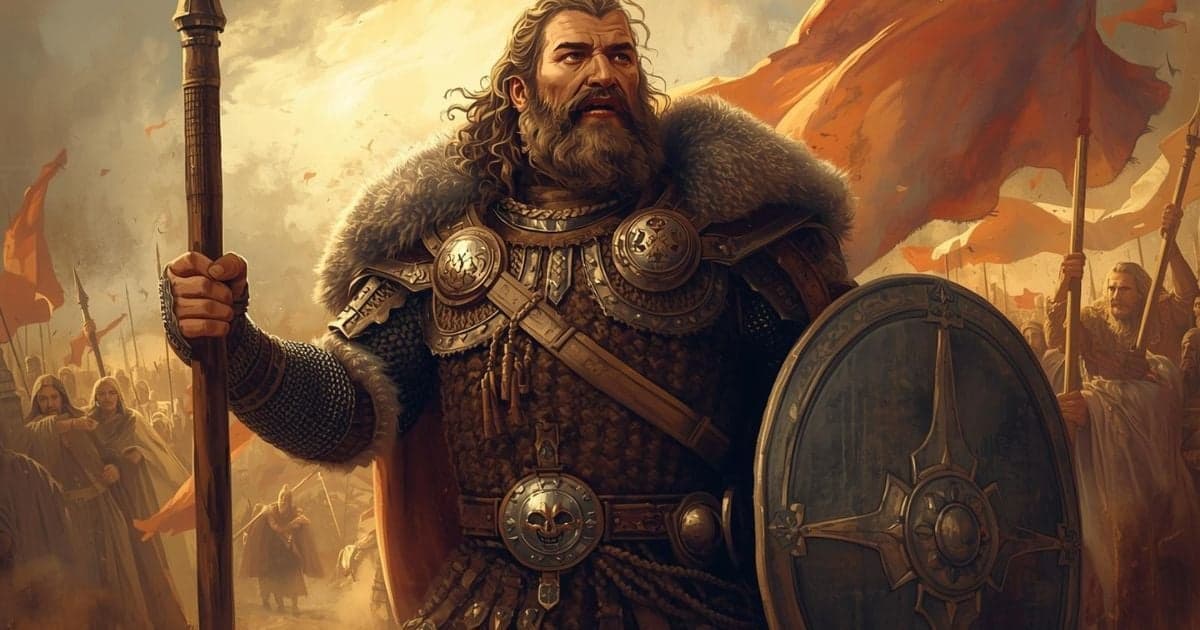
THE LIFE AND DEATH OF SCYLD.
{The famous race of Spear-Danes.}
Lo! the Spear-Danes' glory through splendid achievements
The folk-kings' former fame we have heard of,
How princes displayed then their prowess-in-battle.
{Scyld, their mighty king, in honor of whom they are often called
Scyldings. He is the great-grandfather of Hrothgar, so prominent in the
poem.}
Oft Scyld the Scefing from scathers in numbers
5 From many a people their mead-benches tore.
Since first he found him friendless and wretched,
The earl had had terror: comfort he got for it,
Waxed 'neath the welkin, world-honor gained,
Till all his neighbors o'er sea were compelled to
10 Bow to his bidding and bring him their tribute:
An excellent atheling! After was borne him
{A son is born to him, who receives the name of Beowulf--a name afterwards
made so famous by the hero of the poem.}
A son and heir, young in his dwelling,
Whom God-Father sent to solace the people.
He had marked the misery malice had caused them,
15 [1]That reaved of their rulers they wretched had erstwhile[2]
Long been afflicted. The Lord, in requital,
Wielder of Glory, with world-honor blessed him.
Famed was Beowulf, far spread the glory
Of Scyld's great son in the lands of the Danemen.
[2]
{The ideal Teutonic king lavishes gifts on his vassals.}
20 So the carle that is young, by kindnesses rendered
The friends of his father, with fees in abundance
Must be able to earn that when age approacheth
Eager companions aid him requitingly,
When war assaults him serve him as liegemen:
25 By praise-worthy actions must honor be got
'Mong all of the races. At the hour that was fated
{Scyld dies at the hour appointed by Fate.}
Scyld then departed to the All-Father's keeping
Warlike to wend him; away then they bare him
To the flood of the current, his fond-loving comrades,
30 As himself he had bidden, while the friend of the Scyldings
Word-sway wielded, and the well-lovèd land-prince
Long did rule them.[3] The ring-stemmèd vessel,
Bark of the atheling, lay there at anchor,
Icy in glimmer and eager for sailing;
{By his own request, his body is laid on a vessel and wafted seaward.}
35 The belovèd leader laid they down there,
Giver of rings, on the breast of the vessel,
The famed by the mainmast. A many of jewels,
Of fretted embossings, from far-lands brought over,
Was placed near at hand then; and heard I not ever
40 That a folk ever furnished a float more superbly
With weapons of warfare, weeds for the battle,
Bills and burnies; on his bosom sparkled
Many a jewel that with him must travel
On the flush of the flood afar on the current.
45 And favors no fewer they furnished him soothly,
Excellent folk-gems, than others had given him
{He leaves Daneland on the breast of a bark.}
Who when first he was born outward did send him
Lone on the main, the merest of infants:
And a gold-fashioned standard they stretched under heaven
[3] 50 High o'er his head, let the holm-currents bear him,
Seaward consigned him: sad was their spirit,
Their mood very mournful. Men are not able
{No one knows whither the boat drifted.}
Soothly to tell us, they in halls who reside,[4]
Heroes under heaven, to what haven he hied.
[1] For the 'Þæt' of verse 15, Sievers suggests 'Þá' (= which). If
this be accepted, the sentence 'He had ... afflicted' will read: _He_
(_i.e._ God) _had perceived the malice-caused sorrow which they,
lordless, had formerly long endured_.
[2] For 'aldor-léase' (15) Gr. suggested 'aldor-ceare': _He perceived
their distress, that they formerly had suffered life-sorrow a long
while_.
[3] A very difficult passage. 'Áhte' (31) has no object. H. supplies
'geweald' from the context; and our translation is based upon this
assumption, though it is far from satisfactory. Kl. suggests
'lændagas' for 'lange': _And the beloved land-prince enjoyed (had) his
transitory days (i.e. lived)_. B. suggests a dislocation; but this is
a dangerous doctrine, pushed rather far by that eminent scholar.
[4] The reading of the H.-So. text has been quite closely followed;
but some eminent scholars read 'séle-rædenne' for 'sele-rædende.' If
that be adopted, the passage will read: _Men cannot tell us, indeed,
the order of Fate, etc._ 'Sele-rædende' has two things to support it:
(1) v. 1347; (2) it affords a parallel to 'men' in v. 50.Master this chapter. Complete your experience
Purchase the complete book to access all chapters and support classic literature
As an Amazon Associate, we earn a small commission from qualifying purchases at no additional cost to you.
Available in paperback, hardcover, and e-book formats
Why This Matters
Connect literature to life
This chapter teaches how to distinguish between real authority based on earned respect versus hollow authority based on titles or fear.
Practice This Today
This week, notice who people actually turn to for help or advice in your workplace—it's rarely the person with the biggest title, but the one who consistently delivers value to others.
Now let's explore the literary elements.
Key Quotes & Analysis
"Oft Scyld the Scefing from scathers in numbers / From many a people their mead-benches tore"
Context: The opening declaration of Scyld's conquests over neighboring peoples
The mead-bench is not incidental detail. In the heroic world of Beowulf, the mead-hall is where a king holds court, distributes treasure, and binds his men to him. To tear out another king's mead-benches is to destroy the institution of his power — the social fabric of loyalty and feasting that holds a warband together. Scyld's greatness is measured not by battle-count but by this: he dismantled his enemies' worlds.
In Today's Words:
He didn't just defeat his enemies — he destroyed the very foundations of their kingdoms
"Since first he found him friendless and wretched"
Context: The narrator's description of Scyld's origins as a foundling
Scyld arrives in Daneland as an abandoned child — without kin, without a lord, without the networks of obligation that define identity and safety in this world. That he rises from that condition to become a king who commands tribute across the sea is the founding miracle of the Spear-Danish line. The poem begins here deliberately: the greatest kings can emerge from nothing, but only if they earn it.
In Today's Words:
He started with nothing — no family, no allies, no status — and built an empire anyway
"So the carle that is young, by kindnesses rendered / The friends of his father, with fees in abundance"
Context: The narrator's lesson on how a young prince must earn loyalty
This is the poem's first articulation of its political philosophy: loyalty is not inherited, it is earned. A son cannot assume his father's companions will transfer their allegiance automatically. He must act — giving generously, binding men with gifts — so that when war comes, those men will stand beside him. The word 'fees' is deliberate: treasure in Beowulf is not personal wealth, it is the currency of obligation.
In Today's Words:
A young leader earns loyalty the same way: be generous to the people who mattered to those who came before you
Thematic Threads
Class
In This Chapter
Scyld transforms from outcast to king, showing that social position can be changed through actions
Development
Introduced here
In Your Life:
Your background doesn't determine your potential for leadership or respect in any situation
Identity
In This Chapter
Scyld creates his identity through deeds rather than accepting the role of friendless outcast
Development
Introduced here
In Your Life:
You have the power to redefine who you are through consistent actions, regardless of how others initially see you
Personal Growth
In This Chapter
Scyld's journey from nothing to legendary king demonstrates transformative potential
Development
Introduced here
In Your Life:
Growth happens through facing challenges head-on and learning to serve others while building your own strength
Human Relationships
In This Chapter
Scyld builds lasting loyalty through generosity and strategic relationship-building
Development
Introduced here
In Your Life:
Strong relationships require investing in others' success and showing up consistently, not just when you need something
Social Expectations
In This Chapter
The funeral ritual shows how great leaders inspire others to exceed normal social obligations
Development
Introduced here
In Your Life:
When you truly serve others well, they'll go above and beyond normal expectations to support and honor you
You now have the context. Time to form your own thoughts.
Discussion Questions
- 1
How did Scyld transform from a friendless outcast into a powerful king that neighboring tribes feared and respected?
analysis • surface - 2
Why does Scyld give generous gifts to his followers instead of keeping all the wealth for himself?
analysis • medium - 3
Think about leaders you respect at work, in your family, or community. Do they use Scyld's strategy of earning loyalty through actions and generosity?
application • medium - 4
If you wanted to gain more influence in your workplace or family, how could you apply Scyld's approach without seeming fake or manipulative?
application • deep - 5
What does Scyld's funeral reveal about the difference between being feared and being genuinely respected?
reflection • deep
Critical Thinking Exercise
Map Your Authority Network
Draw a simple diagram of your workplace, family, or friend group. Mark who has real influence (not just titles) and trace how they built that influence. Look for the Scyld pattern: Who proves their value consistently? Who lifts others up? Who do people turn to during problems?
Consider:
- •Notice the difference between formal authority (titles, positions) and real influence (who people actually listen to)
- •Pay attention to how influential people handle both success and conflict
- •Look for patterns of reciprocity - who helps others and gets help in return
Journaling Prompt
Write about someone who has earned your respect and loyalty. What specific actions did they take? How could you build that same kind of trust with others in your life?
Coming Up Next...
Chapter 2: Building Dreams and Awakening Nightmares
With Scyld gone, his descendants must prove themselves worthy of his legacy. The focus shifts to his great-grandson Hrothgar, who will face a challenge that tests everything Scyld taught about leadership and loyalty.