Chapter 21
The Revolutionary Network Revealed
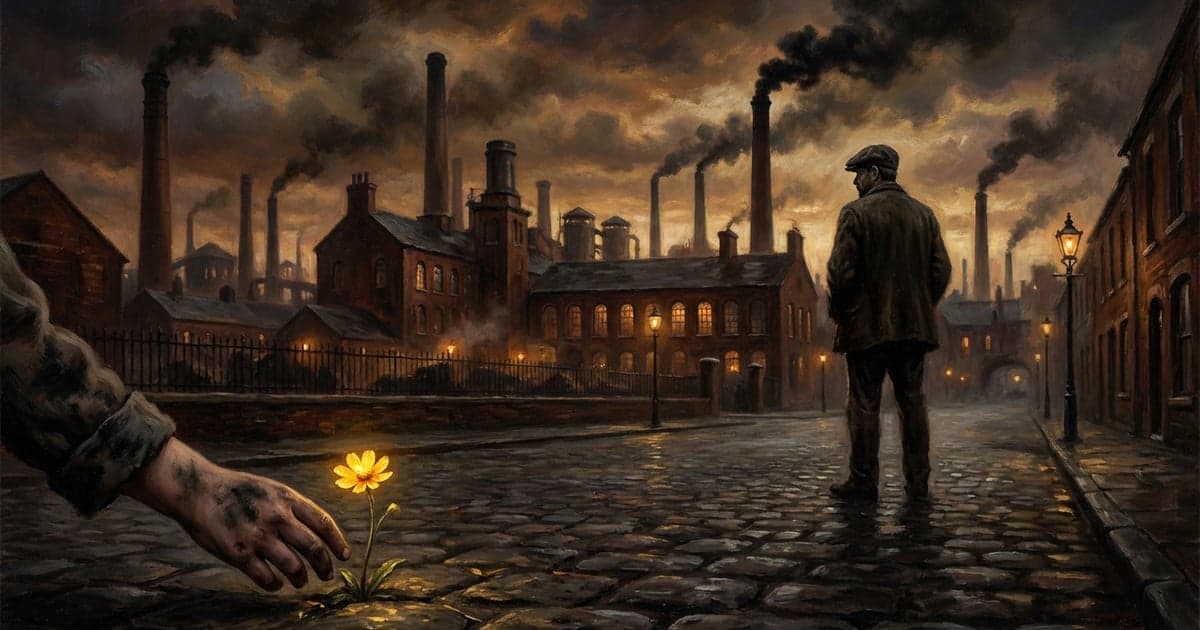
Knitting There had been earlier drinking than usual in the wine-shop of Monsieur Defarge. As early as six o’clock in the morning, sallow faces peeping through its barred windows had descried other faces within, bending over measures of wine. Monsieur Defarge sold a very thin wine at the best of times, but it would seem to have been an unusually thin wine that he sold at this time. A sour wine, moreover, or a souring, for its influence on the mood of those who drank it was to make them gloomy. No vivacious Bacchanalian flame leaped out of the pressed…
Public-domain chapter text, formatted for reading.
Master this chapter. Complete your experience
Purchase the complete book to access all chapters and support classic literature
Available in paperback, hardcover, and e-book formats
Now let's explore the literary elements.
Key Quotes & Analysis
"Thus, Saint Antoine in this vinous feature of his, until midday."
Context: A key line from the opening of the chapter
The wine shop becomes a gathering place where men consume information rather than alcohol, showing how revolutionary movements create alternative spaces for forbidden communication. The metaphor of 'swallowing talk in lieu of drink' reveals how hunger for change can replace basic physical needs.
In Today's Words:
For three days running, the coffee shop filled with people who came not to buy drinks but to whisper and listen, feeding on rumors and plans instead of food. That is how it feels when institutions treat your survival as someone else's paperwork problem. The pattern repeats whenever rank decides who must stay calm while.
"As they descend the hill like madmen running a race, he falls."
Context: A key line from the middle of the chapter
The brutal treatment of the captured prisoner demonstrates how authority uses public humiliation to maintain control through fear. The image of soldiers driving a wounded man like an animal reveals the dehumanization that fuels revolutionary anger.
In Today's Words:
As they rushed down the hill, he stumbled and fell, but they just laughed, picked him up, and kept pushing him forward with their rifle butts. Ground it in the scene: who holds power, who absorbs risk, and what changes if. The pattern repeats whenever rank decides who must stay calm while everyone else panics.
"Who can gossip of an evening, under that shadow!"
Context: A key line from the closing third of the chapter
This quote captures how oppressive regimes create atmospheres of constant surveillance and fear that poison normal community life. The shadow represents not just physical presence but psychological terror that prevents ordinary human connection.
In Today's Words:
Who wants to chat casually in the evening when that dark presence looms over everything, making even friendly conversation feel dangerous and watched. That is how it feels when institutions treat your survival as someone. You see the same squeeze when a manager passes blame down and the person with no exit absorbs the cost.
"After a gloomy silence, the first Jacques said, “Good!"
Context: A key line from the closing third of the chapter
The formal structure of the revolutionary cell, with numbered identities and ritualized approval, shows how underground movements must balance secrecy with decisive action. The simple word 'Good' carries the weight of a death sentence being approved.
In Today's Words:
After a heavy silence, the first member of their group nodded grimly and said, 'Approved. We move forward with the plan.'. Ground it in the scene: who holds power, who absorbs risk, and what changes if you name it early. Ground it in the scene: who holds power, who absorbs risk, and what changes if.
Thematic Threads
Class
In This Chapter
The aristocrats see the road mender's tears of joy as proof of natural hierarchy, missing the strategic performance underneath
Development
Evolved from earlier economic inequality to active class warfare preparation
In Your Life:
You might recognize this when wealthy people mistake your politeness for acceptance of unfair treatment
Identity
In This Chapter
The Jacques system creates revolutionary identities that override individual names and histories
Development
Expanded from personal identity struggles to collective identity formation
In Your Life:
You see this in any group that uses code names or insider language to build solidarity
Deception
In This Chapter
Defarge deliberately exposes the road mender to royal splendor to maintain the revolutionaries' cover
Development
Introduced here as strategic deception rather than personal dishonesty
In Your Life:
You might use this when you need to appear non-threatening while documenting workplace problems
Memory
In This Chapter
Madame Defarge's knitting becomes the revolution's unbreakable memory system
Development
Introduced here as collective memory preservation
In Your Life:
You create your own 'knitting' when you keep private records of important conversations or events
Power
In This Chapter
The revolutionaries gain power through organization while appearing powerless to their enemies
Development
Shifted from aristocratic power display to underground power building
In Your Life:
You see this when seemingly powerless groups coordinate action through informal networks
You now have the context. Time to form your own thoughts.
Discussion Questions
This is not a test. Five prompts guide you through the chapter, from how it opens to how it closes, so you notice context and rhythm rather than facts to memorize. Sit with each question in your own words. When you see "One way to read it," treat it as a starting point, not the only answer.
- 1
Why does Dickens emphasize that the men in the wine shop are 'swallowing talk in lieu of drink' rather than actually purchasing wine?
analysis • mediumOne way to read it
This shows how revolutionary fervor replaces basic needs, and how the shop serves as a cover for political organizing rather than commerce.
- 2
What does the road mender's detailed testimony about the prisoner's capture reveal about how the revolutionaries gather and use information?
analysis • deepOne way to read it
They systematically document aristocratic cruelty as evidence to justify future violence, turning personal witness into revolutionary propaganda.
- 3
How does the Jacques numbering system reflect the practical needs of underground revolutionary cells?
application • mediumOne way to read it
Anonymous identities protect members from betrayal while maintaining organizational structure necessary for coordinated action.
- 4
What does Defarge's careful staging of the road mender's testimony suggest about his role as a revolutionary leader?
analysis • deepOne way to read it
He orchestrates both information gathering and psychological preparation, showing how revolution requires both strategic planning and emotional conditioning.
- 5
How might witnessing the prisoner's brutal treatment affect the road mender's own political views going forward?
reflection • mediumOne way to read it
Seeing such cruelty firsthand likely transforms him from passive observer to active sympathizer with revolutionary goals.
Critical Thinking Exercise
Design Your Documentation System
Think of a situation where you might need to keep track of problems or injustices - workplace issues, landlord problems, family dynamics, or community concerns. Design your own 'knitting code' system for documenting what happens in a way that looks innocent but creates an unbreakable record. Consider what information you'd track, how you'd disguise it, and where you'd store it safely.
Consider:
- •What would make your system look harmless to others while remaining useful to you?
- •How would you ensure your records are accessible to you but not to those who might use them against you?
- •What patterns or codes could you use that would be meaningful to you but meaningless to outsiders?
Journaling Prompt
Write about a time when you wish you had kept better records of a situation. What would have been different if you had documented what was happening as it unfolded?
Coming Up Next...
Chapter 22: The Spy in the Wine Shop
The knitting continues as Madame Defarge's register grows longer, and the revolutionary network prepares for the storm that will soon break over France. The threads of conspiracy tighten around those marked for destruction.