
Reframe · No. 36
Fathers and Sons is not a generation-gap story. Turgenev never wrote one.
Most readers arrive with the title already explained: sons against fathers, and a young nihilist who wins the talk. That is the cliché. It is not what Ivan Turgenev published in 1862.
Arkady says the word at breakfast. Paul stops a buttered knife. The novel then follows the sentences people will not send: a rose, a refused hand, a dying compliment, a toast kept to a whisper.
What most readers assume
“A clash of generations: the radical son demolishes the liberal fathers, wins the arguments, falls in love, fights a duel, and dies of a cut, so that either youth or the old estate can be declared the winner.”
What Ivan Turgenev actually stages
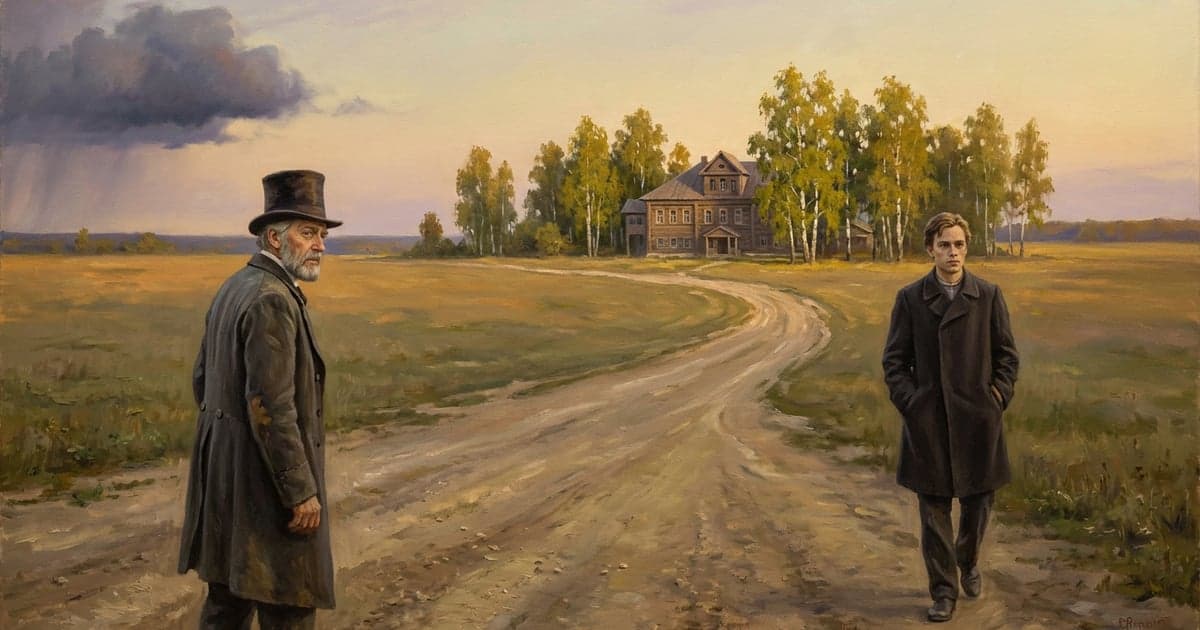
Most readers arrive with the title already explained: sons against fathers, a young nihilist against the old estate. Ivan Turgenev published the novel in 1862 and let Arkady say the word at breakfast, while Paul Petrovitch stopped a knife that still had butter on it. The book then refuses to award the argument. A rose becomes a kiss, a dying message is only a compliment, and at the wedding the name stays a whisper.
Fathers and Sons · Ivan Turgenev
The popular summary keeps the nihilist and the duel. The novel keeps the hand he would not take, and the toast nobody said aloud.
Common Questions
Search questions this reframe installment answers about Fathers and Sons.
Is Fathers and Sons actually a generation-gap story?
The title invites it, and the breakfast seems to confirm it: Arkady says his friend is a Nihilist, and Paul Petrovitch stops a knife that still has butter on it. Arkady defines the word as a man who declines to bow to authority, or to accept any principle on trust. The rest of the novel does not score that argument. It follows what those people do when a plainer sentence will not come out.
Is Bazarov a heroic nihilist?
He arrives from the marsh with frogs and mud, and he does refuse what the household reveres. He also tells Anna he loves her, is told he has mistaken her, and later steps back from her pitying hand because, though poor, he has never accepted alms. A peasant he questions about Russia's future says they might manage it if the village first had a new chapel, then tells a neighbour the gentleman was only chattering.
Why does Bazarov die?
He cuts his finger uncovering a typhus body the village had tried to hide, and tells his father that four hours have already made every remedy too late. He refuses a letter to Anna. The messenger may say only that Evgenii Vasilitch sends his compliments, and is dying. She comes, feels terror rather than love, kisses his forehead, and at the holy oil one eyelid lifts as if in distaste.
Does Anna love Bazarov?
She forces the confession, says he has mistaken her, and only in her mind adds that she has failed to understand herself. Later they call it a dream, and he calls love a mere empirical sentiment, without either of them knowing if that is the whole truth. At the deathbed she feels chill terror, and thinks that if she had loved him she would not feel that. She keeps her glove on and kisses his forehead anyway.
What is Fathers and Sons really about?
The novel keeps returning to what people withhold. Vasili sends the horses and never mentions the flowers fetched for the room. Bazarov asks for a red rose and takes a kiss, and Paul calls the duel an insult to Sir Robert Peel before asking his brother to marry her. Arkady is shown two jackdaws, forgets his friend by nightfall, and at the wedding will not repeat the whispered toast.
Why do people misread Fathers and Sons?
The title, the word Nihilist, and the duel are easy to lift out and call the theme, and the death can be made to mean that youth was punished or that love redeemed a cynic. Turgenev keeps those scenes, and also the alms refused, the letter refused, and two parents at a grave the sheep do not trample. Sitnikov later says he is carrying on the work of the late Bazarov. The grave does not agree.