
The Collision · No. 5
Before The Five Love Languages, Darcy wrote the letter — and refused to call it love.
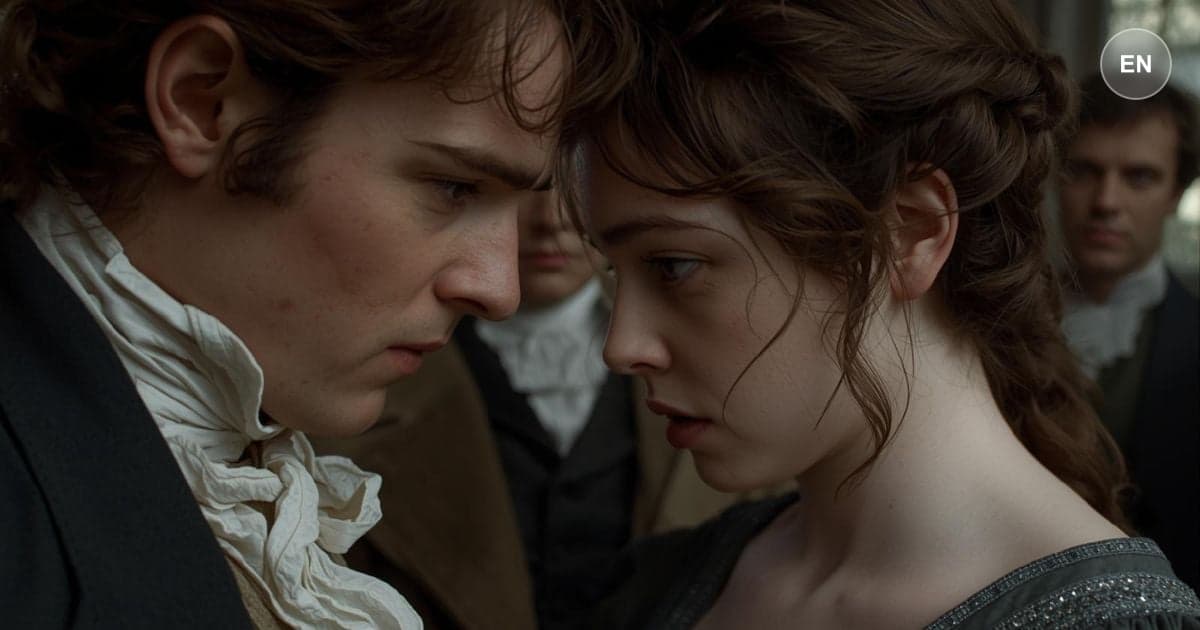
The morning after the proposal at Hunsford, Elizabeth walks to exercise and deliberately avoids the grove where Mr. Darcy sometimes appears. He meets her at the park gate anyway. He holds out a letter. She takes it instinctively. “Will you do me the honour of reading that letter?” he asks, with a look of haughty composure — then bows and disappears into the plantation before she can answer.
Two sheets, close-written. The envelope full. Dated from Rosings at eight o'clock in the morning. No renewal of last night's offers, which were “so disgusting to you.” Only what his character requires: a full account of Bingley and Jane, Wickham and Georgiana, witnesses named, motives laid bare. In Chapter XXXV, Austen hands you the scene before she hands you the theory. The letter is not courtship. It is evidence submitted to a hostile court.
Gary Chapman's The Five Love Languages (1992) would arrive a century and a half later with a cleaner diagram: five buckets — words of affirmation, acts of service, receiving gifts, quality time, physical touch — and a prescription. Learn your partner's primary language. Speak it. The mismatch that feels like neglect is often a translation error. That insight sells because it is often true. Austen had already staged the harder case: a gesture that overflows two buckets, arrives in the wrong register, and still rewires a mind — not because Elizabeth finally felt seen, but because she was forced to admit she had been wrong.
The book you bought
“The key is to learn the primary love language of your spouse and choose to speak it.”
The 5 Love Languages · Gary Chapman · 1992 · ~20M copies
The book that beat it by 179 years
The effort which the formation and the perusal of this letter must occasion, should have been spared, had not my character required it to be written and read… I demand it of your justice.
Pride and Prejudice · Jane Austen · 1813 · Ch. XXXV
Chapman wants you to find the right dialect. Austen wants you to understand that the gesture that changes everything costs you something real — and arrives when the recipient is not asking for it.
Chapman's move is useful — and it does not hold the letter
Chapman names what millions of couples already feel: I am trying, and you are not receiving it. People tend to express love in the language they most want to hear. When partners speak different languages, affection can miss entirely — the dishes done while she wanted a conversation, the compliments that land as noise while he wanted help with the car. Workshops hand you a quiz. You leave with a primary language and a homework assignment. It is diagnostic, actionable, and kind enough to keep selling.
Map Darcy's letter onto Chapman's grid and it refuses to sit in one bucket. Words of affirmation: two sheets of close-written defense — Bingley, Wickham, Georgiana, Colonel Fitzwilliam summoned as witness, signed “God bless you.” Acts of service: written by hand at dawn after a humiliating evening; delivered in person after walking the grove to intercept her; the letter itself narrates interventions at Ramsgate, refusals to Wickham, the London trip Elizabeth first read as cruelty. Hand to hand at the gate — labor, exposure, pride swallowed — then he leaves. Quality time? He sought her out and vanished. Gifts? Conspicuously absent. He gives her information, not a token.
The overflow is the point. Chapman's taxonomy assumes love travels in one primary channel if you learn the code. Austen stages love as a single gesture where language and labor collapse — and the recipient reads it with “strongest curiosity” and “no expectation of pleasure.” Darcy is not speaking Elizabeth's language. He is demanding justice for his character while she is still certain he has none.
 Read the chapter
The source · Chapter XXXV, Pride and Prejudice
“Be not alarmed, madam, on receiving this letter, by the apprehension of its containing any repetition of those sentiments, or renewal of those offers, which were last night so disgusting to you… The effort which the formation and the perusal of this letter must occasion, should have been spared, had not my character required it to be written and read… I demand it of your justice.”Jane Austen, Pride and Prejudice, Chapter XXXV (public domain)
Why the old one is harder than the new one
Chapman's version is a communication protocol: identify the dialect, adjust output, refill the love tank. It works when the problem is translation. Austen removes that comfort. The gesture that changes Elizabeth is costly truth delivered to someone who does not want to receive it — and who fights the text even when it is in her hands.
In Chapter XXXVI, she reads with “a strong prejudice against everything he might say,” vows never to look again, and unfolds the letter within half a minute. Chapman assumes correct delivery eventually lands. Austen shows a woman whose identity is invested in being right about Wickham — the letter threatens that story, so she attacks the style (“all pride and insolence”) before she can face the facts. The right language, wrong moment, hostile reader — and still it works, but not because she felt loved. Because the evidence was true.
Before the letter, Darcy's acts of service read as interference — separating Bingley, managing Georgiana, the proud silence that looked like contempt. His proposal was words, and disastrous words. The letter is words without romance — forensic, haughty, unsigned by any plea for affection — and that is why it penetrates. Austen separates performance of love from evidence of character. Service without explanation looks like control. Words without warmth look like arrogance — until the context flips and Elizabeth walks two hours on the lane and names her folly: “vanity, not love, has been my folly… Till this moment, I never knew myself.”
That is the line the workshop deletes. Love languages make mismatch a category error — he is acts of service, you are words of affirmation, learn the code. Austen makes mismatch a judgment error — wrong about Wickham, wrong about Darcy, wrong about Jane, wrong about your own pride. No quiz fixes that. Only evidence, and a body that cannot keep walking indoors until the verdict lands.
Bring this to the table
Darcy's letter worked because it was evidence, not affection. When has someone loved you in a way you could not receive — and when has someone's honesty felt more loving than their effort?
Common Questions
Search questions this collision answers—what readers ask about love languages vs. what Austen stages in the letter.
Is Darcy's letter words of affirmation or acts of service?
Both, deliberately. The letter is exhaustive written defense (words) and exhaustive labor (handwritten at dawn, delivered in person after tracking her walk). Austen does not treat these as separate languages — they are one gesture whose force comes from cost and truth, not category fit.
Did Gary Chapman base The Five Love Languages on Pride and Prejudice?
No direct citation. The collision is structural: Chapman taxonomizes how love is expressed; Austen dramatizes a moment where the gesture that changes everything collapses multiple expressions into one act — and the recipient initially refuses it.
What does Elizabeth learn from Darcy's letter?
Not that Darcy loves her in her language. She learns she was wrong — about Wickham, about Darcy's role with Jane, about her own pride. Her conversion is moral, not linguistic. The long walk in Ch. XXXVI is reckoning, not feeling finally seen.
Why doesn't Darcy propose again in the letter?
He explicitly refuses: no renewal of those offers which were last night so disgusting to you. The letter is character defense, not courtship. That refusal is why it works — and why it is not a love-languages success story.
Read the letter in context — not the rom-com cut.
Pride and Prejudice is not a love-language manual. It is a novel about two people who misread each other until evidence forces a reckoning. The letter is one chapter in a sixty-one-chapter argument. We narrate it chapter by chapter in plain language. First chapter's audio is free. The rest is $2.99 a month, every book on the shelf.