
Letters from a Stoic

Letters from a Stoic
A Brief Description
Between approximately 63 and 65 AD, as Rome's political tensions reached a breaking point, Seneca wrote a series of letters to his friend Gaius Lucilius Junior, a Roman knight serving as procurator of Sicily. He never stopped. The result was 124 surviving letters, the Epistulae Morales ad Lucilium, that together form one of the most intimate and practical works of philosophical instruction ever written.
The letters are not theoretical. Each begins with something immediate: a walk Seneca just took, a gladiatorial show he reluctantly attended, a crowd he moved through. Then it pivots to a broader principle. Letter 1 opens with the most urgent advice he ever gives: reclaim your time. "Vindica te tibi": rescue yourself for yourself. Time is the one resource that, once spent, cannot be recovered. Everything else follows from this.
Seneca writes on death repeatedly, and without flinching. He does not treat it as a distant abstraction but as a daily companion. Prepare for it, he argues, and the fear dissolves. Face it early and the rest of life becomes cleaner, less cluttered with anxious grasping. These are not the words of a sheltered academic. Seneca had been exiled to Corsica for eight years on politically motivated charges. He had served as tutor and chief minister to the Emperor Nero, watching a man he had mentored become increasingly dangerous. He had been rich beyond measure while writing about the irrelevance of wealth. He knew the gap between ideal and reality, and he did not pretend it away.
The tension between Seneca's philosophy and his biography is part of what makes the letters so compelling. He was not a saint. He accumulated enormous wealth. He made compromises with power that haunted him. But he kept writing about how to live better, not as someone who had arrived, but as someone still working it out. "I am not yet wise," he admits more than once. That honesty is what makes him trustworthy.
The letters cover practical concerns: how to choose friends worth keeping, how to handle grief without being destroyed by it, how to maintain integrity under pressure, how to read books properly, how to think about illness and old age, how to work with people who frustrate you. Seneca is especially sharp on the difference between what we think will make us happy (wealth, status, reputation, comfort) and what actually does: virtue, self-knowledge, honest relationships, and the ability to act in accordance with your own values rather than the crowd's expectations.
In 65 AD, Nero accused Seneca of involvement in an assassination plot, almost certainly fabricated, and ordered him to die. Seneca opened his veins and died as he had taught others to: calmly, without complaint, in full possession of himself. The letters are his last and deepest work, a final sustained conversation with a friend about how to live well before there is no more time to live.
Wide Reads tracks all 124 letters with Samuel, a retired philosophy professor running a community mentorship program while facing his own mortality. You will learn to guard your time, face adversity without theatrics, choose friends wisely, and live according to values when the world rewards performance instead.
Written nearly two thousand years ago, they have never stopped being useful.
Essential Life Skills Deep Dive
Explore chapter-by-chapter breakdowns of the essential skills taught in this classic work.
Managing Time and Priorities
Seneca's opening intervention: time is the only thing truly yours. Guard it from busywork, distraction, and the illusion that tomorrow is guaranteed.
Emotional Regulation
Anger, fear, and grief without being ruled by them. Seneca trains delay, judgment, and self-command before emotion hardens into action you regret.
Dealing with Adversity
Illness, exile, loss, and hardship without surrendering dignity. Seneca maps endurance when the world refuses to cooperate.
Choosing Friendships Wisely
Test your inner circle, flee corrupting crowds, and keep company that improves you rather than merely comforts you.
Facing Mortality with Courage
Death as daily companion, not distant horror. Prepare early, drain fear's leverage, and let mortality clarify the present.
Living According to Values
Close the gap between what you praise and what you do. Integrity under wealth, applause, and the crowd's expectations.
Table of Contents
Your Time Is Being Stolen
Focus Your Reading, Focus Your Mind
There's a trap hiding inside ambition: the belief that more is always better. More books, more trave...
Testing Your Inner Circle
Lucilius sends a letter through someone he calls a friend, then in the very next sentence warns Sene...
Facing Death Without Fear
Most people spend their lives trying to extend life while doing very little actual living. That's th...
Finding Your Authentic Middle Ground
Becoming a better person is one thing. Performing it for an audience is another. Letter 5 draws that...
The Power of Sharing Knowledge
Letter 6 opens with something rare in philosophy: a confession. 'I feel that I am being not only ref...
Why Crowds Can Corrupt You
Every crowd has a cost. Letter 7 opens with Seneca's admission that he never returns from a gatherin...
The Power of Strategic Withdrawal
When someone accuses Seneca of hiding from the world, his answer surprises. He isn't hiding, he's wo...
The Art of True Friendship
If a wise man is truly self-sufficient, why does he need friends at all? Letter 9 is Seneca's carefu...
The Art of Being Alone
Solitude and wisdom aren't the same thing, and confusing them can be dangerous. Letter 10 opens with...
The Blush of Modesty and Finding Your Moral Compass
Even the wisest person blushes. Letter 11 begins with Seneca observing a young man's face redden dur...
Finding Joy in Life's Final Season
A visit to his country estate hits Seneca with the same message everywhere he looks: he is old. The ...
Fear Is Usually Worse Than Reality
Most of the suffering we endure hasn't happened yet, and may never happen at all. Letter 13 opens wi...
Strategic Withdrawal from Dangerous People
The body is entrusted to us. We are not slaves to it. Letter 14 opens with that distinction and buil...
Mind Over Muscle: True Strength
The old Roman greeting was 'If you are well, it is well.' Seneca suggests a better version: 'If you ...
About Seneca
Published 65
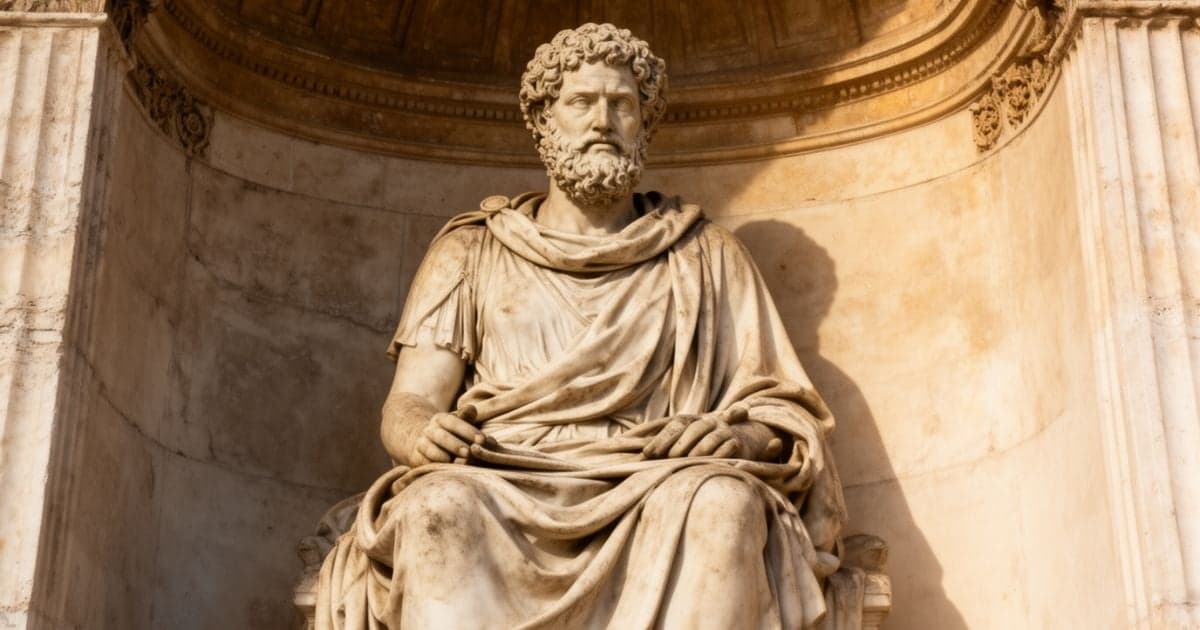
Lucius Annaeus Seneca (c. 4 BC to 65 AD) was a Roman Stoic philosopher, statesman, and dramatist who lived one of history's most turbulent lives. Born in Spain and educated in Rome, he rose to become one of the most powerful men in the Roman Empire as tutor and later advisor to Emperor Nero. Yet his life was marked by dramatic reversals: he was exiled to Corsica for eight years on adultery charges likely political in origin, recalled to become Nero's mentor, accumulated vast wealth while writing about the virtues of poverty, and ultimately was forced to commit suicide when accused of conspiracy.
This tension between his philosophical ideals and messy reality makes his writing uniquely authentic. Seneca did not write as a saint but as a fellow struggler, openly admitting his failures while striving to live better. His practical approach to Stoicism, focused on daily application rather than abstract theory, has made him the most accessible of the ancient philosophers and profoundly influential on thinkers from Montaigne to modern cognitive behavioral therapy.
Why Seneca Matters Today
Seneca speaks to the moment when you already know what matters and still cannot make yourself live accordingly: the overtime you keep accepting, the friend who drags you down, the fear of death you postpone until it owns you. His answer is not a system to admire from a distance. It is a letter from someone still working it out, written to a real person with a real schedule and real compromises.
What makes him indispensable is the honesty of his biography. Exiled, enriched, entangled with power, ordered to die by the pupil he had tried to civilize. He never pretends to be a saint. That is why the letters land. Each one begins with something ordinary, a walk, a show, a crowd, a delayed message, then turns into instruction you can use before lunch. Time, friendship, grief, wealth, mortality: the themes are modern because the failures are modern.
Stoicism is often reduced to slogans on coffee mugs. Seneca is the correction. He writes with warmth, urgency, and self-accusation. Montaigne kept him close. Cognitive therapy keeps rediscovering his moves. If you want philosophy that reads like a mentor who will not let you lie to yourself, these 124 letters are where Stoicism becomes personal.
Wide Reads is different.
not a sparknotes, nor a cliffnotes
Two ways in
Read & listen to the summary
Walk with the characters. Hear the story told completely — chapter by chapter, with audio. Feel what they feel. The meaning arrives because you experienced it, not because someone listed bullet points. Every chapter has a summary that speaks.
Start with this.
Read the original text
The manuscript. The actual words the author wrote. Every book on Wide Reads includes the original text alongside the summary — so you can read Austen as Austen wrote her, Dostoevsky as he wrote his. Use the summary as a guide, then step into the source.
Then step into the source.
Either way, the door opens inward.
As you enter the realm — each chapter goes deeper
— and most of all, Why does this matter?
Get the Full Book
Purchase the complete book to access all chapters and support classic literature
Available in paperback, hardcover, and e-book formats
You Might Also Like



Free to read • No account required