Chapter 07
The Machinery of Words and Power
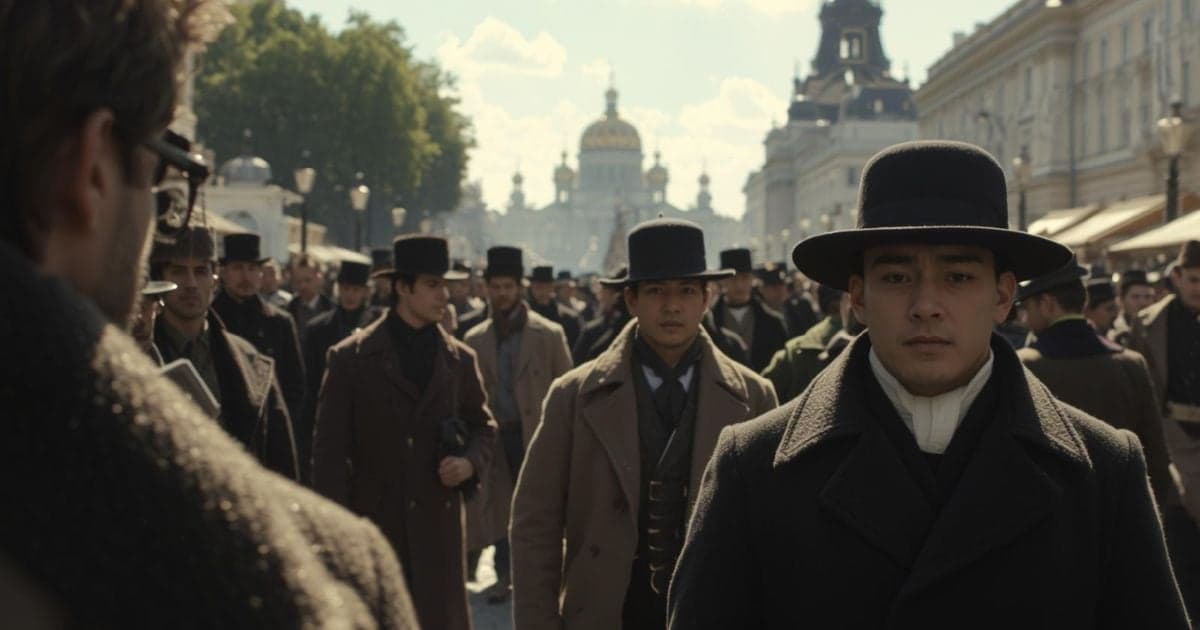
Episode 7: Aeolus IN THE HEART OF THE HIBERNIAN METROPOLIS Before Nelson’s pillar trams slowed, shunted, changed trolley, started for Blackrock, Kingstown and Dalkey, Clonskea, Rathgar and Terenure, Palmerston Park and upper Rathmines, Sandymount Green, Rathmines, Ringsend and Sandymount Tower, Harold’s Cross. The hoarse Dublin United Tramway Company’s timekeeper bawled them off: —Rathgar and Terenure! —Come on, Sandymount Green! Right and left parallel clanging ringing a doubledecker and a singledeck moved from their railheads, swerved to the down line, glided parallel. —Start, Palmerston Park! THE WEARER OF THE CROWN Under the porch of the general post office shoeblacks called and…
Public-domain chapter text, formatted for reading.
Master this chapter. Complete your experience
Purchase the complete book to access all chapters and support classic literature
Available in paperback, hardcover, and e-book formats
Now let's explore the literary elements.
Key Quotes & Analysis
"We were weak, therefore worthless."
Context: Recounting a speech about Irish cultural identity and resistance to British rule
This captures the colonial mindset that equates political powerlessness with cultural worthlessness. MacHugh argues for the value of Irish culture independent of political power.
In Today's Words:
When hunger makes you honest about want, This captures the colonial mindset that equates political powerlessness with cultural worthlessness. MacHugh argues for the value of Irish culture independent of political power. The pattern still runs through modern work, love, and city life. Ask whether the moment is asking for honesty or for another performance.
"Dublin. I have much, much to learn."
Context: Stephen's reflection after telling his parable about the two women
Despite his education and artistic ambitions, Stephen recognizes that real wisdom comes from understanding ordinary people and everyday life, not just books.
In Today's Words:
If a brilliant theory is also a shield, Despite his education and artistic ambitions, Stephen recognizes that real wisdom comes from understanding ordinary people and everyday life, not just books. Ordinary heroism rarely announces itself with a speech. Ask whether the moment is asking for honesty or for another performance.
"Episode 7: Aeolus IN THE HEART OF THE HIBERNIAN METROPOLIS Before Nelson’s pillar trams slowed, shunted, changed trolley, started for Blackrock, Kingstown and Dalkey, Clonskea, Rathgar and Terenure, Palmerston Park and upper Rathmines, Sandymount Green, Rathmines, Ringsend and Sandymount Tower, Harold’s Cross."
Context: From The Machinery of Words and Power
In The Machinery of Words and Power, Joyce uses this line to anchor the chapter's argument: "Episode 7: Aeolus IN THE HEART OF THE HIBERNIAN METROPOLIS Before Nelson’s pillar trams..."
In Today's Words:
When the city keeps moving whether you understand it or not, In The Machinery of Words and Power, Joyce uses this line to anchor the chapter's argument: "Episode 7: Aeolus IN THE HEART OF THE HIBERNIAN METROPOLIS Before Nelson’s pillar trams...". Bloom's day teaches through attention, not argument.
"The hoarse Dublin United Tramway Company’s timekeeper bawled them off: —Rathgar and Terenure!"
Context: From The Machinery of Words and Power
In The Machinery of Words and Power, Joyce uses this line to anchor the chapter's argument: "The hoarse Dublin United Tramway Company’s timekeeper bawled them off: , Rathgar and Terenure!"
In Today's Words:
When charm and dependency share the same address, In The Machinery of Words and Power, Joyce uses this line to anchor the chapter's argument: "The hoarse Dublin United Tramway Company’s timekeeper bawled them off: , Rathgar and Terenure!". Notice whether you are performing resilience or actually inhabiting the moment.
Thematic Threads
Class
In This Chapter
Bloom's practical middle-class concerns contrast sharply with the journalists' intellectual posturing and empty rhetoric
Development
Continues from earlier chapters, showing how class differences manifest in communication styles and priorities
In Your Life:
You might notice how working-class practical concerns get dismissed in environments dominated by people who can afford to debate abstractions.
Power
In This Chapter
The newspaper office reveals how narrative control shapes public opinion, with editors and journalists wielding influence through selective storytelling
Development
Introduced here as institutional power operating through information control
In Your Life:
You encounter this when local news shapes community opinion or when workplace communications frame situations to benefit management.
Communication
In This Chapter
Multiple forms of communication compete: mechanical printing, flowery speeches, cynical journalism, and Stephen's simple parable about ordinary people
Development
Builds on earlier exploration of how different characters express themselves and connect with others
In Your Life:
You see this in how the same information gets packaged differently for different audiences, from medical explanations to family discussions.
Identity
In This Chapter
Characters define themselves through their relationship to language and culture, from Professor MacHugh's passionate nationalism to Bloom's practical detachment
Development
Continues the exploration of how characters construct and maintain their sense of self
In Your Life:
You might recognize this in how you present differently at work versus home, or how cultural background shapes your communication style.
Alienation
In This Chapter
Bloom remains somewhat outside the journalists' world despite being physically present, highlighting his position as eternal outsider
Development
Deepens the theme established in earlier chapters of Bloom's complex relationship with Dublin society
In Your Life:
You experience this when you're the only person from your background in professional or social settings that feel foreign to your experience.
You now have the context. Time to form your own thoughts.
Discussion Questions
This is not a test. Five prompts guide you through the chapter, from how it opens to how it closes, so you notice context and rhythm rather than facts to memorize. Sit with each question in your own words. When you see "One way to read it," treat it as a starting point, not the only answer.
- 1
What happens in the opening of "The Machinery of Words and Power" when Bloom visits the Freeman's Journal newspaper office to place an...?
analysis • surfaceOne way to read it
Joyce opens by showing Bloom visits the Freeman's Journal newspaper office to place an advertisement, and the chapter... before the chapter's human stakes sharpen.
- 2
Why does the middle of "The Machinery of Words and Power" turn on It changes nothing.?
analysis • mediumOne way to read it
The episode escalates when It changes nothing., exposing how inner life collides with social pressure.
- 3
Where do you see the signal-noise trap in Leo's life or your own?
application • mediumOne way to read it
One reading: the same pattern appears when dependency, grief, or desire stays unnamed in daily life.
- 4
If you were Leo watching Bloom's day in "The Machinery of Words and Power", what would you do differently?
application • deepOne way to read it
A practical response is to act with attention and decency before trying to win the room.
- 5
What does "The Machinery of Words and Power" suggest about finding meaning in an ordinary day?
reflection • deepOne way to read it
It suggests that a fully inhabited ordinary day can hold more truth than any grand narrative.
Critical Thinking Exercise
Map Your Noise Filters
Think of a current situation where you're trying to accomplish something specific but keep getting distracted by other people's opinions, drama, or competing priorities. Write down your actual goal at the top of a page. Then list all the 'noise' that's making it harder to focus. Finally, identify which voices or influences actually matter for achieving your goal and which ones you can politely ignore.
Consider:
- •Notice the difference between people who can help you achieve your goal and people who just have loud opinions
- •Consider how your own need to be liked or included might pull you into irrelevant conversations
- •Think about whether the 'urgent' things demanding your attention are actually important to your specific objective
Journaling Prompt
Write about a time when you successfully stayed focused on your goal despite chaos around you. What did you do differently? How did it feel to resist getting pulled into the drama?
Coming Up Next...
Chapter 8: The Hunger Within
Bloom's day continues as hunger drives him through Dublin's streets in search of lunch. His wandering thoughts about food, desire, and human nature will lead to encounters that test his compassion and reveal deeper truths about appetite - both physical and emotional..