Chapter 30
The Weight of Small Lives
A Variation of Protestantism Unknown to Bossuet Journeying down the Rhone on a summer’s day, you have perhaps felt the sunshine made dreary by those ruined villages which stud the banks in certain parts of its course, telling how the swift river once rose, like an angry, destroying god, sweeping down the feeble generations whose breath is in their nostrils, and making their dwellings a desolation. Strange contrast, you may have thought, between the effect produced on us by these dismal remnants of commonplace houses, which in their best days were but the sign of a sordid life, belonging in…
Public-domain chapter text, formatted for reading.
Master this chapter. Complete your experience
Purchase the complete book to access all chapters and support classic literature
Available in paperback, hardcover, and e-book formats
Now let's explore the literary elements.
Key Quotes & Analysis
"the strongest fibres of their hearts. The suffering, whether of martyr or victim, which belongs to every historical advance of mankind, is represented in this way in every town, and by hundreds of obscure hearths"
Context: Explaining why ordinary family conflicts matter in the bigger picture
Every generation produces young people who suffer from being mentally ahead of their time while emotionally bound to it. Personal growth often requires painful separation from loved ones.
In Today's Words:
Every community has people silently bearing the cost of ideas whose time hasn't come yet. A teacher grading papers in a struggling town, a teenager challenging everything their parents believe over dinner. These quiet personal battles are where real historical change begins, one difficult conversation and one painful relationship at a time.
"The religion of the Dodsons consisted in revering whatever was customary and respectable"
Context: Describing how the family approaches faith and morality
Their religion is more about social conformity than spiritual depth. They follow religious practices because it's expected and maintains their social standing, not from genuine faith.
In Today's Words:
For some families, morality has nothing to do with kindness or genuine belief and everything to do with appearances. Going to church, keeping up the house, marrying the right person all matter because the neighbors are watching. Goodness gets measured by how normal you look, not by what you feel inside.
"Western palaces to die before the infidel strongholds in the sacred East"
Context: From the opening of the chapter
This line anchors the scene's pressure and shows how provincial judgment, family debt, or forbidden feeling can harden before anyone offers mercy.
In Today's Words:
Some battles are lost before they begin because opposing forces have built for centuries. A woman seeking respect in a small town, a borrower facing merciless creditors, a person loving someone forbidden to them, these walls were constructed long before anyone ever approached the gate seeking entry.
"Therefore it is that these Rhine castles thrill me with a sense of poetry; they belong to the grand historic life of humanity, and raise up for me the vision of an echo"
Context: From the opening of the chapter
This line anchors the scene's pressure and shows how provincial judgment, family debt, or forbidden feeling can harden before anyone offers mercy.
In Today's Words:
Old ruins and crumbling landmarks move us because they link our small personal lives to something far larger than ourselves. When you feel stuck in a narrow town with few choices, even a glimpse of history in a photograph reminds you that human longing has always stretched beyond any single place.
Thematic Threads
Class
In This Chapter
Eliot examines how middle-class respectability creates its own prison of expectations and limitations
Development
Deepened from earlier focus on economic struggle to psychological constraints of social position
In Your Life:
You might recognize this when family members question your ambitions or when you feel guilty for wanting more than your parents had.
Identity
In This Chapter
Tom and Maggie struggle between their individual potential and their inherited family identity
Development
Evolved from childhood confusion to adolescent tension between personal growth and family loyalty
In Your Life:
This appears when you feel torn between who you're becoming and who your family expects you to remain.
Social Expectations
In This Chapter
The Dodson family system prioritizes appearances and conformity over individual expression or growth
Development
Expanded from individual character traits to reveal the systematic nature of social pressure
In Your Life:
You see this in workplace cultures that punish innovation or family dynamics that discourage risk-taking.
Personal Growth
In This Chapter
Young people with expanding minds remain emotionally bound to narrow family traditions
Development
Introduced as the central tension that will drive future conflicts
In Your Life:
This manifests when your education or experiences outpace your family's understanding, creating isolation within intimacy.
You now have the context. Time to form your own thoughts.
Discussion Questions
This is not a test. Five prompts guide you through the chapter, from how it opens to how it closes, so you notice context and rhythm rather than facts to memorize. Sit with each question in your own words. When you see "One way to read it," treat it as a starting point, not the only answer.
- 1
What situation opens "The Weight of Small Lives", and what is at stake for Maggie or the people around her?
analysis • surfaceOne way to read it
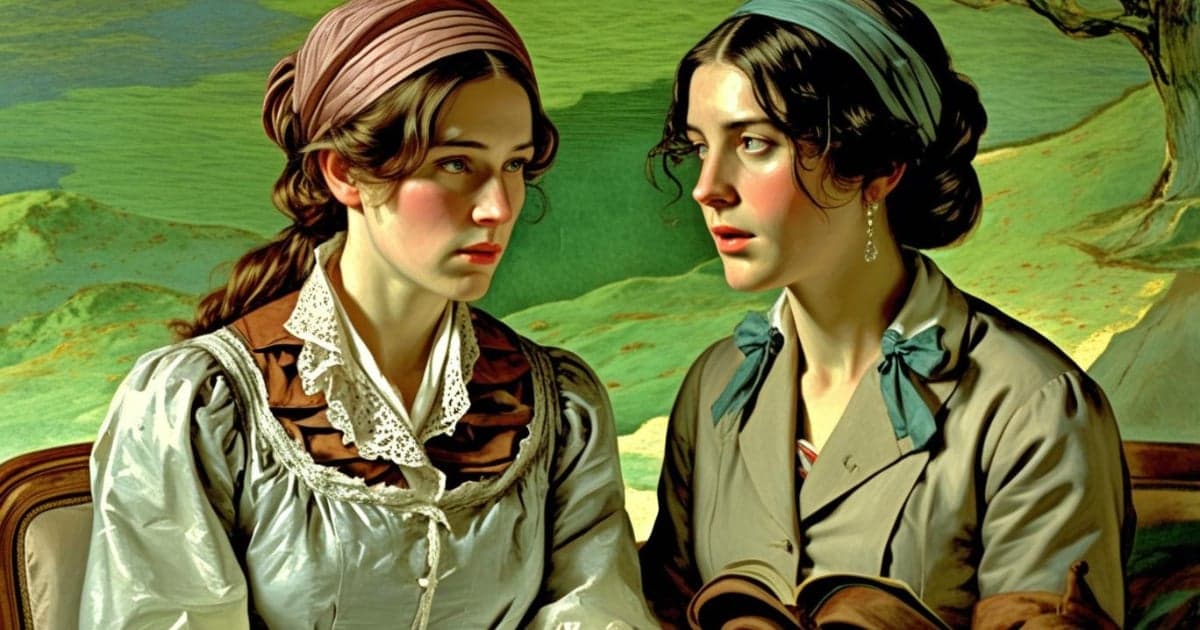
Eliot steps back from the story to examine the world that shaped Tom and Maggie Tulliver.
- 2
How does the middle of "The Weight of Small Lives" test loyalty, pride, or survival under provincial judgment?
analysis • mediumOne way to read it
Their religion is more about social custom than spiritual depth, they go to church because it's expected, not from deep faith.
- 3
Where in "The Weight of Small Lives" do family obligation and personal desire pull in opposite directions?
application • mediumOne way to read it
Their religion is more about social custom than spiritual depth, they go to church because it's expected, not from deep faith.
- 4
What does the closing movement of "The Weight of Small Lives" suggest about love, reputation, or self-knowledge?
application • deepOne way to read it
The chapter reveals how social expectations and family traditions can both nurture and constrain human potential.
- 5
After "The Weight of Small Lives", what would you do differently if you were trying to honor family without surrendering your values?
reflection • deepOne way to read it
The chapter reveals how social expectations and family traditions can both nurture and constrain human potential.
Critical Thinking Exercise
Map Your Background Gravity
Draw a simple diagram with yourself in the center and the major influences around you - family, community, workplace, social groups. For each influence, write one expectation they have for you and one way that expectation either supports or limits your growth. Look for patterns in what gets praised versus what gets discouraged.
Consider:
- •Notice which expectations feel protective versus restrictive
- •Identify areas where you might be self-limiting to maintain belonging
- •Consider how you could expand while still honoring your roots
Journaling Prompt
Write about a time when you felt caught between what your family or community expected and what you wanted for yourself. How did you handle it, and what would you do differently now?
Coming Up Next...
Chapter 31: When Life Becomes a Grinding Routine
The metaphor of a 'torn nest pierced by thorns' suggests that the Tulliver family's fragile security is about to face sharp new challenges. The protective shell of their world may finally crack completely. The opening of The Torn Nest Is Pierced by the Thorns will force Maggie to act faster than she expected, and the choice she makes there will echo through every relationship still..