Chapter 75
A Signed Statement
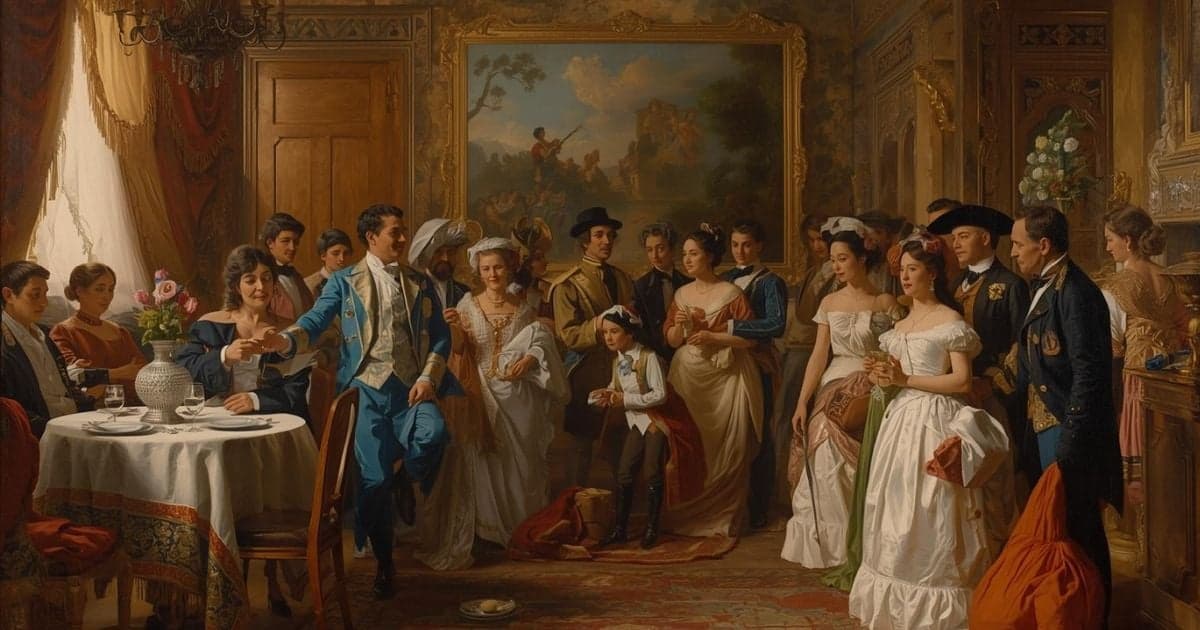
Noirtier was prepared to receive them, dressed in black, and installed in his armchair. When the three persons he expected had entered, he looked at the door, which his valet immediately closed. “Listen,” whispered Villefort to Valentine, who could not conceal her joy; “if M. Noirtier wishes to communicate anything which would delay your marriage, I forbid you to understand him.” Valentine blushed, but did not answer. Villefort, approached Noirtier. “Here is M. Franz d’Épinay,” said he; “you requested to see him. We have all wished for this interview, and I trust it will convince you how ill-formed are your…
Public-domain chapter text, formatted for reading.
Master this chapter. Complete your experience
Purchase the complete book to access all chapters and support classic literature
Available in paperback, hardcover, and e-book formats
Now let's explore the literary elements.
Key Quotes & Analysis
"General de Quesnel"
Context: Noirtier gives Franz the packet about his father
The engagement ends with a name Franz thought was history.
In Today's Words:
Noirtier hands Franz a sealed packet about General de Quesnel, his father. Old files can reopen engagements. When a family elder produces a name from the past, brace for the story behind the marriage. The pattern is not abstract. It appears whenever power, timing, and social ritual quietly decide what people treat as real.
"royalist"
Context: The signed statement records the general's political refusal
Political honor becomes the motive for murder.
In Today's Words:
The statement says General de Quesnel declared himself a royalist and refused club secrecy. Principle can be fatal in closed rooms. Know what your refusal costs when the group demands silence. The pattern is not abstract. It appears whenever power, timing, and social ritual quietly decide what people treat as real.
"killed my father"
Context: Franz confronts Noirtier after reading the assassin's identity
The marriage dies in one sentence of recognition.
In Today's Words:
Franz cries that Noirtier killed his father when the document names the assassin. Recognition can arrive on paper. When truth finally has a face, decide whether revenge or exit comes first. The pattern is not abstract. It appears whenever power, timing, and social ritual quietly decide what people treat as real.
"MYSELF"
Context: Franz reaches the assassin's name in the statement
The final word turns confession into generational war.
In Today's Words:
The narrator says Franz arrived at the word MYSELF in the signed statement. One word can end a dynasty's plan. Read the last line of any family document before you treat it as formality. The pattern is not abstract. It appears whenever power, timing, and social ritual quietly decide what people treat as real.
Thematic Threads
Forbidden translation
In This Chapter
Villefort orders Valentine not to understand Noirtier.
Development
The daughter must hear truth anyway.
In Your Life:
Parents who forbid interpretation often fear what the child will learn.
Political murder
In This Chapter
The statement describes the Bonapartist club killing Quesnel.
Development
Old party rage breaks a present engagement.
In Your Life:
Family histories of faction can veto modern love.
Eye as confession
In This Chapter
Noirtier answers yes when Franz reads MYSELF.
Development
Silence ends; guilt is named without speech.
In Your Life:
A steady look can confirm what documents only imply.
You now have the context. Time to form your own thoughts.
Discussion Questions
This is not a test. Five prompts guide you through the chapter, from how it opens to how it closes, so you notice context and rhythm rather than facts to memorize. Sit with each question in your own words. When you see "One way to read it," treat it as a starting point, not the only answer.
- 1
Noirtier gives Franz a sealed packet about General de Quesnel, Franz's father. Why wait until the day of the funeral to break an engagement?
analysis • surfaceOne way to read it
One way to read it: the truth arrives when ceremony demands decisions. One document ends a marriage before the ink can dry.
- 2
The statement describes a Bonapartist club meeting where General de Quesnel refused to swear secrecy and was killed. What role did Noirtier play?
analysis • mediumOne way to read it
One way to read it: he was president of the club that judged the general. Franz learns his grandfather-in-law's past is blood, not legend.
- 3
Franz cries that he now understands why his father was murdered while Valentine watches his filial grief. How does history wound the innocent present?
application • mediumOne way to read it
One way to read it: children inherit quarrels they never chose. Valentine's marriage dies because old oaths outlive the men who swore them.
- 4
Villefort forbids Valentine to interpret Noirtier's signs yet Franz opens the secretaire anyway. Who really governs this house?
application • deepOne way to read it
One way to read it: the paralytic in the chair. Villefort commands by law; Noirtier commands by documents locked in drawers.
- 5
Franz leaves to write that the alliance is impossible after disclosures Villefort should have foreseen. When does silence become its own confession?
reflection • deepOne way to read it
One way to read it: when a magistrate hides what a grandfather reveals. Villefort's shock proves he feared this hour for years.
Critical Thinking Exercise
Write Your Recognition Moment
Think of a time when someone from your past saw through a change you'd made in yourself - maybe they called out behavior you'd adopted, questioned choices you'd made, or reminded you of who you used to be. Write a brief dialogue between your past self and current self about this moment. What would each version of you say to defend their choices?
Consider:
- •Focus on specific behaviors or attitudes that changed, not just circumstances
- •Consider whether the recognition felt threatening or enlightening
- •Think about what core values remained constant despite the changes
Journaling Prompt
Write about a time when you had to choose between what felt justified and what felt merciful. What helped you make that decision, and how do you feel about it now?
Coming Up Next...
Chapter 76: Progress of Cavalcanti the Younger
In Paris Andrea Cavalcanti will charm the Danglars drawing room with song and diamonds while Monte Cristo watches. Then Danglars will rush out at word from Greece, and whispered news about Fernand and Yanina will turn the banker's hospitality into another trap..