Chapter 05
The Marriage Feast
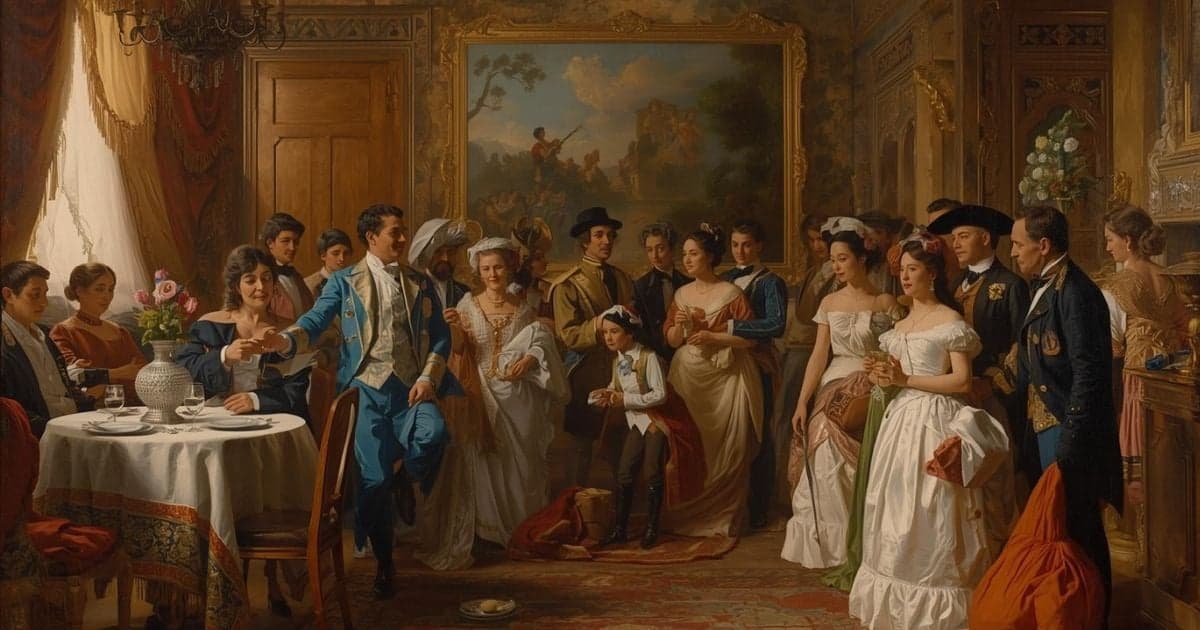
The morning’s sun rose clear and resplendent, touching the foamy waves into a network of ruby-tinted light. The feast had been made ready on the second floor at La Réserve, with whose arbor the reader is already familiar. The apartment destined for the purpose was spacious and lighted by a number of windows, over each of which was written in golden letters for some inexplicable reason the name of one of the principal cities of France; beneath these windows a wooden balcony extended the entire length of the house. And although the entertainment was fixed for twelve o’clock, an hour…
Public-domain chapter text, formatted for reading.
Master this chapter. Complete your experience
Purchase the complete book to access all chapters and support classic literature
Available in paperback, hardcover, and e-book formats
Now let's explore the literary elements.
Key Quotes & Analysis
"Man does not appear to me to be intended to enjoy felicity so unmixed; happiness is like the enchanted palaces we read of in our childhood, where fierce, fiery dragons defend the entrance and approach; and monsters of all shapes and kinds, requiring to be overcome ere victory is ours."
Context: Edmond speaks to his guests at the wedding table, confessing an unease he cannot explain at the height of his happiness
Edmond's foreboding is intuitive and genuine, but it works against him. He names the threat without identifying its source. The dragons he fears are already seated at his table, toasting his health.
In Today's Words:
When everything finally lines up at once, that is often when you are most exposed. Every gain creates a new vulnerability, and the bigger the prize, the harder others will work to take it from you. Stay alert precisely when you feel most settled in what you have earned and who you are becoming.
"upon my word, Dantès is a downright good fellow, and when I see him sitting there beside his pretty wife that is so soon to be. I cannot help thinking it would have been a great pity to have served him that trick you were planning yesterday."
Context: Caderousse, softened by wine and Edmond's warmth, speaks quietly to Danglars in the corner of the room
Caderousse's conscience surfaces exactly when it is least useful. The guilt that should have stopped the letter now only produces a passing regret that Danglars is ready to manage with a few calm sentences.
In Today's Words:
When someone you quietly wronged turns out to be genuinely kind, guilt does not automatically push you to make it right. More often it produces a brief twinge of regret that dissolves when someone nearby offers a convincing reason to stay silent. Caderousse drinks himself into goodwill but back into compliance within minutes.
"I am the bearer of an order of arrest, and although I most reluctantly perform the task assigned me, it must, nevertheless, be fulfilled. Who among the persons here assembled answers to the name of Edmond Dantès?"
Context: The magistrate enters the wedding feast with four soldiers and formally addresses the room
The magistrate's apology makes the arrest more crushing, not less. Reluctance dressed in official language is still enforcement. The trap closes with courteous efficiency, which strips Edmond of any obvious target for his anger.
In Today's Words:
Authority rarely announces itself with cruelty. The magistrate is polite, almost apologetic, explaining he acts reluctantly while doing exactly what was planned for Edmond. Formal language and a legal scarf make the trap look like procedure. When an institution moves against you with courteous efficiency, recognize that courtesy does not equal fairness.
"So far, then, all has gone as I would have it. I am, temporarily, commander of the Pharaon, with the certainty of being permanently so, if that fool of a Caderousse can be persuaded to hold his tongue. My only fear is the chance of Dantès being released. But, there, he is in the hands of Justice; and she will take her own."
Context: Danglars' private thoughts as he steps into a boat toward the Pharaon at the close of the chapter
In his final interior monologue, Danglars reveals the calculation that ran beneath every handshake and expression of shock. The loyalty was performed. The surprise was performed. Even the word Justice carries a smiling contempt for the system he has just weaponized.
In Today's Words:
Danglars reviewed events the way a chess player reviews a game already won. He wrote the letter, performed confusion at the arrest, and stepped into the command vacancy Edmond left behind. Positioning yourself to benefit from a rival's removal while appearing to mourn it is the oldest and most survivable career move available.
Thematic Threads
Class
In This Chapter
Danglars exploits his administrative position as ship's supercargo to fill the vacancy the moment Edmond is removed. Within hours of the arrest, M. Morrel appoints him temporary commander of the Pharaon.
Development
Class advantage in this chapter is not wealth but proximity to paperwork. Whoever controls the record and the shipowner's ear controls the outcome.
In Your Life:
You might experience this when someone with institutional access uses a gap created by your misfortune to consolidate a position they have wanted for some time.
Identity
In This Chapter
For the length of the feast, Edmond is the bridegroom, the future captain, the man whose patron attends and whose crew applauds. The magistrate's one sentence reduces all of it. From that point he is the accused.
Development
Identity built on public role and the approval of others is brittle. When external confirmation disappears in a single scene, there is nothing to stand on.
In Your Life:
You might face this when a job loss, accusation, or public reversal redefines how others see you faster than you can defend the person you know yourself to be.
Loyalty
In This Chapter
Caderousse feels genuine guilt watching Edmond at the table and nearly confesses to Danglars. Danglars reframes silence as self-protection in under a minute, and Caderousse's conscience folds without resistance.
Development
Loyalty to a wronged friend competes directly with fear of personal exposure. When someone nearby reframes silence as prudence rather than complicity, self-preservation usually wins.
In Your Life:
You might recognize this when you know something that could help someone but staying quiet feels safer, and you wait just long enough for the moment to pass and the decision to make itself.
Justice
In This Chapter
The magistrate arrives apologetically, cites legal duty, allows M. Morrel to question him politely, and still delivers Edmond to a carriage headed for Marseilles. The process is courteous, procedurally correct, and completely unjust.
Development
Justice in this chapter is a mechanism, not a value. It operates on information, and the information was designed by Danglars to produce this exact result.
In Your Life:
You might encounter this when a formal process at work, in a legal matter, or through an institution follows every rule correctly and still produces an outcome that harms you.
Human Relationships
In This Chapter
Fernand sits beside Edmond through the entire feast, pale and shaking, forced by social obligation to witness every laugh and toast of the man whose destruction he helped engineer.
Development
The wedding table makes Fernand's proximity to Edmond into a sustained physical ordeal. Social form requires him to stay and watch, which is its own kind of punishment.
In Your Life:
You might face this tension when circumstances require you to celebrate someone else's gain at the cost of your own composure, knowing that leaving early would reveal more than staying.
You now have the context. Time to form your own thoughts.
Discussion Questions
This is not a test. Five prompts guide you through the chapter, from how it opens to how it closes, so you notice context and rhythm rather than facts to memorize. Sit with each question in your own words. When you see "One way to read it," treat it as a starting point, not the only answer.
- 1
Edmond says happiness can oppress like sorrow and fears joy too unmixed. Why does Danglars watch Fernand closely when he hears this?
analysis • surfaceOne way to read it
Edmond's foreboding is intuitive, but Danglars reads the room for leverage. Fernand's face already betrays torment. Any crack in the bridegroom's bliss tells Danglars where pain can still be sharpened.
- 2
Edmond announces he will marry Mercédès within an hour and a half, then magistrates arrive with an order of arrest. Why is the timing of the arrest so devastating?
analysis • mediumOne way to read it
The feast gathers witnesses, allies, and enemies at Edmond's highest point. Arrest at the threshold of marriage turns public triumph into public humiliation and gives the accusation instant circulation.
- 3
Caderousse suddenly remembers the previous night's plot when Edmond is taken, but Danglars talks him down. Where have you seen half-forgotten knowledge return too late to prevent harm?
application • mediumOne way to read it
Think of the uneasy memory after a party, the comment you laughed off, or the document you did not take seriously until someone was already hurt. Fear and self-interest then silence the witness.
- 4
Morrel pleads for Edmond, but Danglars warns that Morrel's Bonapartist uncle makes speaking up risky. How does a political label shut down defense of the innocent?
application • deepOne way to read it
Once the charge touches faction, helpers must weigh their own exposure. Danglars reframes silence as prudence. Morrel's loyalty remains, but the rumor narrows who can safely fight for Edmond.
- 5
Edmond calls to Mercédès from the carriage that they will soon meet again. What makes that promise heartbreaking for the reader?
reflection • deepOne way to read it
He still trusts the system and his future. The reader knows the accusation is political, the enemies are in the room, and nothing about this case will move quickly or fairly.
Critical Thinking Exercise
Map Your Institutional Safety Net
Create a list of the institutions that currently have power over your life (employer, bank, insurance, healthcare, etc.). For each one, identify: What could go wrong? Who would advocate for you if that institution turned against you? What documentation do you keep? This exercise helps you spot vulnerabilities before they become crises.
Consider:
- •Consider institutions you interact with regularly vs. those that could suddenly impact your life
- •Think about which relationships are purely transactional vs. which involve people who know you personally
- •Identify gaps where you have no advocate or backup plan if things go wrong
Journaling Prompt
Write about a time when you felt abandoned by a system that was supposed to help you. What did you learn about protecting yourself from institutional indifference?
Coming Up Next...
Chapter 6: The Deputy Procureur du Roi
Across Marseilles, at the same hour Edmond is driven away in a carriage, a second feast fills an aristocratic salon with magistrates, royalists, and a young prosecutor named Villefort who has publicly disowned his Bonapartist father to prove his loyalty to the king. A servant pulls him from the table with urgent news of an arrest, and he rises beaming.