Wide Reads
Literature MattersLife IndexEducators
Sign in
Where to Begin

Ideology — The Count of Monte Cristo

The Count of Monte Cristo - Ideology

Alexandre Dumas

The Count of Monte Cristo

Ideology

Home›Books›The Count of Monte Cristo›Chapter 48: Ideology
Previous
48 of 117
Next

Analysis by the Wide Reads editorial team·Reviewed against the source text·Updated November 29, 2025

Summary

Ideology

The Count of Monte Cristo by Alexandre Dumas

0:000:00
Listen to Next Chapter

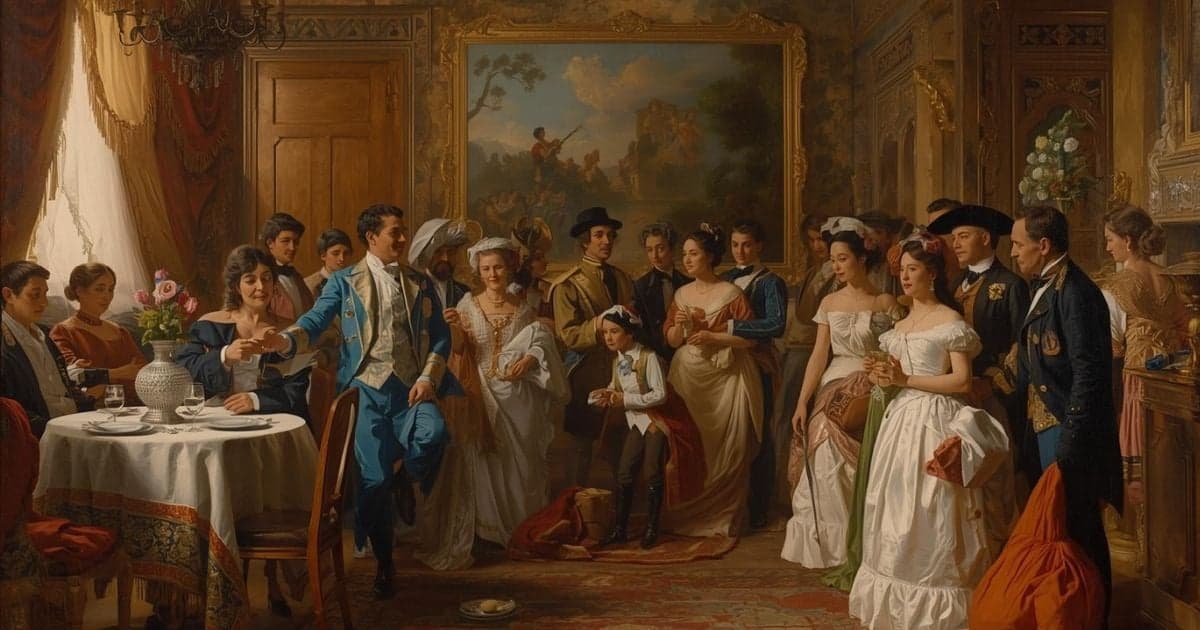
M. de Villefort pays the return call other men would delegate, because the Count saved his son Edward and because magistrates who hate ideology still respect power dressed as principle. The step is significant in Paris: a procureur du roi visiting a foreign noble signals either debt or danger. The procureur arrives in a drawing-room frozen by etiquette, bringing gratitude that will not stay polite for long.

Thanks for the carriage rescue becomes a debate about law, custom, and whether any man may stand above either. Villefort speaks as a servant of the French code; the Count answers with cosmopolitan knowledge and the calm of someone who has read every statute as optional scenery. The procureur hates ideology yet defends a system with religious fervor.

The conversation turns theological. The Count says he once wished to be Providence and accepted Satan's bargain to become an agent of reward and punishment. Villefort listens as if hearing blasphemy wrapped in elegance, unable to decide whether his guest is mad, guilty, or simply beyond reach.

Villefort offers his household as evidence of moral balance: Valentine, Edward, a paralyzed father upstairs whose revolutionary past he calls a buried sin compensated by innocent children. He shows Noirtier as warning and trophy, chess-master reduced to a body that can only blink.

The Count receives the tour without mercy. He praises nothing, commits to nothing, and lets Villefort reveal how he reads guilt, inheritance, and the law he administers for others. Every sentence is filed for later use.

Villefort leaves believing he has tested a dangerous mind; the Count knows he has heard a magistrate justify children as payment for a father's crimes. The interview will matter when Auteuil's garden and Noirtier's blink answer across the same ledger.

When the procureur leaves, the Count calls the interview poison and orders his carriage for Haydée at one o'clock. Ideology was not an abstract quarrel; it was reconnaissance before the antidote of human tenderness.

In this chapter: Terms Characters Key Quotes Themes Modern Story

Why This Matters

Connect literature to life

Skill: Hearing Confession Inside Courtesy

A thank-you call can be intelligence gathering. Villefort praises law and family while showing Noirtier and calling his children compensation for buried sin. Listen for what people reveal while they think they are only being polite.

Coming Up in Chapter 49

After Villefort's poison, the Count will seek Haydée's apartments at noon, where freedom offered and refused will restore the calm his revenge planning keeps trying to kill.

Share it with friends

PreviousPrevious ChapterNextNext Chapter
Original text
4,492 wordscomplete

Chapter 48

Ideology

If the Count of Monte Cristo had been for a long time familiar with the ways of Parisian society, he would have appreciated better the significance of the step which M. de Villefort had taken. Standing well at court, whether the king regnant was of the older or younger branch, whether the government was doctrinaire liberal, or conservative; looked upon by all as a man of talent, since those who have never experienced a political check are generally so regarded; hated by many, but warmly supported by others, without being really liked by anybody, M. de Villefort held a high…

Public-domain chapter text, formatted for reading.

Master this chapter. Complete your experience

Purchase the complete book to access all chapters and support classic literature

Buy at Powell'sBuy on Amazon

Available in paperback, hardcover, and e-book formats

Now let's explore the literary elements.

Key Quotes & Analysis

"ideality,—these were the elements of private and public life displayed by M. de Villefort"

— Narrator

Context: Description of Villefort's rigid salon principles

The chapter title lands on a man who despises ideas yet lives inside them.

In Today's Words:

The narrator lists Villefort's freezing politeness and hatred of ideality as his public character. People who boast of pragmatism often worship their own doctrine. Ask what unspoken ideology a strict realist is really defending. The pattern is not abstract. It appears whenever power, timing, and social ritual quietly decide what people treat as real.

"agents of that Providence"

— The Count of Monte Cristo

Context: The Count describes accepting a bargain to judge reward and punishment

He confesses revenge theology while Villefort must treat it as philosophy.

In Today's Words:

The Count calls himself one of the agents of Providence after describing Satan's offer. That is revenge dressed as sacred duty. When someone claims heaven's proxy, check what punishment they are already planning. The pattern is not abstract. It appears whenever power, timing, and social ritual quietly decide what people treat as real.

"Enough of this poison"

— The Count of Monte Cristo

Context: The Count reacts after Villefort leaves

He names the visit toxic and immediately seeks emotional antidote.

In Today's Words:

The Count says enough of this poison once Villefort is gone. Some conversations contaminate the rest of the day. When you name a talk poisonous, believe yourself and change the room before you make a decision. The pattern is not abstract. It appears whenever power, timing, and social ritual quietly decide what people treat as real.

"antidote"

— The Count of Monte Cristo

Context: The Count tells Ali he will seek the antidote in Haydée's chamber

Human love is framed as medicine after legal theology.

In Today's Words:

The Count tells Ali he will seek the antidote after Villefort's visit. He plans to recover in Haydée's presence. Know what person or place restores you after a meeting that drains your judgment. The pattern is not abstract. It appears whenever power, timing, and social ritual quietly decide what people treat as real.

Thematic Threads

Law vs providence

In This Chapter

Villefort defends the code; the Count claims a higher bargain.

Development

Magistrate and avenger speak past each other on purpose.

In Your Life:

Institutional authority and personal justice rarely share the same vocabulary.

Sin as family ledger

In This Chapter

Villefort calls Valentine and Edward compensation for Noirtier's past.

Development

Children become entries in a moral accounting book.

In Your Life:

People sometimes treat offspring as proof they have paid for earlier harm.

Poison and antidote

In This Chapter

The Count rejects Villefort's visit and rides to Haydée.

Development

Revenge planning requires human recovery or it consumes the planner.

In Your Life:

After toxic meetings, choose deliberately what restores your judgment.

You now have the context. Time to form your own thoughts.

Discussion Questions

This is not a test. Five prompts guide you through the chapter, from how it opens to how it closes, so you notice context and rhythm rather than facts to memorize. Sit with each question in your own words. When you see "One way to read it," treat it as a starting point, not the only answer.

  1. 1

    Villefort visits to thank the count for saving Edward, yet their talk turns into a duel over justice and divine power. Why does gratitude become a philosophical trap?

    ▶One way to read it

    One way to read it: the procureur expects a polite exchange and meets a man who studies souls like cases. Each answer strips Villefort's certainty without raising a voice.

    analysis • surface
  2. 2

    Monte Cristo tells Villefort he wished to be Providence and accepted Satan's offer to become an agent of reward and punishment. How should we read that confession?

    ▶One way to read it

    One way to read it: he names the engine of his life in plain language. Villefort hears blasphemy; the reader hears the blueprint of the revenge plot.

    analysis • medium
  3. 3

    Villefort describes Noirtier reduced by apoplexy from a revolutionary chess-master to a helpless body. Why does he offer that spectacle to a stranger who claims to be above ordinary men?

    ▶One way to read it

    One way to read it: he warns that pride meets ruin in the flesh. The count already knows Noirtier's name; he accepts the invitation as reconnaissance, not humility.

    application • medium
  4. 4

    Villefort calls Valentine and Edward God's compensation for his father's hidden sin. What does that theology reveal about how he reads his own household?

    ▶One way to read it

    One way to read it: he admits guilt in the family line while claiming innocence for himself. The count nearly groans because the magistrate unknowingly describes his own crimes.

    application • deep
  5. 5

    After Villefort leaves, Monte Cristo calls the interview poison and orders the carriage for Haydée. When have you needed an antidote after a conversation that drained you?

    ▶One way to read it

    One way to read it: he cannot stay in the magistrate's world without tasting his old cell. Joy with Haydée and mercy with the Morrels are deliberate counterweights.

    reflection • deep

Critical Thinking Exercise

10 minutes

Identity Audit - Past Self vs. Present Self

Think of someone from your past who hasn't seen you in years - maybe an old coworker, classmate, or neighbor. Write down three ways you've genuinely changed since they knew you, then three ways you're still fundamentally the same person. Now imagine running into them tomorrow - which version of you would they see first, and how would you want to handle that recognition?

Consider:

  • •Consider both positive changes you're proud of and areas where you feel you've grown
  • •Think about whether their old perception of you would help or hurt your current goals
  • •Reflect on whether you'd want to prove your growth or simply accept their outdated view

Journaling Prompt

Write about a time when someone from your past treated you like you hadn't changed, even though you knew you had. How did it feel, and what did you learn about managing others' perceptions of your growth?

Coming Up Next...

Chapter 49: Haydée

After Villefort's poison, the Count will seek Haydée's apartments at noon, where freedom offered and refused will restore the calm his revenge planning keeps trying to kill.

Continue to Chapter 49
Previous
The Dappled Grays
Contents
Next
Haydée
Keep exploring

Continue Exploring

Study guides, teaching tools, themes, and the full library.More ways to read The Count of Monte Cristo: study guides, teaching tools, and the wider library.

  • The Count of Monte Cristo Study Guide
  • Teaching Resources
  • Essential Life Index
  • Browse by Theme
  • All Books

Life-skill deep dives in The Count of Monte Cristo

  • Distinguishing Justice from RevengeExplore distinguishing justice from revenge through The Count of Monte Cristo by Alexandre Dumas. Timeless wisdom for modern life.
  • How Trauma Transforms IdentitySee how suffering creates new selves—Edmond Dantès dies in the Château d
  • Surviving Catastrophic BetrayalUnderstand how to endure when people you trusted destroy you—Dantès loses everything yet survives through will and learning, showing growth is...
  • Understanding Collateral DamageRecognize how revenge never limits itself to the guilty—watch how the Count
Moral Dilemmas & EthicsPower & CorruptionIdentity & Self-Discovery

You Might Also Like

Les Misérables: Essential Edition cover

Les Misérables: Essential Edition

Victor Hugo

Explores justice & fairness

Noli Me Tángere cover

Noli Me Tángere

José Rizal

Explores justice & fairness

A Tale of Two Cities cover

A Tale of Two Cities

Charles Dickens

Explores justice & fairness

Crime and Punishment cover

Crime and Punishment

Fyodor Dostoevsky

Explores suffering & resilience

Browse all 106+ books

Share This Chapter

Know someone who'd enjoy this? Spread the wisdom!

TwitterFacebookLinkedInEmail

Go further with Prestige

Unlock study guides and downloads, early access, and exclusive content — and support free access for everyone.

Subscribe to PrestigeCreate free account
Intelligence Amplifier
Intelligence Amplifier™Powering Wide Reads

Exploring human-AI collaboration through books, essays, and philosophical dialogues. Classic literature transformed into navigational maps for modern life.

2025 Books

→ The Amplified Human Spirit→ The Alarming Rise of Stupidity Amplified→ San Francisco: The AI Capital of the World
Visit intelligenceamplifier.org
hello@widereads.com

WideReads Originals

→ You Are Not Lost→ The Last Chapter First→ The Lit of Love→ Wealth and Poverty→ Wisdom for the Wounded
Arvintech
arvintechAmplify your Mind
Visit at arvintech.com

Navigate

  • Home
  • Library
  • Essential Life Index
  • How It Works
  • Subscribe
  • Account
  • About
  • Contact
  • Authors
  • Suggest a Book
  • Landings

Made For You

  • Trending
  • Students
  • Educators
  • Families
  • Readers
  • Literary Analysis
  • Finding Purpose
  • Letting Go
  • Recovering from a Breakup
  • Corruption
  • Gaslighting in the Classics

Newsletter

Weekly insights from the classics. Amplify Your Mind.

Legal

  • Privacy Policy
  • Terms of Service
  • Editorial Standards
  • Cookie Policy
  • Accessibility

Why Public Domain?

We focus on public domain classics because these timeless works belong to everyone. No paywalls, no restrictions—just wisdom that has stood the test of centuries, freely accessible to all readers.

Public domain books have shaped humanity's understanding of love, justice, ambition, and the human condition. By amplifying these works, we help preserve and share literature that truly belongs to the world.

A Pilgrimage

Powell's City of Books

Portland, Oregon

If you ever find yourself in Portland, walk to the corner of Burnside and 10th. The building takes up an entire city block. Inside is over a million books, new and used on the same shelf, organized by color-coded rooms with names like the Rose Room and the Pearl Room. You can lose an afternoon. You can lose a weekend. You will find a book you have been looking for your whole life, and three you did not know existed.

It is a pilgrimage. We cannot find a bookstore like it anywhere on earth. If you read the classics, and you ever get the chance, go. It belongs on every reader's bucket list.

Visit powells.com

We are not in any way affiliated with Powell's. We are just a very big fan.

© 2026 Wide Reads™. All Rights Reserved.

Intelligence Amplifier™ and Wide Reads™ are proprietary trademarks of Arvin Lioanag.

Copyright Protection: All original content, analyses, discussion questions, pedagogical frameworks, and methodology are protected by U.S. and international copyright law. Unauthorized reproduction, distribution, web scraping, or use for AI training is strictly prohibited. See our Copyright Notice for details.

Disclaimer: The information provided on this website is for general informational and educational purposes only and does not constitute professional, legal, financial, or technical advice. While we strive to ensure accuracy and relevance, we make no warranties regarding completeness, reliability, or suitability. Any reliance on such information is at your own risk. We are not liable for any losses or damages arising from use of this site. By using this site, you agree to these terms.