Chapter 03
The Catalans
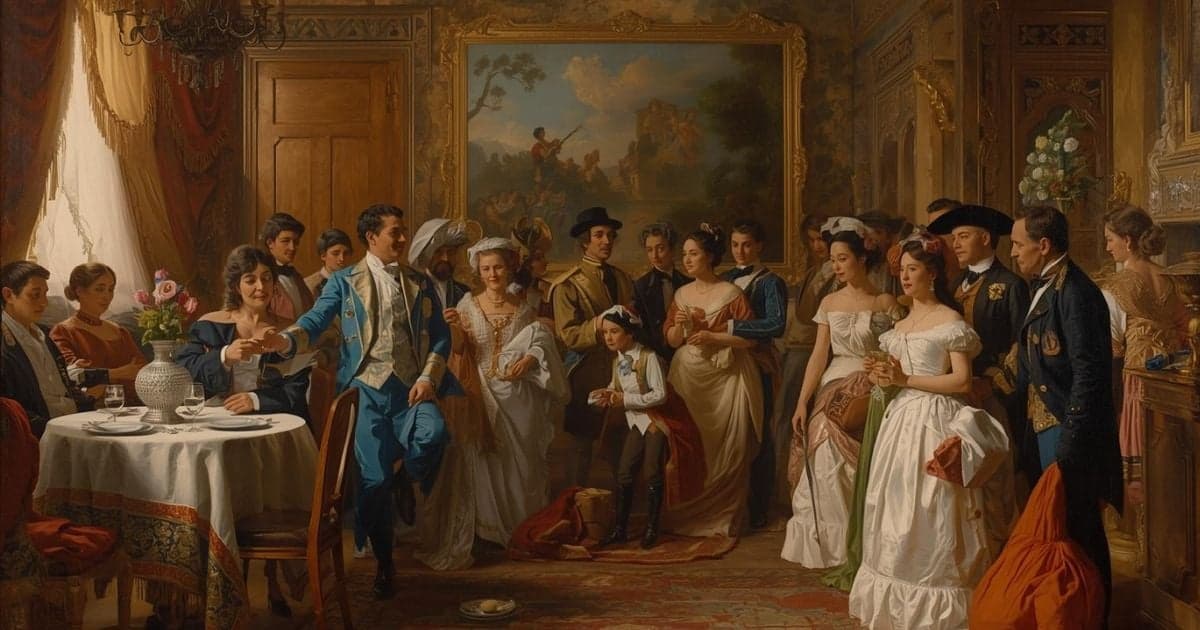
Beyond a bare, weather-worn wall, about a hundred paces from the spot where the two friends sat looking and listening as they drank their wine, was the village of the Catalans. Long ago this mysterious colony quitted Spain, and settled on the tongue of land on which it is to this day. Whence it came no one knew, and it spoke an unknown tongue. One of its chiefs, who understood Provençal, begged the commune of Marseilles to give them this bare and barren promontory, where, like the sailors of old, they had run their boats ashore. The request was granted;…
Public-domain chapter text, formatted for reading.
Master this chapter. Complete your experience
Purchase the complete book to access all chapters and support classic literature
Available in paperback, hardcover, and e-book formats
Now let's explore the literary elements.
Key Quotes & Analysis
"I have answered you a hundred times, Fernand, and really you must be very stupid to ask me again."
Context: Mercédès to Fernand in the Catalans cottage, when he asks her again to consider marrying him instead of Edmond
The limit of patience reached: when a clear answer has been given many times and is still questioned, the repetition says more about the asker's unwillingness to accept reality than about any ambiguity in the answer.
In Today's Words:
A clear answer repeated a hundred times is not ambiguous; it is being refused. When someone has told you no plainly and repeatedly, the question asked again is no longer a request for information. It is pressure designed to outlast the other person's resolve. Mercédès holds the line; the repetition is Fernand's problem, not hers.
"“I love Edmond Dantès,” the young girl calmly replied, “and none but Edmond shall ever be my husband.”"
Context: Mercédès to Fernand when he asks one final time whether she will always love Edmond
Absolute clarity about one's commitment, stated once and without softening, is the most merciful thing one can offer someone who will not accept ambiguity.
In Today's Words:
Stating what you want clearly is not arrogance; it is respect for the person who will not be chosen. Mercédès gives Fernand the plain answer, once, without softening it. A clean refusal held with that directness rarely does more damage than the vague kind that keeps everyone in uncertainty.
"We are always in a hurry to be happy, M. Danglars; for when we have suffered a long time, we have great difficulty in believing in good fortune."
Context: Edmond to Danglars at La Réserve, explaining why the wedding is set so soon after his return
The psychology of relief after deprivation: happiness felt while it is within reach, because experience teaches that good things do not stay without being seized.
In Today's Words:
The rush to act when good fortune arrives after a long wait is not impatience; it is the body catching up with relief. Edmond tells Danglars that the longer you have waited for something good, the harder it is to believe it will stay, and the more urgently you move to secure it.
"Ah, this letter gives me an idea—a capital idea!"
Context: Danglars' private thought after Edmond mentions going to Paris to deliver the dying captain's letter, spoken quietly as Edmond walks away
The pivot from passive resentment to active conspiracy: a single piece of voluntarily shared information converts an envious observer into an adversary with a plan.
In Today's Words:
Information volunteered in good faith is the most useful kind of intelligence, because the person sharing it has no idea they are handing over a weapon. Edmond tells Danglars about the Paris commission without a second thought. That single disclosure is all Danglars needs to move from envy to action.
Thematic Threads
Loyalty
In This Chapter
Mercédès tells Fernand she would climb to the highest point of Cape de Morgiou and cast herself headlong from it rather than betray Edmond, framing her commitment not as sentiment but as a physical absolute.
Development
Established here as the emotional foundation of the love triangle: a loyalty that cannot be argued with, only outmaneuvered.
In Your Life:
You encounter this when someone's commitment to another person is so complete it closes every avenue of persuasion or appeal.
Unrequited Love
In This Chapter
Fernand listens to Mercédès declare that none but Edmond shall ever be her husband, cannot speak, cannot move, and when Edmond extends his hand in friendship, has no choice but to take it while his silence fills with violence he cannot use.
Development
Established here as the emotional fuel that Danglars will convert into a deliberate scheme in the following chapter.
In Your Life:
You recognize this whenever deep feeling for someone cannot be acted on because the person you want belongs, completely, to someone else.
Resentment as a Tool
In This Chapter
Danglars surveys the table at La Réserve, reads Fernand's pain and Caderousse's drunkenness precisely, and selects his toast to 'Captain Edmond Dantès, husband of the beautiful Catalane' knowing it will wound one man and bore the other into compliance.
Development
Introduced here as Danglars' defining trait: the ability to convert others' emotions into operational leverage.
In Your Life:
You see this when someone in a group uses another person's visible hurt or anger to push an agenda of their own.
Transparency as Vulnerability
In This Chapter
Edmond volunteers the Paris commission and its connection to Captain Leclère to the table at La Réserve without registering that the information is a weapon; Danglars has to say nothing to provoke the disclosure.
Development
Set up across chapters 1 and 2 as Edmond's defining quality; revealed here as the mechanism by which goodness becomes exploitable.
In Your Life:
You experience this when honest information you shared in good faith is later used against you, not because you were careless but because you assumed the room was safe.
Obliviousness at Peak Fortune
In This Chapter
Edmond and Mercédès walk away from La Réserve 'calm and joyous as if they were the very elect of heaven,' while the people who will destroy them sit a hundred paces behind.
Development
The closing image of chapter 3 establishes the dramatic irony that will carry the first arc: Edmond's happiness and his danger are simultaneous and invisible to him.
In Your Life:
You feel this retrospectively, when you look back on a period of confidence and realize you had no idea what was assembling around you.
You now have the context. Time to form your own thoughts.
Discussion Questions
This is not a test. Five prompts guide you through the chapter, from how it opens to how it closes, so you notice context and rhythm rather than facts to memorize. Sit with each question in your own words. When you see "One way to read it," treat it as a starting point, not the only answer.
- 1
Fernand invokes the Catalan custom of intermarriage to claim Mercédès. How does she answer that argument?
analysis • surfaceOne way to read it
Mercédès says it is custom, not law, and that she has always told Fernand she loves him as a brother only. She refuses to marry without love even if tradition and poverty argue otherwise.
- 2
When Edmond arrives, Mercédès threatens to throw herself from Cape Morgiou if harm comes to him. What effect does that have on Fernand in the moment?
analysis • mediumOne way to read it
Fernand reads her sincerity and drops back into his seat. His impulse toward violence is checked because he believes she would carry out the threat. Jealousy remains, but direct attack feels blocked.
- 3
Danglars toasts Captain Edmond Dantès and the beautiful Catalane while Fernand dashes his glass to the ground. Where have you seen celebration used to provoke or humiliate?
application • mediumOne way to read it
Think of public praise for someone you resent, or a group toast that forces you to smile while losing. Danglars names the future Edmond wants most and makes Fernand swallow the defeat in company.
- 4
Edmond invites Danglars, Caderousse, and Fernand to the wedding though two already wish him ill. What does his generosity cost him?
application • deepOne way to read it
He gives his enemies access, information, and social cover. Danglars learns of the Paris trip tied to Elba, and Fernand's humiliation deepens where witnesses can see it. Open-heartedness feeds the plot.
- 5
Danglars ends the chapter saying he may take a hand unless Edmond's star keeps rising. What mix of traits makes him dangerous?
reflection • deepOne way to read it
He is cold, calculating, and patient. He will not duel or denounce with his own name yet, but he sees Fernand's pain and Caderousse's wine as tools. Envy becomes paperwork.
Critical Thinking Exercise
Map Your Own Breaking Points
Think of a time when something you believed about fairness, loyalty, or 'how things should work' got completely shattered. Draw a simple timeline showing your emotional stages: what you felt first, then next, then after that. Mark the moment when you stopped trying to go back to who you were before and started becoming someone new.
Consider:
- •Notice if you tried to skip stages or rush the process
- •Identify what beliefs about the world had to die
- •Look for signs of who you were becoming during the worst moments
Journaling Prompt
Write about what you learned about yourself during your darkest moment that you couldn't have learned any other way. What strength did you discover you had?
Coming Up Next...
Chapter 4: Conspiracy
Danglars watches Edmond and Mercédès disappear behind the angles of Fort Saint Nicolas, then turns to find Fernand slumped pale in his chair. With Caderousse drunk and Fernand willing, the scheme takes shape: someone will write a letter to the royal procureur, and no one will sign it..