Chapter 11
The Corsican Ogre
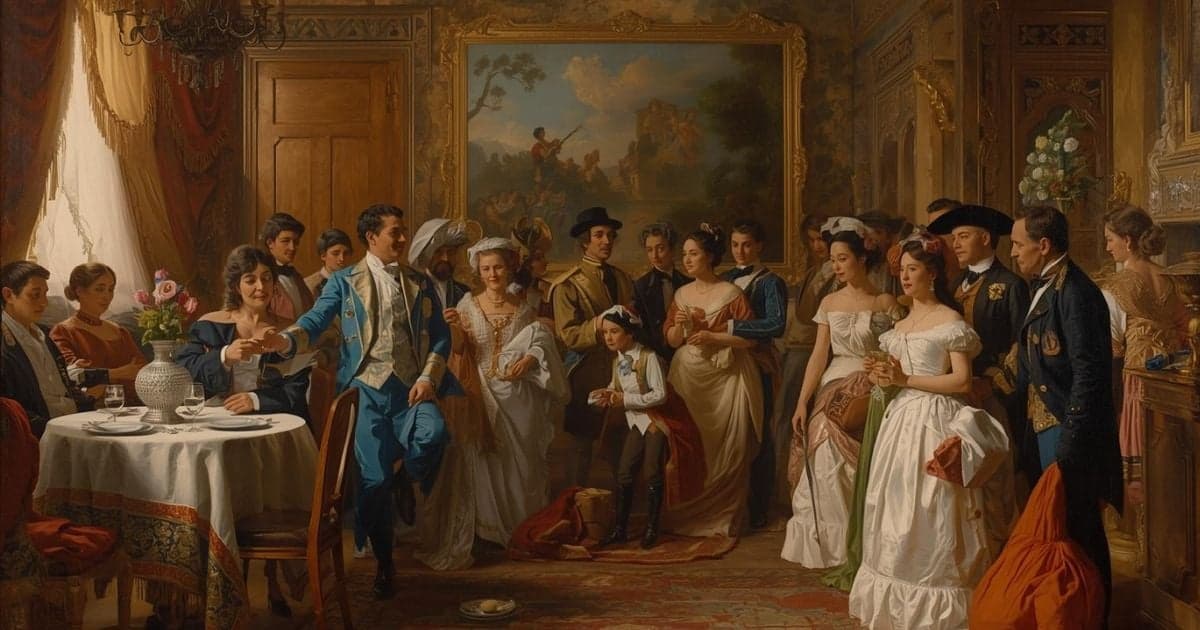
At the sight of this agitation Louis XVIII. pushed from him violently the table at which he was sitting. “What ails you, baron?” he exclaimed. “You appear quite aghast. Has your uneasiness anything to do with what M. de Blacas has told me, and M. de Villefort has just confirmed?” M. de Blacas moved suddenly towards the baron, but the fright of the courtier pleaded for the forbearance of the statesman; and besides, as matters were, it was much more to his advantage that the prefect of police should triumph over him than that he should humiliate the prefect. “Sire,——”…
Public-domain chapter text, formatted for reading.
Master this chapter. Complete your experience
Purchase the complete book to access all chapters and support classic literature
Available in paperback, hardcover, and e-book formats
Now let's explore the literary elements.
Key Quotes & Analysis
"“Well, sire, the usurper left Elba on the 26th February, and landed on the 1st of March.”"
Context: The police minister finally delivers the news that collapses the court's complacency
The sentence is simple and catastrophic. It destroys the minister's credibility and instantly recolors Villefort's arrival as prophecy rather than panic.
In Today's Words:
The minister finally says aloud what the room can no longer deny: Napoleon has landed in France. One plain fact can undo weeks of soothing reports when the fact arrives too late to be managed. In any organization, the moment everyone knows the comforting story is false is also the moment someone else gets promoted for having said so first.
"“In France, sire,—at a small port, near Antibes, in the Gulf of Juan.”"
Context: The king asks where Napoleon landed, expecting Italy
Geography makes the threat real. The usurper is not far away in exile; he is already inside the country the ministers claimed to be watching.
In Today's Words:
The king expects the threat to be distant, and the answer places it inside France itself. That is how delayed intelligence feels: not merely wrong, but wrong in the most dangerous direction. When leadership discovers the problem is already local, the first instinct is often to blame the messenger rather than repair the system that stayed comfortable too long.
"“you entered by luck’s door—your fortune is made.”"
Context: To Villefort as they leave the Tuileries after his royal triumph
The fallen minister names the truth Villefort already knows: advancement here is luck plus timing, not justice.
In Today's Words:
The king mocks the police minister for calling ignorance impossible while spending a fortune on spies. That public humiliation is also a promotion ceremony for Villefort. In hierarchical systems, one person's exposure often becomes another person's ladder. Watch who gains standing when the official story collapses, because their rise may depend on the same silence that buried Edmond.
"“Father!” cried Villefort, “then I was not deceived; I felt sure it must be you.”"
Context: Noirtier enters the hotel room dressed exactly like the wanted man in the Quesnel investigation
The chapter's final beat reveals that the political mystery and the family secret are the same person. Villefort's royal triumph immediately collides with private danger.
In Today's Words:
Villefort realizes the wanted man from the king's description is his own father. That is the chapter's cruelest turn: public advancement and private catastrophe arrive in the same hour. Family loyalty and state survival are suddenly opposite instructions. When your rise depends on hiding what your household knows, the next crisis will not come from a rival. It will walk through your door.
Thematic Threads
Power
In This Chapter
Louis XVIII. turns sarcasm into punishment and hands Villefort a Legion of Honor cross while Dandré trembles.
Development
Power shifts from the minister who soothed to the magistrate who alarmed.
In Your Life:
You might see this when leadership promotes the alarmist only after the damage is already public.
Family
In This Chapter
Noirtier arrives dressed as the wanted man from the Quesnel investigation and calls Villefort insufficiently filial.
Development
Villefort's public triumph immediately collides with a father who embodies the danger he is paid to fight.
In Your Life:
You might recognize when career advancement and family secrets stop being separate problems and become the same problem.
Betrayal
In This Chapter
The police hunt a man matching Noirtier's description while Villefort has just helped the king celebrate his own foresight.
Development
State loyalty and blood loyalty diverge in the same room.
In Your Life:
You might feel this when protecting someone you love would require betraying the institution that just rewarded you.
Identity
In This Chapter
Edmond remains only the imprisoned sailor Villefort used to buy access to the king.
Development
His real case is being absorbed into a larger political narrative that serves his prosecutor.
In Your Life:
You might see this when one person's life becomes evidence in someone else's career story.
You now have the context. Time to form your own thoughts.
Discussion Questions
This is not a test. Five prompts guide you through the chapter, from how it opens to how it closes, so you notice context and rhythm rather than facts to memorize. Sit with each question in your own words. When you see "One way to read it," treat it as a starting point, not the only answer.
- 1
The police minister learns by telegraph that Napoleon has landed in France two days late, while Louis XVIII had dismissed earlier warnings. Why is the king so furious at the messenger rather than the threat itself?
analysis • surfaceOne way to read it
The blow is not only military but humiliating. A clerk with no police apparatus outran the whole ministry. Louis reads the delay as proof his court is blind, and ridicule matters as much as danger.
- 2
When the General Quesnel murder is discussed, the witness describes a man in a blue frock-coat with a Legion of Honor rosette. Why does Villefort turn pale and then breathe again when the suspect is lost at Rue Coq-Héron?
analysis • mediumOne way to read it
The description matches his father Noirtier, who was seen near Quesnel before the drowning. If police catch him, Villefort's family scandal detonates. The lost trail is a personal reprieve disguised as routine police work.
- 3
Villefort deflects praise toward the failing police minister instead of crushing him, even though they are rivals. Where have you seen someone protect a weakened enemy to avoid a shared secret coming out?
application • mediumOne way to read it
Think of coworkers who soften an investigation, share credit, or stall a review because exposure would damage them too. Self-preservation sometimes looks like mercy.
- 4
Louis XVIII gives Villefort the Legion of Honor and sends him back toward Marseilles after asking whether he visited his father. How does the king reward ambition while noting the family tie Villefort denies in public?
application • deepOne way to read it
The king sees Villefort's usefulness and his rupture with Noirtier as proof of loyalty. The cross buys devotion. The question about his father reminds Villefort that the throne knows exactly what he is sacrificing.
- 5
The chapter ends with a stranger matching the police description entering Villefort's room and saying, 'Is it the custom in Marseilles for sons to keep their fathers waiting?' What does this arrival suggest about who really holds leverage?
reflection • deepOne way to read it
Villefort has just risen at court, but the man the police hunt is his father, already inside his hotel. Political triumph does not erase the past; it may have delivered Noirtier to his door.
Critical Thinking Exercise
Map Your Information Lifelines
Create a map of who knows where you are and what you're doing in your main life areas - work, family, community. Identify which relationships exist outside any single institution's control. Then imagine someone wanted to isolate you systematically - what would they target first?
Consider:
- •Which of your important relationships depend on a single institution or person to maintain?
- •What records of your activities exist outside your workplace or main social circle?
- •Who would notice and speak up if you suddenly 'disappeared' from normal activities?
Journaling Prompt
Write about a time when you felt systematically excluded or isolated from a group or situation. What warning signs did you notice? How did you respond, and what would you do differently now?
Coming Up Next...
Chapter 12: Father and Son
Noirtier bolts the doors, sits down with maddening calm, and tells Villefort that the Bonapartist club in the Rue Saint-Jacques has more to do with this crisis than the king's ministers know M. Noirtier locks the doors, teases Villefort for looking less than delighted, and reveals that he is vice-president of the Bonapartist club in the Rue Saint-Jacques..