Wide Reads
Literature MattersLife IndexEducators
Sign in
Where to Begin

Bath Society — Persuasion

Persuasion - Bath Society

Jane Austen

Persuasion

Bath Society

Home›Books›Persuasion›Chapter 16: Bath Society
Previous
16 of 24
Next

Analysis by the Wide Reads editorial team·Reviewed against the source text·Updated November 29, 2025

Summary

Bath Society

Persuasion by Jane Austen

0:000:00
Listen to Next Chapter

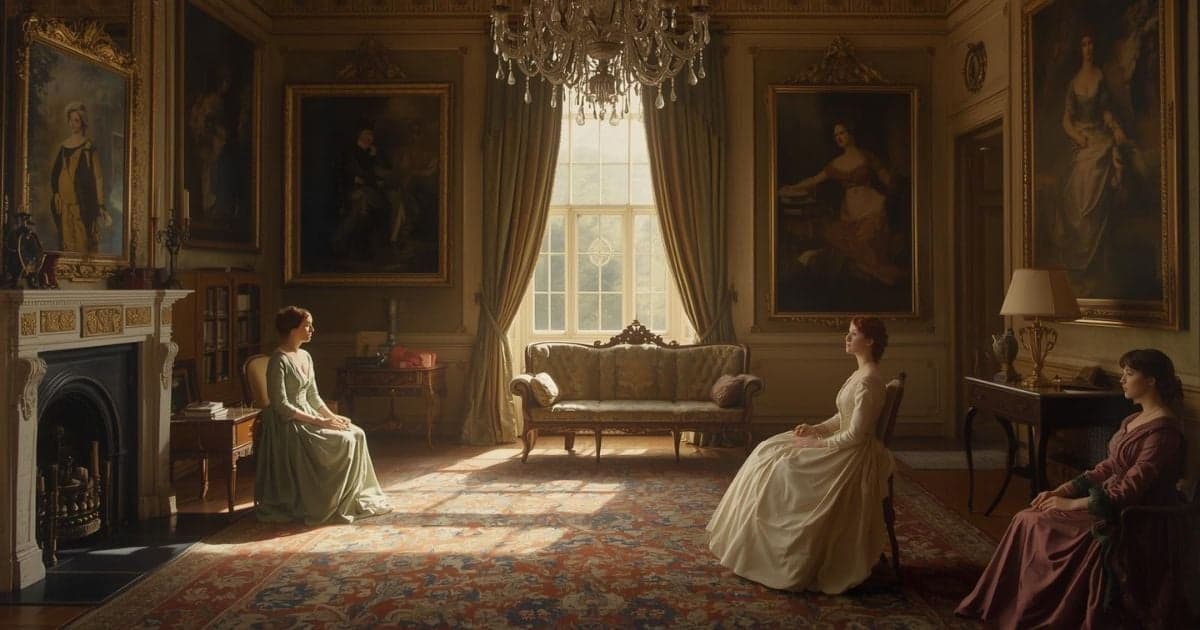
Mr. Elliot calls late on Anne's first evening, his first meeting with her since Lyme, and he's delighted to discover that the beautiful woman who caught his eye is actually his cousin. His eyes brighten with pleasure. He's polished, sensible, perfectly agreeable, and Anne finds herself comparing his manners to only one other person's: Wentworth. "They were not the same, but they were, perhaps, equally good." He stays an hour, genuinely interested in what happened at Lyme, showing real concern for Anne's experience. She's surprised: her first evening in Bath passes well after all. But darker currents run beneath the pleasant surface. Anne discovers her father may be developing feelings for Mrs. Clay, the scheming widow who's embedded herself in the household. Sir Walter praises Mrs. Clay's "fine mind" with alarming sincerity, insists she must stay in Bath, compliments how his recommended beauty treatment has improved her freckles (though Anne sees no improvement). If Sir Walter marries Mrs. Clay and has a son, Mr. Elliot loses Kellynch. Anne suspects this is why Mr. Elliot has suddenly returned to court the family, not for Elizabeth's sake, but to prevent Mrs. Clay from becoming Lady Elliot. Meanwhile, Sir Walter and Elizabeth throw themselves into pursuing connection with distant aristocratic cousins: the Dalrymples. Much agitation, many letters, elaborate social maneuvering, all to secure recognition from relatives who care nothing about them. When the connection is finally renewed, Anne is ashamed. Lady Dalrymple and Miss Carteret turn out to be boring, vapid nobodies. "There was no superiority of manner, accomplishment, or understanding." But her father and Elizabeth parade them everywhere: "Our cousins in Laura Place" becomes the constant refrain. Anne tells Mr. Elliot her definition of good company: "clever, well-informed people, who have a great deal of conversation." He gently corrects her: "that is not good company; that is the best." Good company, he explains, requires only birth and manners. Anne realizes that despite his polish and intelligence, Mr. Elliot values rank more than substance, he's more like her father than she'd hoped. Still, she's pleased when he reveals his real motive for promoting the Dalrymple connection: diverting Sir Walter's attention from Mrs. Clay, "those who are beneath him." At least they share one goal.

In this chapter: Terms Characters Key Quotes Themes Modern Story

Why This Matters

Connect literature to life

Skill: Naming Your Company

Not every introduction improves your life; some only teach you who is willing to beg for a nod. Anne meets the Dalrymples and finds no superiority of manner, accomplishment, or understanding, yet her father parades the cousins all day while she defines good company as clever, well-informed conversation. Before you chase a connection for status, decide whether you want the name on the card or the minds in the room.

Coming Up in Chapter 17

While the Elliots parade their noble cousins, Anne slips away to Westgate Buildings and a very different friendship. Mrs Smith, poor, ill, and nearly excluded from society, proves more alive than Camden Place, and Lady Russell will soon decide Mr Elliot is the match Anne should accept.

Share it with friends

PreviousPrevious ChapterNextNext Chapter
Original text
2,406 wordscomplete

Chapter 16

Bath Society

There was one point which Anne, on returning to her family, would have been more thankful to ascertain even than Mr Elliot’s being in love with Elizabeth, which was, her father’s not being in love with Mrs Clay; and she was very far from easy about it, when she had been at home a few hours. On going down to breakfast the next morning, she found there had just been a decent pretence on the lady’s side of meaning to leave them. She could imagine Mrs Clay to have said, that “now Miss Anne was come, she could not suppose…

Public-domain chapter text, formatted for reading.

Master this chapter. Complete your experience

Purchase the complete book to access all chapters and support classic literature

Buy at Powell'sBuy on Amazon

Available in paperback, hardcover, and e-book formats

Now let's explore the literary elements.

Key Quotes & Analysis

"There was no superiority of manner, accomplishment, or understanding."

— Narrator

Context: Anne's disappointment after meeting Lady Dalrymple and Miss Carteret

The sought aristocrats are socially empty. Anne's shame is not snobbery but the spectacle of her family's eager performance for people who add nothing.

In Today's Words:

Chasing a famous connection that turns out dull is embarrassing not because you wanted quality and got mediocrity, but because you performed need in front of people who felt nothing either way Name the pattern when you notice it in your own relationships and daily choices.

"My idea of good company, Mr Elliot, is the company of clever, well-informed people, who have a great deal of conversation; that is what I call good company."

— Anne Elliot

Context: Debating the value of the Dalrymple connection with Mr Elliot

Anne defines company by mind and exchange. The sentence is her clearest public claim for substance over birth.

In Today's Words:

Good company is not the guest list with the highest titles but the room where informed people talk honestly. If you have to chase introductions to feel legitimate, you may already be in the wrong definition of worth Name the pattern when you notice it in your own relationships and daily choices.

"Good company requires only birth, education, and manners, and with regard to education is not very nice."

— Mr Elliot

Context: Correcting Anne's definition of good company

Mr Elliot reveals rank as policy, not accident. He values connection for what it circulates socially, not for what it thinks.

In Today's Words:

Some people do not want the best conversation; they want the right names in the room. Understanding that difference early can save you from joining a performance you despise Name the pattern when you notice it in your own relationships and daily choices Name the pattern when you notice it in your own relationships and

"We must feel that every addition to your father's society, among his equals or superiors, may be of use in diverting his thoughts from those who are beneath him."

— Mr Elliot

Context: Speaking quietly to Anne while glancing toward Mrs Clay's seat

He names a shared practical goal: keep Sir Walter from Mrs Clay. Anne is pleased by the aim even when she doubts his pride matches hers.

In Today's Words:

Allies can oppose the same threat for different reasons. You may accept help blocking a social climber near your parent while still distrusting the helper's love of hierarchy Name the pattern when you notice it in your own relationships and daily choices Name the pattern when you notice it in your own relationships and daily

Thematic Threads

Bath Society

In This Chapter

Anne experiences navigating social performance

Development

This connects to the broader themes of constancy and second chances

In Your Life:

Consider how authenticity, pretension, belonging appear in your own relationships

You now have the context. Time to form your own thoughts.

Discussion Questions

This is not a test. Five prompts guide you through the chapter, from how it opens to how it closes, so you notice context and rhythm rather than facts to memorize. Sit with each question in your own words. When you see "One way to read it," treat it as a starting point, not the only answer.

  1. 1

    Why is Anne relieved that her father does not appear in love with Mrs Clay?

    ▶One way to read it

    A marriage to Mrs Clay could produce an heir and threaten Mr Elliot's inheritance, but Anne's immediate fear is her father's vulnerability to flattery.

    analysis • surface
  2. 2

    What disappoints Anne when she finally sees Sir Walter and Elizabeth with nobility?

    ▶One way to read it

    She expected more from their high ideas of themselves and finds the Dalrymples offer no superiority of manner, accomplishment, or understanding.

    analysis • medium
  3. 3

    How do Anne's and Mr Elliot's definitions of good company differ?

    ▶One way to read it

    Anne values clever, informed conversation, while he says good company requires birth, education, and manners, with little demand on depth.

    application • medium
  4. 4

    Why is Anne pleased when Mr Elliot admits he wants to divert her father from Mrs Clay?

    ▶One way to read it

    They share a protective goal even though their pride works differently, and she would rather have his help against Mrs Clay than stand alone.

    application • deep
  5. 5

    When have you felt ashamed of your family's pursuit of status rather than substance?

    ▶One way to read it

    Like Anne hearing 'our cousins' all day, many people recognize hollow performances once the sought connection proves ordinary.

    reflection • deep

Critical Thinking Exercise

10 minutes

Understanding Bath Society

Reflect on a situation in your life involving authenticity, pretension, belonging. How did you handle it, and what would you do differently now?

Consider:

  • •How did authenticity affect your decisions?
  • •What did you learn from the experience?

Journaling Prompt

Write about how understanding authenticity, pretension, belonging has changed your approach to relationships.

Coming Up Next...

Chapter 17: Lady Russell's Approval

While the Elliots parade their noble cousins, Anne slips away to Westgate Buildings and a very different friendship. Mrs Smith, poor, ill, and nearly excluded from society, proves more alive than Camden Place, and Lady Russell will soon decide Mr Elliot is the match Anne should accept.

Continue to Chapter 17
Previous
Mr. Elliot Appears
Contents
Next
Lady Russell's Approval
Keep exploring

Continue Exploring

Study guides, teaching tools, themes, and the full library.More ways to read Persuasion: study guides, teaching tools, and the wider library.

  • Persuasion Study Guide
  • Teaching Resources
  • Essential Life Index
  • Browse by Theme
  • All Books

Life-skill deep dives in Persuasion

  • Inner Worth vs. Outer AppearanceExplore inner worth vs outer appearance through Persuasion by Jane Austen. Life lessons from classic literature applied to modern challenges.
  • Navigating Social DeclineExplore navigating social decline through Persuasion by Jane Austen. Life lessons from classic literature applied to modern challenges.
  • Second Chances and ConstancyExplore second chances and constancy through Persuasion by Jane Austen. Life lessons from classic literature applied to modern challenges.
  • Trusting Your Own JudgmentLearn how Anne Elliot was persuaded against her heart—and what it takes to trust your own convictions when others advise otherwise in Persuasion...
Love & RelationshipsSocial Class & StatusIdentity & Self-Discovery

You Might Also Like

Pride and Prejudice cover

Pride and Prejudice

Jane Austen

Also by Jane Austen

Sense and Sensibility cover

Sense and Sensibility

Jane Austen

Also by Jane Austen

Emma cover

Emma

Jane Austen

Also by Jane Austen

Northanger Abbey cover

Northanger Abbey

Jane Austen

Also by Jane Austen

Browse all 106+ books

Share This Chapter

Know someone who'd enjoy this? Spread the wisdom!

TwitterFacebookLinkedInEmail

Go further with Prestige

Unlock study guides and downloads, early access, and exclusive content — and support free access for everyone.

Subscribe to PrestigeCreate free account
Intelligence Amplifier
Intelligence Amplifier™Powering Wide Reads

Exploring human-AI collaboration through books, essays, and philosophical dialogues. Classic literature transformed into navigational maps for modern life.

2025 Books

→ The Amplified Human Spirit→ The Alarming Rise of Stupidity Amplified→ San Francisco: The AI Capital of the World
Visit intelligenceamplifier.org
hello@widereads.com

WideReads Originals

→ You Are Not Lost→ The Last Chapter First→ The Lit of Love→ Wealth and Poverty→ Wisdom for the Wounded
Arvintech
arvintechAmplify your Mind
Visit at arvintech.com

Navigate

  • Home
  • Library
  • Essential Life Index
  • How It Works
  • Subscribe
  • Account
  • About
  • Contact
  • Authors
  • Suggest a Book
  • Landings

Made For You

  • Trending
  • Students
  • Educators
  • Families
  • Readers
  • Literary Analysis
  • Finding Purpose
  • Letting Go
  • Recovering from a Breakup
  • Corruption
  • Gaslighting in the Classics

Newsletter

Weekly insights from the classics. Amplify Your Mind.

Legal

  • Privacy Policy
  • Terms of Service
  • Editorial Standards
  • Cookie Policy
  • Accessibility

Why Public Domain?

We focus on public domain classics because these timeless works belong to everyone. No paywalls, no restrictions—just wisdom that has stood the test of centuries, freely accessible to all readers.

Public domain books have shaped humanity's understanding of love, justice, ambition, and the human condition. By amplifying these works, we help preserve and share literature that truly belongs to the world.

A Pilgrimage

Powell's City of Books

Portland, Oregon

If you ever find yourself in Portland, walk to the corner of Burnside and 10th. The building takes up an entire city block. Inside is over a million books, new and used on the same shelf, organized by color-coded rooms with names like the Rose Room and the Pearl Room. You can lose an afternoon. You can lose a weekend. You will find a book you have been looking for your whole life, and three you did not know existed.

It is a pilgrimage. We cannot find a bookstore like it anywhere on earth. If you read the classics, and you ever get the chance, go. It belongs on every reader's bucket list.

Visit powells.com

We are not in any way affiliated with Powell's. We are just a very big fan.

© 2026 Wide Reads™. All Rights Reserved.

Intelligence Amplifier™ and Wide Reads™ are proprietary trademarks of Arvin Lioanag.

Copyright Protection: All original content, analyses, discussion questions, pedagogical frameworks, and methodology are protected by U.S. and international copyright law. Unauthorized reproduction, distribution, web scraping, or use for AI training is strictly prohibited. See our Copyright Notice for details.

Disclaimer: The information provided on this website is for general informational and educational purposes only and does not constitute professional, legal, financial, or technical advice. While we strive to ensure accuracy and relevance, we make no warranties regarding completeness, reliability, or suitability. Any reliance on such information is at your own risk. We are not liable for any losses or damages arising from use of this site. By using this site, you agree to these terms.