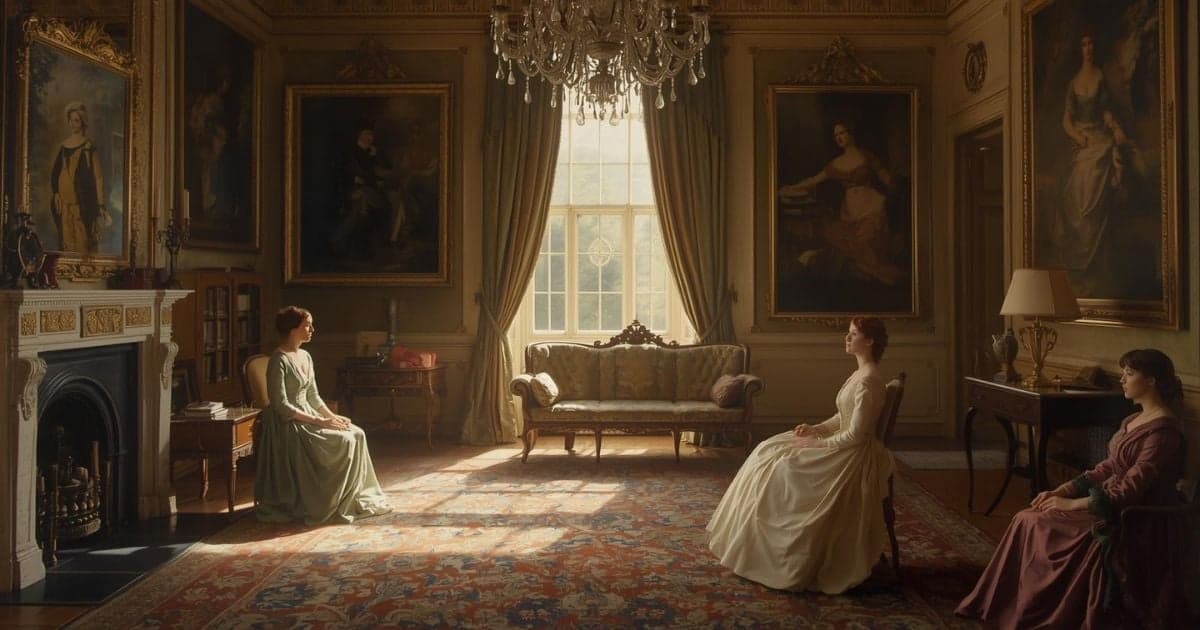

Chapter 23
The Forbidden Gallery
An hour passed away before the General came in, spent, on the part of his young guest, in no very favourable consideration of his character. “This lengthened absence, these solitary rambles, did not speak a mind at ease, or a conscience void of reproach.” At length he appeared; and, whatever might have been the gloom of his meditations, he could still smile with them. Miss Tilney, understanding in part her friend’s curiosity to see the house, soon revived the subject; and her father being, contrary to Catherine’s expectations, unprovided with any pretence for further delay, beyond that of stopping five…
Public-domain chapter text, formatted for reading.
Master this chapter. Complete your experience
Purchase the complete book to access all chapters and support classic literature
Available in paperback, hardcover, and e-book formats
Now let's explore the literary elements.
Key Quotes & Analysis
"lengthened absence, these solitary rambles, did not speak a mind at ease, or a conscience void of reproach."
Context: Catherine interprets the General's solitary walks
Neutral habits become guilt signals once murder is the working theory.
In Today's Words:
Catherine reads the general's long solitary walks as a guilty conscience. When you already suspect someone, ordinary solitude looks like secrecy. Generate one innocent explanation before you treat habit as confession. The same pressure appears today when people perform a version of themselves that looks impressive on paper but drains the energy needed for real competence and connection.
"mother’s room—the room in which she died—” were all her words; but few as they were, they conveyed pages of intelligence to Catherine."
Context: Eleanor tries to show Catherine her mother's room
A few words feed Catherine's Gothic narrative more than the grand tour did.
In Today's Words:
Eleanor mentions her mother's death and Catherine hears volumes of suspicion. Sparse facts swell when you are hunting proof. Do not let one emotional detail carry a whole case. The same pressure appears today when people perform a version of themselves that looks impressive on paper but drains the energy needed for real competence and connection.
"forbidden. The latter was not going to retire. “I have many pamphlets to finish,” said he to Catherine, “before I can close my eyes"
Context: He blocks access to Mrs Tilney's room
A father's grief and control read as cover for crime to Catherine.
In Today's Words:
The general forbids the room and retreats to his pamphlets. Refusal plus paperwork can look sinister if you have already cast someone as villain. Ask what pain or privacy might explain the door staying shut. The same pressure appears today when people perform a version of themselves that looks impressive on paper but drains the energy needed for
"Could it be possible? Could Henry’s father—? And yet how many were the examples to justify even the blackest suspicions!"
Context: Catherine's thoughts after the interrupted tour
Novels supply precedents where evidence is thin.
In Today's Words:
Catherine wonders if Henry's father could be guilty and summons fictional examples. Literature can feel like evidence when real facts are scarce. Separate what happened in books from what happened in the house. The same pressure appears today when people perform a version of themselves that looks impressive on paper but drains the energy needed for real competence
Thematic Threads
Class
In This Chapter
The General uses his wealth and status to impress Catherine, showing off his modern conveniences and grand rooms as markers of his superiority
Development
Evolved from earlier social positioning—now we see how the wealthy use material displays to maintain power dynamics
In Your Life:
You might notice how people use possessions, job titles, or achievements to establish dominance in conversations or relationships
Grief
In This Chapter
The General's protection of his wife's untouched room and his evening walks reveal a man still processing loss after nine years
Development
Introduced here—shows how private pain can be misinterpreted by outsiders
In Your Life:
You might misread someone's emotional distance or protective behaviors as rejection when they're actually grieving or healing
Imagination
In This Chapter
Catherine's gothic novel obsession transforms ordinary behaviors into evidence of murder and imprisonment
Development
Escalated from earlier romantic fantasies—now her imagination creates dangerous misunderstandings
In Your Life:
You might find yourself creating dramatic narratives about people's motives when the reality is much more mundane
Social Expectations
In This Chapter
The General performs the role of gracious host while hiding his true emotional state and controlling what Catherine can see
Development
Continued theme of people managing their public image while concealing private struggles
In Your Life:
You might recognize how you or others maintain social facades that prevent authentic connection and understanding
Power
In This Chapter
The General's angry interruption when Eleanor tries to show Catherine their mother's room demonstrates his absolute control over the household narrative
Development
Developed from earlier subtle control—now we see how authority figures can shut down conversations that threaten their comfort
In Your Life:
You might notice how people in positions of power (bosses, parents, partners) sometimes prevent discussions that make them vulnerable
You now have the context. Time to form your own thoughts.
Discussion Questions
This is not a test. Five prompts guide you through the chapter, from how it opens to how it closes, so you notice context and rhythm rather than facts to memorize. Sit with each question in your own words. When you see "One way to read it," treat it as a starting point, not the only answer.
- 1
What happens when Eleanor tries to show Catherine her mother's room?
analysis • surfaceOne way to read it
The general angrily forbids it and insists on his pamphlets instead.
- 2
How does Catherine interpret the general's solitary walks?
analysis • mediumOne way to read it
As signs of a troubled conscience rather than ordinary habit or grief.
- 3
When have you treated someone's privacy as proof of wrongdoing?
application • mediumOne way to read it
Answers should describe reading closed doors or silence as guilt without direct evidence.
- 4
Why does Austen show the general proud of modern improvements?
application • deepOne way to read it
It contrasts his real vanity and control with Catherine's imaginary Gothic villainy.
- 5
How does this chapter prepare Catherine's intrusion in chapter 24?
reflection • deepOne way to read it
Each blocked clue increases her determination to investigate Mrs Tilney's room herself.
Critical Thinking Exercise
The Alternative Explanation Challenge
Think of someone whose behavior you've been interpreting negatively lately—a coworker, family member, or neighbor. Write down the behavior that bothers you, then force yourself to generate three completely different, innocent explanations for why they might act that way. Consider their possible stress, background, or circumstances you don't know about.
Consider:
- •Most people aren't trying to hurt or slight you personally
- •Everyone has private struggles and pressures you can't see
- •Your first interpretation is usually filtered through your own fears or past experiences
Journaling Prompt
Write about a time when you later discovered your negative assumptions about someone were completely wrong. What did you learn about jumping to conclusions?
Coming Up Next...
Chapter 24: Reality Crashes the Gothic Fantasy
Sunday arrives, and Catherine's burning curiosity about the mysterious apartments must wait. But will a day of forced normalcy calm her gothic fantasies, or will they continue to grow stronger in the shadows?