Chapter 44
The Emptiness of Ease
LIV. EASE NOT PEACE. “A dull rotation, never at a stay, Yesterday’s face twin image of to-day.” COWPER. “Of what each one should be, he sees the form and rule, And till he reach to that, his joy can ne’er be full.” RÜCKERT. It was very well for Margaret that the extreme quiet of the Harley Street house, during Edith’s recovery from her confinement, gave her the natural rest which she needed. It gave her time to comprehend the sudden change which had taken place in her circumstances within the last two months. She found herself at once an inmate…
Public-domain chapter text, formatted for reading.
Master this chapter. Complete your experience
Purchase the complete book to access all chapters and support classic literature
Available in paperback, hardcover, and e-book formats
Now let's explore the literary elements.
Key Quotes & Analysis
"Dixon, in her business-like letters, quoted, every now and then, an opinion of Mr. Thornton’s"
Dixon's letters function as the novel's indirect channel for keeping Thornton present in Margaret's London life. The detail that Dixon quotes his opinions tells us both that Thornton is still a topic in the Milton household and that Dixon understands more about Margaret's situation than she ever says directly.
In Today's Words:
Gaskell is telling us that Thornton's name keeps appearing in Dixon's letters from Milton, embedded in practical information about the household, and that his opinions are quoted in the matter-of-fact way of someone reporting on a local figure of significance. In plain terms, Thornton is present in Margaret's London life only through Dixon's letters, and the indirectness of the channel is typical of the novel's final movement: both characters keeping track of the other without direct contact.
"She was the first to recover her self-possession"
In a socially awkward encounter, Margaret's composure returns first. It is characteristic: throughout the novel she has been the person whose equilibrium reasserts itself ahead of others', often at personal cost. Here it functions as social competence; it has also functioned as self-suppression.
In Today's Words:
In what is presumably a difficult social encounter, Margaret regains her composure before anyone else does. Gaskell uses this detail throughout the novel as a quiet marker of Margaret's particular kind of strength: the ability to restore public functioning under pressure. In plain terms, she is the person who pulls herself together first, which has always been both a resource and a cost, because pulling yourself together first means managing the situation for everyone rather than being managed by it.
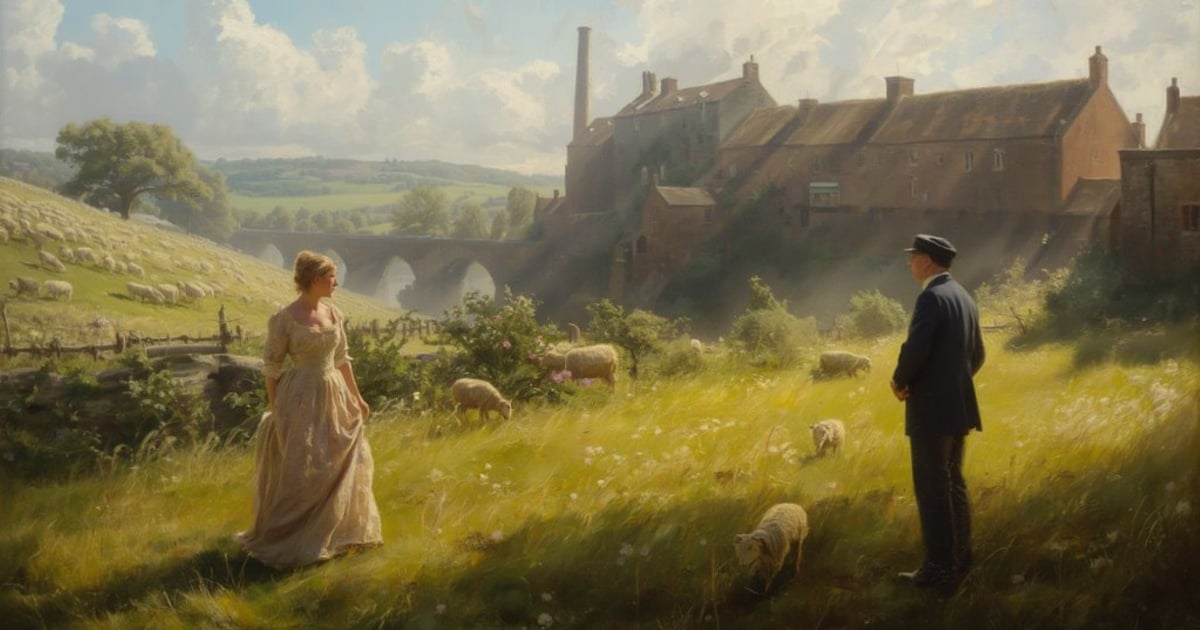
"warehouses that are built upon my father’s orchard."
The specific image of Helstone transformed, the orchard buried under industrial buildings, is Margaret's most direct expression of what has been lost in the novel's multiple displacements. It is personal rather than sociological and speaks to the physical specificity of what home means.
In Today's Words:
Margaret is naming a precise transformation: the orchard where she grew up in Helstone has been replaced by warehouses, which is a compression of everything the novel's movement from south to north has meant. In plain terms, the England she was formed in, the pastoral south, has not remained as she left it; it too has been industrialised, and there is no simpler physical image available to her for the double loss of both the home she left and the idea of the home she left.
"Do we part here? Well, good-night, sir; I suppose we shall meet in Harley Street to-morrow morning."
The ordinary parting, social in its form and deliberately undramatic, ends a chapter that has been managing the emotional weight of displacement with social courtesy. The suppressed content of the parting is everything that cannot be said in a Harley Street goodnight.
In Today's Words:
What appears to be a completely ordinary social goodbye, shall we part here, good night, see you tomorrow morning, is given weight by everything the novel has told us is not being said in it. In plain terms, two people with a great deal of unresolved feeling between them are using the most conventional possible farewell to get through a moment that their social position does not give them the language to manage any other way.
Thematic Threads
Purpose
In This Chapter
Margaret feels hollow and restless despite luxury because her days lack meaningful engagement or contribution
Development
Evolved from her active role helping families in Milton to passive recipient of care in London
In Your Life:
You might feel this when a promotion removes you from hands-on work you found fulfilling
Class
In This Chapter
The invisible machinery of upper-class life runs without Margaret's input, making her feel unnecessary
Development
Contrasts sharply with Milton's visible class struggles where everyone's role mattered
In Your Life:
You see this in workplaces where different levels have vastly different daily realities and concerns
Identity
In This Chapter
Margaret doesn't know who she is when stripped of challenges and meaningful work to define her
Development
Built on her earlier identity crises but now shows how comfort can be as disorienting as conflict
In Your Life:
You might experience this during retirement, unemployment, or any major life transition
Connection
In This Chapter
Despite being surrounded by loving family, Margaret feels more isolated than when facing real struggles with others
Development
Continues her pattern of finding deeper bonds through shared hardship rather than shared privilege
In Your Life:
You might notice this when moving to a 'better' neighborhood where you feel less connected to neighbors
Growth
In This Chapter
Stagnation in comfort versus the personal development that came through facing Milton's harsh realities
Development
Shows how her earlier growth came through challenge, not ease
In Your Life:
You experience this when a job becomes too easy and you stop learning new skills
You now have the context. Time to form your own thoughts.
Discussion Questions
This is not a test. Five prompts guide you through the chapter, from how it opens to how it closes, so you notice context and rhythm rather than facts to memorize. Sit with each question in your own words. When you see "One way to read it," treat it as a starting point, not the only answer.
- 1
The chapter is titled 'Ease Not Peace.' What is the difference Gaskell is drawing between the two, and how does Margaret's experience in London embody it?
One way to read it
Ease is the absence of external difficulty: comfort, social smoothness, the removal of material and practical stress. Peace is an internal state that ease cannot automatically produce. Margaret's London life has ease but not peace: she is comfortable and socially managed and internally at odds with her environment, because the difficulty of Milton was not only a hardship but the substance of a life that required things of her that London does not. The title names the distinction that the whole chapter explores.
- 2
Dixon's letters from Milton keep quoting Thornton's opinions, keeping him present in Margaret's life at a distance. What does this indirect presence tell us about both Dixon's perceptiveness and the state of Margaret's feelings?
One way to read it
Dixon is not subtle and is not trying to engineer anything, but she understands more about what matters to Margaret than she says: quoting Thornton's opinions in a business letter is a way of passing on information she knows will be attended to. Margaret reads these references carefully enough for us to know she does, and the care she brings to news of someone she is not supposed to be thinking about is its own form of disclosure.
- 3
Margaret mentions that Helstone orchards have been replaced by warehouses. How does this detail function in the chapter's argument about home and displacement?
One way to read it
The orchard-warehouse image is the novel's sharpest physical compression of its central theme: the pastoral England that formed Margaret does not hold still while she is away from it. Helstone has been industrialised in her absence, which means there is no simple return to what she left: the south she came from has been changed by the same forces that changed the north she lived in. The image removes the fantasy of a stable origin to go back to.
- 4
Margaret's social composure, her ability to recover herself first in an awkward encounter, has been a recurring feature of the novel. How does Gaskell use this characteristic differently in the London context than in the Milton one?
One way to read it
In Milton, Margaret's composure was frequently tested by genuine social and moral challenge, and its maintenance was correspondingly demanding. In London, the social encounters are easier but her composure there feels more like a reflex than a resource: there is nothing requiring the discipline she has developed, which means the discipline serves primarily to maintain surfaces that do not particularly need maintaining. The same quality looks different in a less demanding context.
- 5
The social world of the London chapters, with its round of calls and dinners, is comfortable and affectionate but Margaret cannot settle into it. What does her restlessness suggest about how a person's environment forms them?
One way to read it
Margaret's inability to settle in London despite its genuine pleasantness is evidence that she has been shaped by Milton in ways she cannot simply leave behind. The social ease of London is not a problem; it is simply insufficiently demanding for someone who has developed her capacities in response to genuine difficulty. Gaskell is making an argument about how environment forms character: the environment that requires the most of you is the one that most thoroughly shapes you, and you cannot simply transfer the person it made into a less demanding context.
Critical Thinking Exercise
Map Your Purpose vs. Comfort Balance
Draw two columns: 'Comfortable but Empty' and 'Challenging but Meaningful.' List activities, relationships, or responsibilities from your own life in each column. Then identify one item from the 'comfortable' side that you could modify to add more purpose, and one meaningful challenge you could take on.
Consider:
- •Consider both paid work and unpaid activities - volunteering, family responsibilities, hobbies
- •Think about times when you felt most alive and engaged - what made those experiences different?
- •Remember that meaningful challenges should serve something bigger than yourself, not just create stress
Journaling Prompt
Write about a time when you had to choose between comfort and growth. What did you learn about yourself from that choice, and how does it inform decisions you're facing now?
Coming Up Next...
Chapter 45: Dreams and Painful Realities
Margaret's restlessness in London continues to grow, and important news from Milton may force her to confront feelings she's been trying to suppress. Meanwhile, family dynamics shift as the Lennox household prepares for significant changes..