Chapter 02
Homecoming and Hidden Tensions
ROSES AND THORNS. “By the soft green light in the woody glade, On the banks of moss where thy childhood played By the household tree, thro’ which thine eye First looked in love to the summer sky.” MRS. HEMANS. Margaret was once more in her morning dress, travelling quietly home with her father, who had come up to assist at the wedding. Her mother had been detained at home by a multitude of half-reasons, none of which anybody fully understood, except Mr. Hale, who was perfectly aware that all his arguments in favour of a grey satin gown, which was…
Public-domain chapter text, formatted for reading.
Master this chapter. Complete your experience
Purchase the complete book to access all chapters and support classic literature
Available in paperback, hardcover, and e-book formats
Now let's explore the literary elements.
Key Quotes & Analysis
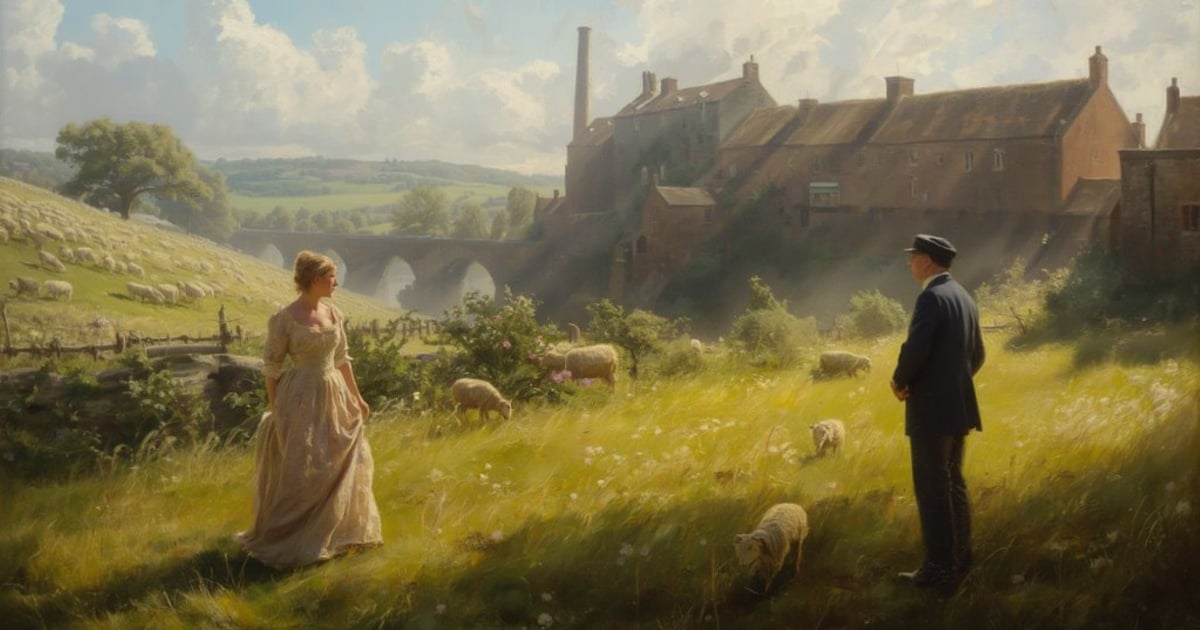
"She took a pride in her forest. Its people were her people. She made hearty friends with them; learned and delighted in using their peculiar words; took up her freedom amongst them; nursed their babies; talked or read with slow distinctness to their old people; carried dainty messes to their sick"
Context: Describing Margaret's immediate and instinctive connection with the Helstone villagers on her return
The list of actions defines Margaret not through opinion but through her hands: nursing, reading aloud, carrying food. Gaskell is quietly noting that Margaret has a genuine capacity for crossing class lines in the direction she chooses. The same instinct will be tested in Milton when the social gap runs in the opposite direction and the crossing is far less comfortable.
In Today's Words:
The new employee who immediately learns the night security guard's name, helps the reception desk during a rush, and brings soup to the colleague who is sick, not as a calculated move but because she genuinely likes people who do real work. That instinct earns loyalty everywhere except in rooms that prefer you to stay in your lane.
"But the cloud never comes in that quarter of the horizon from which we watch for it."
Context: Gaskell's narrator introducing the unexpected nature of the domestic tensions Margaret finds at Helstone
The aphorism crystallizes the chapter's central reversal: Margaret planned her homecoming as an escape, but the anxiety she finds in Helstone is entirely different in kind from anything she anticipated. Her mother's low-grade grievance and her father's unspoken burden were not on any map Margaret drew for herself. Preparation for one kind of trouble leaves us open to the kind we didn't imagine.
In Today's Words:
You rehearsed the difficult conversation with your manager all week, then discovered the actual problem came from a trusted colleague on a different team. Gaskell's aphorism names that gap precisely: we watch the quarter of the sky that has burned us before, and miss the weather forming somewhere else entirely.
"Frederick was always spoken of, in the rare times when his name was mentioned, as “Poor Frederick.”"
Context: Describing how the Hale household manages the memory of their exiled son, absent since a naval mutiny
The quotation marks around 'Poor Frederick' carry the full weight of the family's suspended grief. He is not simply Frederick but 'Poor Frederick', as though pity has permanently replaced his identity. The chapter offers no facts about the mutiny, only its emotional residue: Dixon's weekly dusting of the room, the parents' careful avoidance of the subject, Margaret's circular approach and retreat each time she considers asking.
In Today's Words:
The former colleague everyone refers to as 'poor James' in the same resigned breath, long after he left under difficult circumstances. The phrase signals that the verdict is already in, even if nobody ever explains what actually happened, and that the story is over for everyone except the person who carries the label.
"Margaret noticed an absence of mind, as if his thoughts were pre-occupied by some subject, the oppression of which could not be relieved by any daily action, such as comforting the survivors, or teaching at the school in hope of lessening the evils in the generation to come."
Context: Margaret observing her father's unusual preoccupation in the closing weeks of her visit to Helstone
Gaskell measures Mr. Hale's distress by what no longer helps: the pastoral routines that normally sustain him, comforting the bereaved and teaching children, have lost their power against whatever burden he is carrying. Margaret reads the failure of his usual remedies as a sign that this trouble is of a different order, which it is. The observation is precise and quietly devastating.
In Today's Words:
When your most reliable colleague stops giving the suggestions that usually come automatically, and skips the meetings she has attended for years, you know the issue isn't a difficult week. Margaret's method, noting what no longer works rather than watching for obvious warning signs, is often how we first recognize that someone is facing a problem ordinary coping cannot reach.
Thematic Threads
Pride
In This Chapter
Mrs. Hale's pride prevents her from attending the wedding in shabby clothes, leading to isolation and bitterness
Development
Introduced here as a destructive force that separates people from connection
In Your Life:
You might recognize this when you avoid social situations because you're embarrassed about your job, home, or financial situation.
Class Anxiety
In This Chapter
The family's financial limitations create constant comparison and resentment about their social position
Development
Introduced here as an ongoing source of family tension
In Your Life:
You see this when you feel inadequate around people with more money or education, affecting your confidence and relationships.
Family Secrets
In This Chapter
Mr. Hale's mysterious anxiety around mail time and the unspoken issue with Frederick create household tension
Development
Introduced here as hidden pressures affecting family dynamics
In Your Life:
You might experience this when family members keep financial or legal problems secret, creating stress everyone feels but can't name.
Coming of Age
In This Chapter
Margaret begins seeing her parents as flawed humans rather than idealized figures, caught between defending each to the other
Development
Continues Margaret's evolution from naive youth to complex adult understanding
In Your Life:
You recognize this when you realize your parents have real struggles and limitations, changing your relationship with them.
Interrupted Peace
In This Chapter
Margaret's attempt to find solace in nature and art is disrupted by Henry Lennox's unexpected arrival
Development
Introduced here as the pattern of outside forces disrupting personal sanctuary
In Your Life:
You see this when work calls interrupt family time, or financial stress invades moments when you're trying to find peace.
You now have the context. Time to form your own thoughts.
Discussion Questions
This is not a test. Five prompts guide you through the chapter, from how it opens to how it closes, so you notice context and rhythm rather than facts to memorize. Sit with each question in your own words. When you see "One way to read it," treat it as a starting point, not the only answer.
- 1
Mrs. Hale stays home from Edith's wedding because Mr. Hale cannot afford to dress her properly for London. What does this opening detail reveal about the gap between the Hale family's social aspirations and their actual circumstances?
analysis • surfaceOne way to read it
The Hales occupy a difficult middle position: too proud to appear underdressed at a London wedding, too poor to appear otherwise. Mrs. Hale's absence is practical, but Gaskell frames it through Mr. Hale's awareness rather than hers, which hints at how differently the two manage the same constraint.
- 2
Margaret befriends Helstone villagers with ease, nursing their babies and reading to their elderly, while dismissing the Gormons as 'shoppy people' she is glad not to visit. How does Gaskell use this contrast to introduce a limitation in Margaret's character?
analysis • mediumOne way to read it
Margaret crosses one kind of social boundary with genuine warmth while maintaining another: she values people 'of the land' and dismisses trade. This is a class prejudice she does not examine. Gaskell plants it early because Milton will force Margaret to reckon with what 'shoppy people' actually build and sacrifice.
- 3
Gaskell writes: 'But the cloud never comes in that quarter of the horizon from which we watch for it.' When have you prepared carefully for one kind of difficulty and been caught off guard by a completely different one, and what did that teach you about where to direct your attention?
application • mediumOne way to read it
Margaret expected to find rest in Helstone and found instead her mother's discontent and her father's secret burden. The aphorism acknowledges that anticipation is not the same as preparation: we tend to watch the sky where we have been burned before, and that focus leaves us open to weather forming somewhere we were not watching.
- 4
Mr. Hale has grown preoccupied by something that none of his usual routines can relieve. Margaret detects his anxiety not by looking for obvious signs but by noticing when ordinary behaviors have stopped. What does this method of observation reveal about how she pays attention to people?
application • deepOne way to read it
Margaret reads her father the way you read a system: not by scanning for red flags but by tracking when the indicators that normally work have gone silent. It is a more sophisticated kind of attention because it requires knowing someone's baseline well enough to notice when it has quietly changed.
- 5
Frederick is kept alive in the household through Dixon's weekly dusting of his room and the fixed phrase 'Poor Frederick,' but the actual story of his mutiny is never told. What does the family's management of his memory suggest about how people use silence to protect themselves from truths they cannot process?
reflection • deepOne way to read it
The Hales have found a way to honor Frederick without revisiting what he did: the clean room preserves love, the silence preserves a kind of peace. But silence also means no one has assigned the event a meaning or worked through the grief. The family remains suspended between mourning and judgment, choosing neither, which is its own kind of cost.
Critical Thinking Exercise
Break the Shame Spiral
Think of a situation where you or someone you know avoided something important because of shame about circumstances (money, appearance, housing, etc.). Map out how that avoidance led to other problems. Then rewrite the scenario: what would happen if the person chose connection over withdrawal at each decision point?
Consider:
- •Notice how shame makes us predict rejection that may not actually happen
- •Consider what support or opportunities were lost through avoidance
- •Think about which fears were realistic versus which were shame-based assumptions
Journaling Prompt
Write about a time when you let shame keep you from participating in something important. What would you do differently now, knowing how isolation feeds the problem?
Coming Up Next...
Chapter 3: An Unwelcome Proposal
The arrival of Mr. Henry Lennox brings London society directly into Margaret's peaceful country world. His visit will force her to confront questions about her future and what kind of life she truly wants, but his intentions may be more serious than she realizes..