Wide Reads
Literature MattersLife IndexEducators
Sign in
Where to Begin

War Prelude and the Limits of Invulnerability — Metamorphoses

Metamorphoses - War Prelude and the Limits of Invulnerability

Ovid

Metamorphoses

War Prelude and the Limits of Invulnerability

Home›Books›Metamorphoses›Chapter 12: War Prelude and the Limits of Invulnerability
Previous
12 of 15
Next

Analysis by the Wide Reads editorial team·Reviewed against the source text·Updated December 5, 2025

Summary

War Prelude and the Limits of Invulnerability

Metamorphoses by Ovid

0:000:00
Listen to Next Chapter

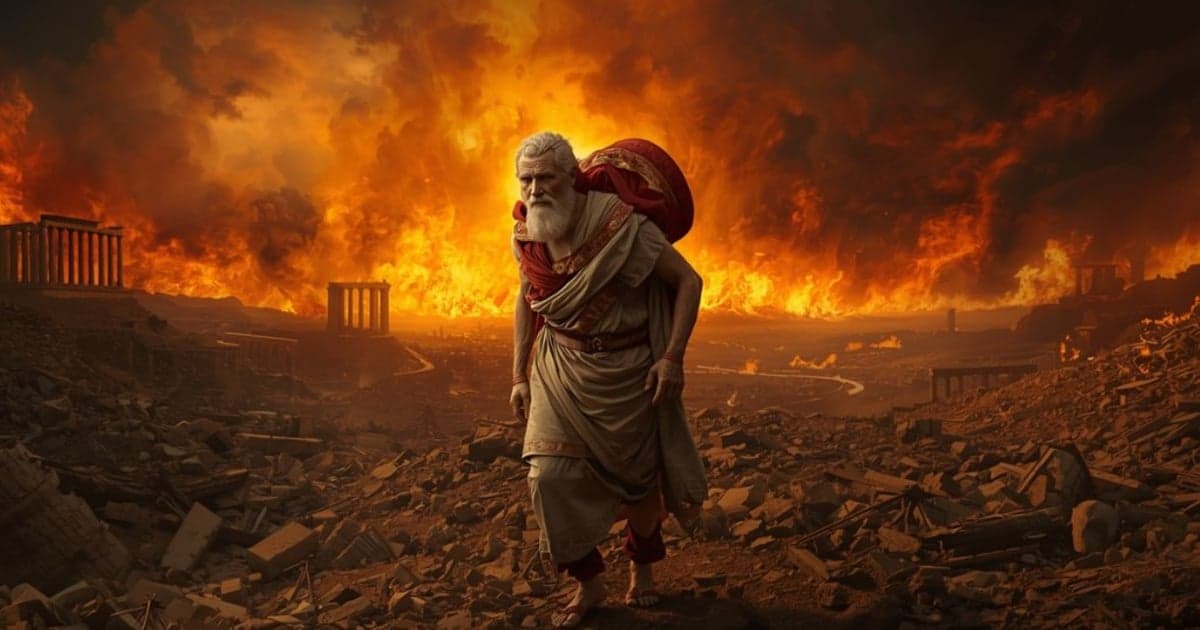
Book 12 opens at Aulis where military ambition stalls against weather, omen, and fear. The Greek coalition has gathered overwhelming force, yet the fleet cannot move because contrary winds reveal a limit no command structure can override. Calchas interprets signs and names the demand that will define the book's moral tone: Agamemnon must offer Iphigenia. Ovid frames the scene not as abstract ritual but as institutional violence disguised as necessity, where public mission overrules private devotion and a father is made to act as sovereign first, parent second. Even the temporary rescue through Diana's substitution does not erase what has happened. The army has learned that success may require sacrificial logic, and once that threshold is crossed, later cruelties become easier to justify. The wind finally shifts and the ships depart, but the moral weather has already changed.

As war begins, Ovid inserts the architecture of rumor through the house of Fame, where truth and fiction circulate together and every retelling amplifies uncertainty. This is a strategic interlude: battles are fought not only with spears but with narrative velocity. The Trojans and Greeks meet under conditions where perception is unstable, and first casualties arrive quickly, including Protesilaus, who fulfills prophecy by dying first upon landing. Achilles then seeks decisive combat against Cygnus, a fighter shielded by Neptune from ordinary harm. The duel becomes a case study in frustrated force. Spears strike and rebound, swords pierce armor but not flesh, and Achilles is forced to abandon heroic expectations about clean victory through superior weapons. He finally wins by grappling, constriction, and relentless pressure, proving that invulnerability is often contextual, not absolute. Even then, Neptune translates Cygnus into a swan, reminding readers that divine economies can rewrite battlefield outcomes at the edge of defeat.

The longest movement of the chapter arrives through Nestor's retrospective tale of the Centaurs and Caeneus, and this nested story deepens the book's argument about identity and violence. Caenis, violated by Neptune, asks not for compensation but for a body no one can violate again, becoming Caeneus and receiving immunity to wounds. That transformation looks like final safety, yet at Pirithous's wedding feast social order collapses under intoxication and sexual aggression, and the war between Lapiths and Centaurs explodes. Ovid's catalog of kills is intentionally excessive, a drumbeat of bodies, improvised weapons, and escalating retaliation. Within that chaos Caeneus withstands every blade until enemies shift tactics and bury him under felled trees. The image is unforgettable: what steel cannot pierce, accumulated weight can still crush. Invulnerability fails not because the gift disappears but because adversaries innovate around it.

Nestor's story returns the narrative to Achilles with a sharpened warning. Heroic cultures tend to mistake temporary advantage for permanent exemption. Cygnus, Caeneus, and eventually Achilles himself each stand as evidence that no defensive system removes contingency. Achilles dies not in glorious duel but through Paris's guided arrow at his vulnerable point, with Apollo and Neptune's resentments running behind the shot. Ovid does not sentimentalize this end. The warrior who seemed to dominate outcome is still embedded in networks of prophecy, divine grievance, and small apertures of exposure. After death, conflict does not end but mutates into a dispute over armor, showing that prestige objects outlive persons and continue redistributing status among the living.

For modern readers, Book 12 reads like a manual for high-pressure systems where leaders face impossible tradeoffs, teams misread risk, and confidence repeatedly outruns reality. Sacrificial thinking appears whenever institutions normalize harming a few for promised victory without honest accounting. Rumor architecture appears in every media cycle where mixed truth shapes morale before facts settle. Invulnerability myths appear in careers, politics, and medicine whenever people assume talent, title, or protection makes them untouchable. Ovid insists on a harder intelligence: map your weak points, expect adversaries to adapt, and never confuse surviving one test with transcending the human condition. The chapter's transformations teach that bodies, reputations, and strategies are all provisional. Wisdom lies not in pretending otherwise but in designing action that remains ethical and adaptive when certainty fails. It also requires post-crisis learning: after each apparent victory, teams must ask what nearly broke, who absorbed hidden cost, and which safeguards only worked by luck. Without that disciplined review, the next arrow always finds a softer place. Ovid's war narrative is therefore also a governance narrative, pressing readers to combine courage with audit culture and transparent accountability. His larger warning is that unmanaged fear quickly becomes policy, and policy built in fear eventually consumes the very people it promised to protect. In practical terms, this means leaders must train for ambiguity, communicate limits clearly, and preserve moral language even when urgency tempts them to speak only in numbers. Clarity, humility, and repair discipline become survival skills, especially when success narratives tempt teams to stop asking hard questions.

In this chapter: Terms Characters Key Quotes Themes Modern Story

Why This Matters

Connect literature to life

Skill: Resisting Invincibility Myths

High-performing teams often fail when success convinces them ordinary safeguards are optional. Book 12 tracks sacrifice politics, rumor pressure, and adaptive enemies to show that every defense has a bypass. Reading it develops practical humility: map hidden weak points before pressure and pride force a painful correction.

Coming Up in Chapter 13

With Achilles gone, argument replaces combat. Book 13 turns to the armor contest, Ajax's despair, and Ulysses's craft, asking who gets to define merit when grief has emptied the room and only narrative can settle what force no longer can.

Share it with friends

PreviousPrevious ChapterNextNext Chapter
Original text
1,841 wordscomplete

Chapter 12

War Prelude and the Limits of Invulnerability

FABLES I. AND II. [XII.1-145] The Greeks assemble their troops at Aulis, to proceed against the city of Troy, and revenge the rape of Helen; but the fleet is detained in port by contrary winds. Calchas, the priest, after a prediction concerning the success of the expedition, declares that the weather will never be favourable till Agamemnon shall have sacrificed his daughter Iphigenia. She is immediately led to the altar for that purpose; but Diana, appeased by this act of obedience, carries away the maiden, and substitutes a hind in her place, on which a fair wind arises. Upon the…

Public-domain chapter text, formatted for reading.

Master this chapter. Complete your experience

Purchase the complete book to access all chapters and support classic literature

Buy at Powell'sBuy on Amazon

Available in paperback, hardcover, and e-book formats

Now let's explore the literary elements.

Key Quotes & Analysis

"After the public good had prevailed over affection, and the king over the father, and Iphigenia, ready to offer her chaste blood, stood before the altar, while the priests were weeping; the Goddess was appeased, and cast a mist before their eyes, and, amid the service and the hurry of the rites, and the voices of the suppliants, is said to have changed Iphigenia, the Mycenian maiden, for a substituted hind."

— Narrator

Context: Iphigenia's sacrifice is framed as state duty outranking family ties.

The line names the political logic that can normalize cruelty when institutions call violence necessity.

In Today's Words:

Thomas hears this logic when a hospital says staffing cuts are unavoidable for system survival. Public-good language can hide real human costs unless someone insists both facts stay visible. Duty matters, but policy without humane limits turns caregivers into instruments. Thomas sees the same pattern in the ER when bodies and identities shift under pressure

"son of Thestor, a soothsayer, foreseeing the truth, says, “Rejoice, Pelasgians, we shall conquer. Troy will fall, but the continuance of our toil will be long;”"

— Narrator

Context: Calchas interprets omens and converts ambiguous signs into military confidence.

Prophetic framing organizes collective action by turning uncertainty into direction.

In Today's Words:

Thomas recognizes this dynamic in crisis huddles where one confident interpretation can settle a chaotic room. Interpretation is necessary, but when it hardens too quickly, teams may mistake narrative certainty for actual control. Thomas sees the same pattern in the ER when bodies and identities shift under pressure nobody chose.

"the Greeks beheld an azure-coloured serpent creep into a plane tree, which was standing near the sacrifice they had begun."

— Narrator

Context: At Aulis, omen imagery sets expectation for the long war ahead.

A single sign becomes a planning framework, tying future duration to symbolic interpretation.

In Today's Words:

In modern terms, teams build forecasts from limited signals and then behave as if the model is fate. Thomas sees this with surge projections: useful for preparation, dangerous when treated as unquestionable truth. Thomas sees the same pattern in the ER when bodies and identities shift under pressure nobody chose.

"And now the Sigæan shores are red {with blood}: now Cygnus, the son of Neptune, has slain a thousand men."

— Narrator

Context: The war's opening clashes immediately stain the coast with blood.

The phrase strips heroic rhetoric down to material cost and attrition.

In Today's Words:

Thomas reads this as the point where abstract strategy meets bodies. In emergency care, plans and policies are tested only when real patients arrive and consequences stop being theoretical. Thomas sees the same pattern in the ER when bodies and identities shift under pressure nobody chose.

Thematic Threads

Power

In This Chapter

Divine power trumps human strength as Neptune protects Cygnus and Apollo guides the arrow that kills Achilles

Development

Evolved from earlier themes of divine intervention to show power's ultimate hierarchy

In Your Life:

You might see this when company policies override your best judgment or when systemic forces make individual effort feel meaningless

Identity

In This Chapter

Cæneus's transformation from woman to invulnerable man, then death by overwhelming force rather than weapons

Development

Continues the exploration of transformed identity, now showing its limitations

In Your Life:

You might recognize this when your new role or status doesn't protect you from old vulnerabilities

Sacrifice

In This Chapter

Agamemnon sacrifices Iphigenia for favorable winds; all characters sacrifice something precious for war

Development

Introduced here as war's central demand

In Your Life:

You might face this when pursuing any major goal demands giving up things you never thought you'd lose

Vulnerability

In This Chapter

Achilles's heel proves that even the greatest protection has a fatal weakness

Development

Builds on earlier themes to show that no defense is absolute

In Your Life:

You might see this in your own 'untouchable' areas that suddenly become your biggest risks

Legacy

In This Chapter

The fight over Achilles's armor shows how death creates new conflicts over a person's meaning

Development

Introduced here as death's aftermath

In Your Life:

You might experience this when a mentor, parent, or leader dies and people argue over their 'true' legacy

You now have the context. Time to form your own thoughts.

Discussion Questions

This is not a test. Five prompts guide you through the chapter, from how it opens to how it closes, so you notice context and rhythm rather than facts to memorize. Sit with each question in your own words. When you see "One way to read it," treat it as a starting point, not the only answer.

  1. 1

    How does the Iphigenia scene redefine what counts as leadership in this chapter?

    ▶One way to read it

    It shows leadership can be judged by willingness to sacrifice others for mission success, raising ethical questions about duty, consent, and accountability.

    analysis • surface
  2. 2

    Why do Cygnus and Caeneus both fail despite extraordinary protection?

    ▶One way to read it

    Because protection worked only against expected attacks. Opponents adapted tactics, proving strength without adaptation eventually creates exploitable rigidity.

    analysis • medium
  3. 3

    What is Ovid suggesting by placing the house of Fame before major battle scenes?

    ▶One way to read it

    He suggests information disorder shapes war outcomes. Rumor alters fear, confidence, and decision speed long before weapons settle facts.

    application • medium
  4. 4

    Where in contemporary healthcare do you see 'invulnerability theater' masking real risk?

    ▶One way to read it

    Common examples include elite units skipping basic protocols, overreliance on star clinicians, and ignoring communication failures because headline outcomes remain strong.

    application • deep
  5. 5

    If you were Thomas, what one safeguard would you implement immediately to counter hidden overload risk?

    ▶One way to read it

    He should implement mandatory mid-shift safety huddles that reassess silent-risk patients, staffing fatigue, and handoff quality before errors accumulate.

    reflection • deep

Critical Thinking Exercise

10 minutes

Map Your Non-Negotiables

Think about a major goal you're currently pursuing or considering. Create two lists: what you're willing to sacrifice to achieve it, and what you would never give up, no matter what. Be brutally honest about where you'd draw the line before the pressure mounts. Consider not just obvious things like money or time, but values, relationships, health, and peace of mind.

Consider:

  • •Notice if your 'willing to sacrifice' list keeps growing as you imagine more pressure
  • •Ask yourself: would I recognize when I'm being asked to sacrifice something from my 'never' list?
  • •Consider how you'll remind yourself of these boundaries when you're deep in the struggle

Journaling Prompt

Write about a time when you sacrificed something important for a goal. Looking back, was it worth it? What would you do differently knowing what you know now?

Coming Up Next...

Chapter 13: After Achilles: Rhetoric, Ruin, and Grief

With Achilles gone, argument replaces combat. Book 13 turns to the armor contest, Ajax's despair, and Ulysses's craft, asking who gets to define merit when grief has emptied the room and only narrative can settle what force no longer can.

Continue to Chapter 13
Previous
When Grief, Greed, and Oaths Reshape Lives
Contents
Next
After Achilles: Rhetoric, Ruin, and Grief
Keep exploring

Continue Exploring

Study guides, teaching tools, themes, and the full library.More ways to read Metamorphoses: study guides, teaching tools, and the wider library.

  • Metamorphoses Study Guide
  • Teaching Resources
  • Essential Life Index
  • Browse by Theme
  • All Books

What this chapter teaches

Theme analyses that draw on this chapter and apply it to modern life.

  • Recognizing Patterns In Human StoriesFour ages, forbidden love, war

You Might Also Like

The Aeneid cover

The Aeneid

Virgil

Explores identity & self

The Iliad cover

The Iliad

Homer

Explores identity & self

The Book of Job cover

The Book of Job

Anonymous

Explores identity & self

Ecclesiastes cover

Ecclesiastes

Qoheleth

Explores identity & self

Browse all 106+ books

Share This Chapter

Know someone who'd enjoy this? Spread the wisdom!

TwitterFacebookLinkedInEmail

Go further with Prestige

Unlock study guides and downloads, early access, and exclusive content — and support free access for everyone.

Subscribe to PrestigeCreate free account
Intelligence Amplifier
Intelligence Amplifier™Powering Wide Reads

Exploring human-AI collaboration through books, essays, and philosophical dialogues. Classic literature transformed into navigational maps for modern life.

2025 Books

→ The Amplified Human Spirit→ The Alarming Rise of Stupidity Amplified→ San Francisco: The AI Capital of the World
Visit intelligenceamplifier.org
hello@widereads.com

WideReads Originals

→ You Are Not Lost→ The Last Chapter First→ The Lit of Love→ Wealth and Poverty→ Wisdom for the Wounded
Arvintech
arvintechAmplify your Mind
Visit at arvintech.com

Navigate

  • Home
  • Library
  • Essential Life Index
  • How It Works
  • Subscribe
  • Account
  • About
  • Contact
  • Authors
  • Suggest a Book
  • Landings

Made For You

  • Trending
  • Students
  • Educators
  • Families
  • Readers
  • Literary Analysis
  • Finding Purpose
  • Letting Go
  • Recovering from a Breakup
  • Corruption
  • Gaslighting in the Classics

Newsletter

Weekly insights from the classics. Amplify Your Mind.

Legal

  • Privacy Policy
  • Terms of Service
  • Editorial Standards
  • Cookie Policy
  • Accessibility

Why Public Domain?

We focus on public domain classics because these timeless works belong to everyone. No paywalls, no restrictions—just wisdom that has stood the test of centuries, freely accessible to all readers.

Public domain books have shaped humanity's understanding of love, justice, ambition, and the human condition. By amplifying these works, we help preserve and share literature that truly belongs to the world.

A Pilgrimage

Powell's City of Books

Portland, Oregon

If you ever find yourself in Portland, walk to the corner of Burnside and 10th. The building takes up an entire city block. Inside is over a million books, new and used on the same shelf, organized by color-coded rooms with names like the Rose Room and the Pearl Room. You can lose an afternoon. You can lose a weekend. You will find a book you have been looking for your whole life, and three you did not know existed.

It is a pilgrimage. We cannot find a bookstore like it anywhere on earth. If you read the classics, and you ever get the chance, go. It belongs on every reader's bucket list.

Visit powells.com

We are not in any way affiliated with Powell's. We are just a very big fan.

© 2026 Wide Reads™. All Rights Reserved.

Intelligence Amplifier™ and Wide Reads™ are proprietary trademarks of Arvin Lioanag.

Copyright Protection: All original content, analyses, discussion questions, pedagogical frameworks, and methodology are protected by U.S. and international copyright law. Unauthorized reproduction, distribution, web scraping, or use for AI training is strictly prohibited. See our Copyright Notice for details.

Disclaimer: The information provided on this website is for general informational and educational purposes only and does not constitute professional, legal, financial, or technical advice. While we strive to ensure accuracy and relevance, we make no warranties regarding completeness, reliability, or suitability. Any reliance on such information is at your own risk. We are not liable for any losses or damages arising from use of this site. By using this site, you agree to these terms.