
Four Sisters, One Ledger of Feeling
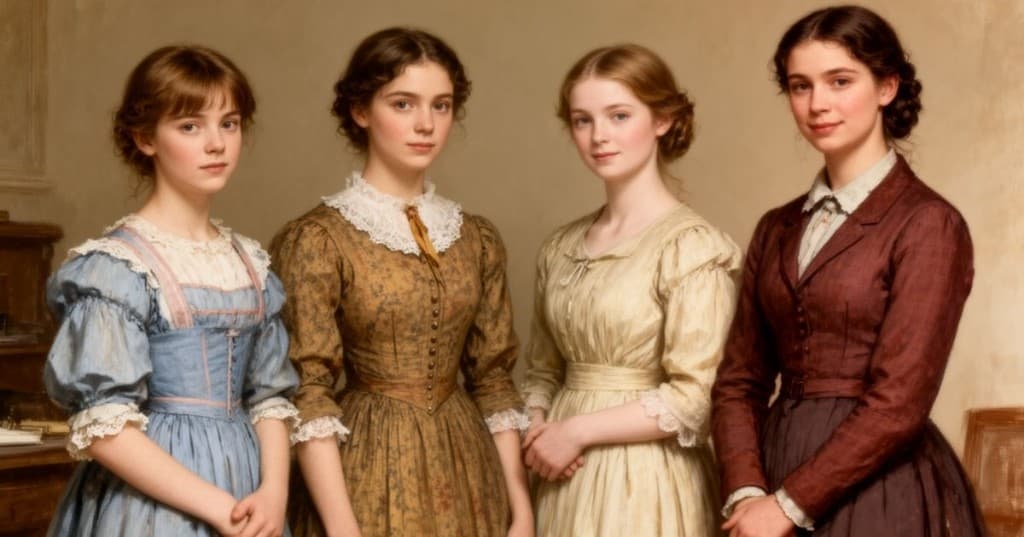
Little Women is often remembered as a warm domestic novel and reduced to who marries whom. Alcott writes something sharper first. A Civil War chaplain's daughters live in genteel poverty while the father is absent and the mother holds the house together on almost nothing. The psychological core is how four different temperaments learn to manage desire when there is no money, no legal power, and no room to fail in public. Each sister chooses a different strategy for being seen: Meg performs respectability, Jo performs refusal, Beth performs invisibility, and Amy performs refinement. Marmee teaches them to call the strategies virtues. The book asks whether those virtues are freedom or a prettier form of self-editing.
Christmas Without Presents
The opening wound is scarcity that still expects gratitude. The March girls want pretty things and moral credit at the same time. Marmee proposes no Christmas gifts because soldiers need the money more, and the sisters talk themselves into sacrifice while still counting what they lack. Jo wants books, Amy wants status, Meg mourns her dress, and Beth alone names the blessing they still share. The scene is not only poverty. It is the first lesson that feeling must be managed for the good of the group before it is allowed to be honest.
Father's letter from the front turns complaint into purpose. He calls them little women and asks them to fight their bosom enemies. The phrase sounds tender and is also a command to internalise the war when the war cannot have them. Jo hears it as a challenge to her temper. Amy hears it as a challenge to her selfishness. Beth returns to her knitting. The letter gives the family a shared plot, Pilgrim's Progress, so private failings can be walked like a road. Psychology here is moral framing as survival: when the outside world offers no security, the inside world must become a training ground.
Jo and the Refusal Script
Jo's central defence is identification with what she is not allowed to be. She hates growing into Miss March, hates long gowns, and would rather fight beside her father than knit at home. Her anger is not random. It is grief that the body she has will be read as a girl's body no matter how she acts. When Amy burns her manuscript, Jo's rage is disproportionate because the pages were one place she could be large without permission. The near drowning on the ice is not a separate sin. It is the same temper redirected into cold silence after Marmee teaches her that love can look like restraint.
Laurie offers Jo the plot readers still want: best friend becomes husband, money solves the house, genius becomes charming. Her refusal is often misread as immaturity. In the book it is a refusal to let friendship be the only form of intimacy she is allowed to want without becoming someone else's project. She can love Laurie and still know that marriage would ask her to shrink into a role she has spent the novel resisting. The later turn toward Professor Bhaer is not a defeat of ambition. It is the first relationship that criticises her writing without trying to own her name.
Meg and the Mirror of Class
Meg's anxiety is visibility in a room that ranks women by cloth and manners. The Moffat party dresses her in borrowed silk until she looks like a stranger to herself. Laurie sees through the costume, and the shame is not only vanity. It is the discovery that Meg has been trained to feel successful when she resembles people who would never help her family in trouble. Her marriage to John Brooke is love and also relief: a small house, honest work, and a life where performance can finally end.
Meg's arc tests whether domestic happiness can satisfy a woman who was raised to want more than domestic happiness. The novel gives her tenderness, children, and real difficulty when money is tight. It does not mock her for wanting pretty things. It shows how wanting pretty things can be a sane response to a world that treats pretty things as proof that you matter. Meg learns to separate the longing from the humiliation. That separation is the work many people still do when they enter rooms where they are the poorest person at the table.
Beth and the Quiet Cost
Beth's psychology is the ethics of the person who makes no demand. She plays the piano, keeps peace, and fears people more than she fears illness. The narrator calls her a mouse, and the pet name is both affection and diagnosis. Beth absorbs what the louder sisters discharge. When she nurses the Hummel baby and catches scarlet fever, the plot treats the illness as consequence. It is also the body of the one who never complained finally speaking in the only language the family could not ignore.
Beth's death is quiet on the page and catastrophic in the structure. Jo promises to comfort their parents, but Beth was already doing that work invisibly. After she is gone, Jo discovers that cheerfulness was a job Beth performed, not a mood the house naturally produced. The novel makes grief teach what praise never did: the shy sister was not background. She was load-bearing. Readers who grew up as the easy child recognise the delayed accounting. The family only learns the cost when the cost stops arriving on schedule.
Amy and the Performance of Being Seen
Amy begins as the sister most openly hungry for rank. Pickled limes, sketching, and European polish are not only childish vanity. They are experiments in whether refinement can buy safety. Exile at Aunt March's teaches her that charm without money is still service. Esther's rosary and the turquoise ring give Amy a language for goodness that includes reward, not only sacrifice. Her will, written in misspelled grandeur, is the first time she practices mortality without performing it for applause.
Amy's late pairing with Laurie shocks readers who wanted Jo to win. Psychologically it is two performers finding a contract they can live inside. Laurie needed someone who understood social art. Amy needed someone whose fortune could fund the artist's life without shaming the artist's ambition. The novel does not pretend their marriage solves class. It shows two people who learned, through humiliation, that love is also a set of daily negotiations about pride, money, and who gets to be the main character in public.
Marmee and the Held Temper
Mrs March is the book's hidden case study in controlled rage. She tells Jo she has been angry every day of her life for forty years, and that she learned to govern it so the home could breathe. That confession reframes Marmee's serenity. It is not absence of feeling. It is a discipline paid for in private so the daughters can believe peace is natural. Marmee's advice is wise and also selective. She can name Jo's temper because Jo's temper is visible. She is slower to name the systems that make tempers necessary.
Marmee's role during the war is to keep meaning intact while the father is absent. She turns scarcity into lesson, grief into pilgrimage, and each daughter's flaw into a chapter of moral growth. The psychology of the mother here is caretaker as narrator: she must tell the story of the house in a way that keeps everyone inside it. When Beth dies, Marmee's tears are allowed because even the narrator must break once. Until then, her composure is the family's primary resource, and the book asks what that resource costs her.
Plumfield and the Second Dream
Jo's late dream is not literary fame in a garret. It is Plumfield, a school where boys who do not fit elsewhere can be taught without being shamed into sameness. The shift follows Beth's death and Jo's renewed writing from truth rather than market sensation. The novel rewards her with partnership and work that looks smaller than her childhood castles and is more durable. Professor Bhaer arrives without Laurie's glamour and with the one thing Jo needed: honest feedback that treats her mind as serious.
The ending is often called sentimental. It is also an argument about where ambition goes when the first ambition cannot be had on the terms you imagined. Jo wanted to be great in the world's eyes. She becomes great in a smaller circle, with ink-stained hands and a house full of noise. Alcott refuses to call that compromise alone. She calls it harvest, which is both agricultural metaphor and audit. The sisters do not each get the plot they wanted at fifteen. They get plots that reveal what their wanting was protecting all along.
Why It Resonates Now
The book's modern pressure is still economic and emotional at once. Many readers live in households where one person's calm is treated as proof that nothing is wrong, while the calm person is managing everyone else's fear. Beth's invisibility and Marmee's held temper map cleanly onto caregiving roles that social media cannot see. Jo's refusal of the easy romantic plot still speaks to anyone who loves a friend and knows marriage would rename the friendship into a job description. Amy's anxiety about presentation is not shallow. It is what happens when respect is visibly tied to clothes, accents, and rooms you cannot afford.
The March sisters also show how comparison splits a family that loves itself. Meg's party shame, Jo's rivalry with Amy, and Laurie's restlessness after rejection are all scenes about ranking without a public scoreboard. Readers today meet the same ranking in feeds, offices, and family group chats. Little Women does not offer a single heroine who got it right. It offers four partial strategies and one mother trying to translate war, poverty, and gender into a vocabulary of virtue. That translation is still happening in homes where the work of feeling is unevenly assigned.
Limits of This Reading
This reading uses attachment language, gender socialisation, and family systems vocabulary that Alcott did not use. Jo is not a case study, and Beth's illness belongs to nineteenth-century medical plot as well as to psychology. The novel's Christian framing, Pilgrim's Progress, and Marmee's moral lessons are not decorative background. They are the actual tools the characters use to understand themselves. Reducing those tools to modern defences alone would flatten the book.
Historical context also limits how far present-day labels should travel. The Marches are white, Protestant, and protected by community charity even in poverty. The Hummels exist at the edge of the story as recipients of help rather than as fully centred psyches. Alcott wrote partly from her own family and partly for market demand. Alternative readings can emphasise class, war, authorship, or feminism without using clinical language at all. This framework names patterns in the feeling life of the text. It does not exhaust what the text is doing.
Across the Shelf
Sense and Sensibility, also on the shelf, splits feeling into two sisters under economic threat and asks who must govern emotion for the house to survive. Little Women splits it four ways and adds a war outside the parlour. Elinor's parentified composure finds a cousin in Marmee's held temper and in Beth's silent service. Marianne's demand that feeling be loud finds echoes in Jo's refusal to be edited and Amy's need to be admired. Read together, Austen and Alcott show two centuries of writers asking how women learn to want something in rooms that punish wanting.